Southeast Asia's archipelagic geography has always dictated its energy economics. Indonesia alone comprises more than 17,000 islands. The Philippines adds over 7,600. Regional grid interconnection remains limited, and much of the industrial growth in these markets sits on isolated grids that run on imported diesel. That diesel dependency is the entry point for a business model that has nothing to do with reactor technology. It is a power purchase agreement.
The Model
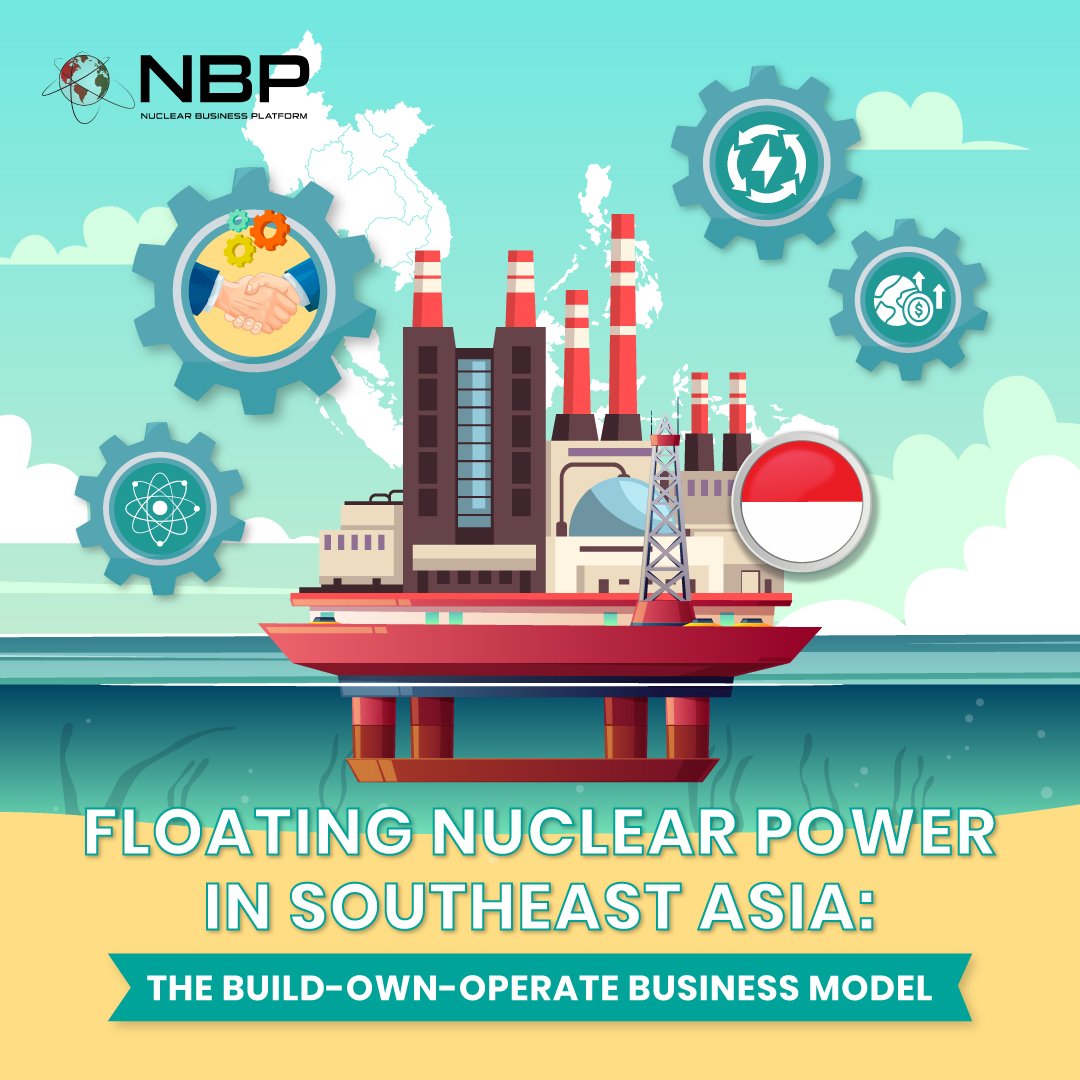
A floating nuclear power plant, owned and operated by the vendor, supplying electricity to a customer that never takes ownership of the unit, never licenses it domestically, never fuels it, and never decommissions it. The customer pays for delivered electricity. The vendor carries construction, operation, fuel, and end-of-life risk.
This structure solves the constraint that has stalled land-based nuclear in the region: the customer does not need to become a nuclear operator. It needs a berth and a contract.
The model is already commercial. An agreement signed between Rosatom and PT Pembangkit Listrik Nuklir in October 2026 provides for two floating power units, 200 MW combined, to supply northern Halmahera Island in North Maluku. Both units remain Rosatom-owned and operated. The project is structured as a business-to-business initiative, driven by private investment, without reliance on Indonesia's state budget. The customer does not assume ownership of the units.
For a country with island grids and mining operations, that is a different product from a land-based SMR. A land-based reactor requires site licensing, a domestic regulator with advanced reactor experience, a trained workforce, a fuel supply chain, and a waste pathway. A floating unit owned by the vendor requires infrastructure to receive it and a power purchase agreement.
The operating record is the asset behind the pitch. The Akademik Lomonosov, the world's only operating floating nuclear plant, has supplied heat and power to the town of Pevek in Russia's Chukotka region for more than five years. Four additional floating units are under construction to supply a copper mining centre in the same region. The RITM-200M reactors in the export units derive from Russia's icebreaker fleet, with more than 400 reactor-years of operating experience.
Rosatom has proposed a two-phased approach to Indonesia: small-scale floating units first, followed by land-based plants with larger units. The floating units are the entry point. The land-based plants follow once the customer has operating experience and domestic regulatory capacity. That sequencing is a commercial strategy, not an engineering one.
The Southeast Asian Context
Across the region, the land-based pipeline is advancing at different speeds. The Philippines targets 1,200 MW of nuclear capacity by 2032, expanding to 4,800 MW by 2050, supported by a 123 Agreement with the United States and a $2.7 million USTDA-funded feasibility study for Meralco to assess U.S.-designed SMRs. Meralco has simultaneously signed a tripartite MOU with Korea Hydro & Nuclear Power and the Export-Import Bank of Korea.
Indonesia's 10-year electricity supply plan, RUPTL 2025–2034, formally integrates nuclear energy with an initial target of 500 MW by 2034 through two 250 MW SMR units, directed at the Sumatra and Kalimantan grids, both centres of industrial growth and mining. The ThorCon molten salt reactor, a 500 MW floating design, received approval for its Site Evaluation Plan from BAPETEN in August 2025 for a site on Kelasa Island.
Vietnam reintroduced nuclear power into its revised Power Development Plan 8 in April 2025, targeting 4,000 to 6,400 MW between 2030 and 2035, with EVN and Petrovietnam designated as primary investors. Thailand's Power Development Plan 2024 targets two 300 MW SMRs, 600 MW total, with construction beginning in 2032 and commercial operations by 2037.
That is a land-based pipeline measured in decades. The floating model operates on a different clock.
The Competitive Position
Vendor competition in Southeast Asia runs along national lines, and each vendor nation offers a different package.
The United States works through government-to-government frameworks, the FIRST program, and 123 Agreements, positioning Western-certified technology with operating history behind it. South Korea offers an integrated export model combining construction, operation, and state-backed financing through KEXIM, with the Barakah project in the UAE as its delivery record. China competes on deployment speed and centralized financing, with the Hualong One already being exported. Russia offers the floating build-own-operate model, backed by the only operating floating nuclear plant in the world.
Three of those four models assume the customer will own and operate a land-based reactor. Only one does not.
Where the Opportunity Sits
The floating nuclear market is a distinct product category with a different customer, a different financing structure, and a different competitive set. The customer is an industrial power consumer buying delivered electricity at a fixed price, with no nuclear infrastructure obligation.
For island grids, remote mining operations, and customers that do not want to build nuclear infrastructure, the build-own-operate floating model currently has one credible supplier.
The adjacent opportunity is in the infrastructure the model requires: berth construction, coastal site preparation, grid connection at the receiving end, and the industrial supply chains that serve these facilities. Those are regional commercial openings that do not depend on which reactor design ultimately wins.
NBP's Asia Nuclear Business Platform (ANBP) takes place in Hanoi from 24 to 26 November 2026. It brings together utilities, regulators, financiers, and suppliers from across the region at a time when each market is sitting at a different point on the road to nuclear power.