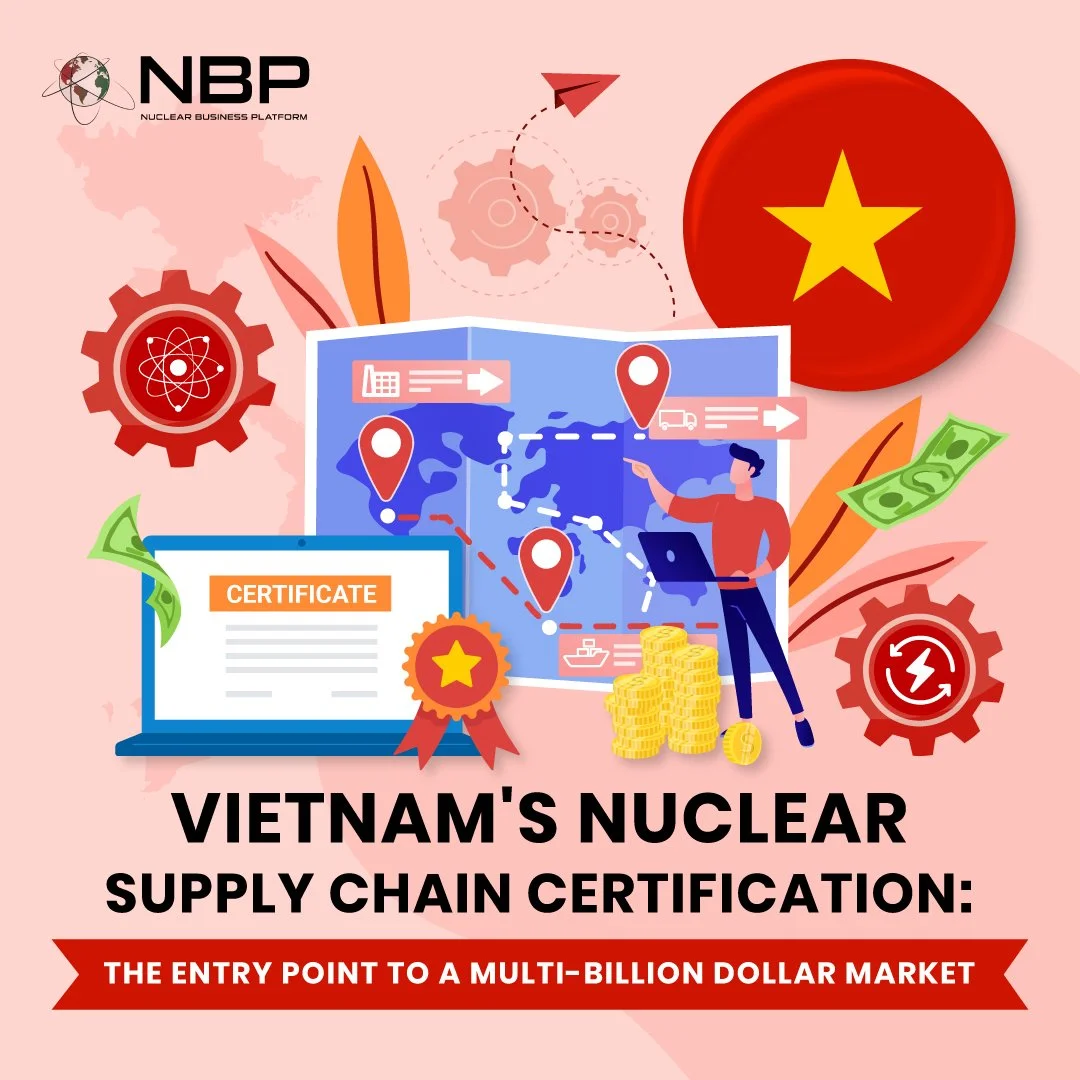
Vietnam has no domestic nuclear-grade supply chain. It has never built a nuclear plant, and every subcontractor hoping to serve Ninh Thuan 1 or Ninh Thuan 2 must first be certified to international nuclear-grade quality standards. That certification work is already underway. The Ministry of Industry and Trade and PetroVietnam are surveying heavy industrial zones and auditing subcontractors before primary site construction begins.
The timing matters because certification is a qualification process that determines which firms are even eligible to bid, not a box checked during construction.
Why Certification Is Harder Than It Sounds
A Vietnamese industrial firm with decades of experience in conventional fabrication does not automatically qualify for nuclear work. Certification requires documented quality management systems, traceability of materials, qualified welding procedures, non-destructive examination capability, and auditable records going back through the entire supply chain.
The standard exists independently of any vendor. A subcontractor certified to international nuclear-grade requirements can serve a Russian VVER project, a Korean APR, a French EPR, or a Chinese Hualong One. The certification is identical across designs. Only the design-specific work that follows differs, and that distinction is the entire commercial case for this service line.
Two Plants, One Standard
Vietnam is building two plants with two lead investors and potentially two reactor designs. Ninh Thuan 1 will use two Russian VVER-1200 reactors with Leningrad-II as the reference plant. Ninh Thuan 2 has no selected design, with KEPCO, EDF, Westinghouse, and Chinese vendors in the field.
A Vietnamese subcontractor cannot wait for the Ninh Thuan 2 vendor decision before beginning certification. The audit process takes years, and the ministry and PetroVietnam are already surveying industrial zones. Firms that start now will be qualified when tenders open. Firms that wait will be spectators.
The Timing Constraint
The bottleneck is not the absence of capable firms. It is the absence of certified firms, and certification is a slow, documented, auditable process that cannot be compressed.
Site clearance at Ninh Thuan 2 reached 97.5 percent in September 2026, and primary site construction is approaching. Subcontractors must be qualified before construction begins, not after. The training and regulatory pipelines run in years rather than months. So does certification. The firms that begin now will be positioned when the first major construction packages are tendered. The firms that wait for the vendor decision will be three years behind.
Three Customer Groups
Three groups need this capability, and each has a different requirement.
Vietnamese subcontractors need audit preparation, quality management system development, documentation support, and guidance on meeting international nuclear-grade standards.
EVN and PetroVietnam, the two owners, need confidence that their supply chains meet standards, and they are surveying industrial zones now. Firms that can help them assess and qualify subcontractors are useful to both programmes simultaneously.
Vendors bring their own approved supplier lists and audit requirements. A vendor entering Vietnam needs to qualify local firms quickly, and a certification specialist with local knowledge accelerates that process for all three groups at once.
The Neutrality Requirement
A certification specialist serving both plants must be genuinely vendor-neutral. A firm perceived as an extension of KEPCO, Rosatom, or EDF loses standing with the other programme's stakeholders.
Firms with existing ties to a bidder can still serve this layer by keeping the work organisationally separate and being open about the relationship. The certification standard or audit method is not proprietary. The neutrality is what makes the service valuable to both owners at once.
What This Means Commercially
The supply chain certification market in Vietnam is not speculative. The ministry and PetroVietnam are already surveying and auditing. The work has started. What is missing is capacity to do it at scale, across two programmes, to international standards, on a timeline that precedes construction.
For firms with quality assurance and audit expertise, this is the most concrete entry point in the Vietnamese nuclear programme. It does not require a vendor relationship. It does not require a reactor design. It requires the ability to certify industrial firms to a standard that exists independently of who wins the bid.
NBP's Asia Nuclear Business Platform (ANBP) takes place in Hanoi from 24 to 26 November 2026, as Vietnam's programme moves from preparation into active construction. It brings together the investors, regulators, training institutions, and supply chain organisations that make up this shared layer, in one place.