
Canada: Strategic Partner for Emerging Nuclear Countries
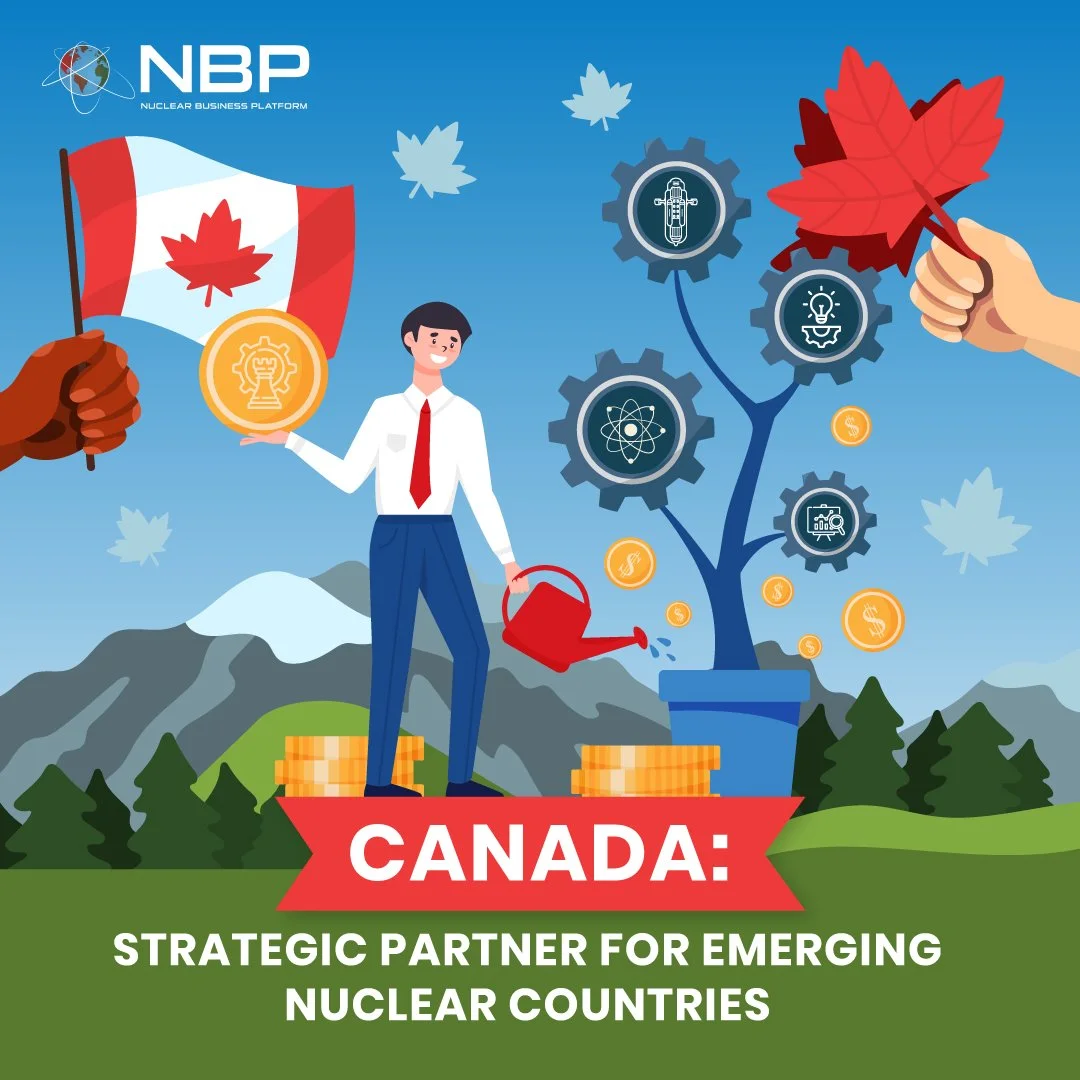
Most countries entering the nuclear market start by shopping for a reactor. That is the wrong starting point. New nuclear programmes rarely fail because nobody will sell them a reactor. They fail because of gaps elsewhere: fuel supply, licensing capacity, skilled labour, financing, or a credible plan for waste. Canada is one of the few countries that can support a newcomer across the whole chain, not just the reactor sale. That makes it worth serious consideration as a long-term partner rather than a one-time vendor.
A Track Record, Not a Pitch Deck
Canada operates 19 commercial nuclear reactors (18 in Ontario, 1 in New Brunswick) with a total installed capacity of approximately 13.6 GWe, supplying roughly 50% of Ontario's electricity and about 15% of Canada's national electricity. This is a mature fleet that has run continuously since the 1970s.
More telling for a prospective partner is what Canada has just finished building. The Darlington refurbishment, worth C$12.8 billion, was completed in March 2026—four months ahead of schedule and C$150 million under budget. The Bruce station refurbishment runs into the tens of billions across a multi-decade programme, and Ontario Power Generation has undertaken a further C$26.8 billion refurbishment at Pickering, with execution starting in January 2027 and completion by the mid-2030s. These are recent, large, complex projects delivered by domestic contractors on regulator-approved timelines. A country partnering with Canada is partnering with an industry that has just proven, at scale, it can deliver.
Reactors for Every Stage of a Nuclear Programme
Canada covers both ends of the reactor spectrum. Its CANDU line, now expressed in AtkinsRéalis's CANDU Monark design (728–1,000 MW, 70-year design life), runs on natural, unenriched uranium. That removes the need to secure enrichment services, historically one of the hardest parts of standing up a new nuclear programme. Westinghouse's AP1000 and the Atmea1 design have also gone through Canadian regulatory review, so a partner country has real technology choice alongside Canadian engineering support.
On small modular reactors, Canada is arguably the most advanced licensing jurisdiction anywhere in practical terms. GE Hitachi's BWRX-300 is already under construction at Darlington (construction started May 2025; reactor basemat installed April 2026), the reference first-mover SMR project worldwide. Canada's regulator has run pre-licensing reviews for roughly ten SMR and microreactor designs, including projects from Terrestrial Energy, ARC Clean Technology, Moltex Energy, and X-energy. New Brunswick's ARC-100 has been told by the CNSC there are no fundamental barriers to licensing (Phase 2 pre-licensing vendor design review completed). For a country trying to work out which SMR design is regulatorily real rather than conceptual, Canada offers a pipeline it can watch in progress.
A Complete Domestic Fuel Cycle
Fuel security is usually a newcomer's biggest long-term worry, and Canada can supply the full chain domestically. Cameco's Blind River refinery converts uranium concentrate at a licensed capacity of 18,000 tonnes UO₃ per year, with approved upgrades to expand to 24,000 tonnes per year contingent on market conditions. Its Port Hope facility provides about 18% of Western conversion capacity and is the only commercial source of fuel-grade natural uranium dioxide, with production limits of 12,500 tonnes UF₆ and 2,800 tonnes UO₂ annually. Two Ontario plants then fabricate that into CANDU fuel bundles. Because CANDU runs on unenriched uranium, a partner adopting Canadian technology can secure mining, conversion and fabrication from one stable, treaty-compliant supplier, without ever touching enrichment. Canada's 2026 national nuclear strategy commits to doubling uranium exports by 2035, a clear signal it wants to serve external as well as domestic demand.
Regulatory Credibility a Newcomer Can Borrow
Building a trusted regulator from scratch takes years. The Canadian Nuclear Safety Commission (CNSC) is already internationally respected, with decades of experience licensing large reactors and now nearly a dozen SMR technologies. Canada is a non-nuclear-weapons state under the Non-Proliferation Treaty, has held an IAEA safeguards agreement since 1972 and an Additional Protocol since 2000, belongs to the Nuclear Suppliers Group, and requires a bilateral safeguards agreement with every customer country. Aligning with that framework gives a newcomer government a running start on the transparency questions its own public and international partners will ask.
Engineering, Financing and Workforce Depth
Canada's industrial base has recently manufactured and installed reactor-grade components at commercial scale. AtkinsRéalis, Aecon, and BWXT Canada have delivered the recent refurbishments and now hold the construction contract for the Darlington SMR. On financing, Canada offers tested models rather than theory: rate-base utility financing, C$3 billion in equity from the Canada Growth Fund and Building Ontario Fund for the Darlington SMR, a convertible loan from the Williams Treaty First Nations, and a 2023 revision to the federal Green Bond Framework that unlocked a C$4 billion nuclear-eligible bond issue in 2024.
Chalk River Laboratories has anchored Canadian nuclear research since the 1940s and remains a hub for SMR development. The University of Regina is building a dedicated SMR safety and licensing centre. Canada's nuclear sector currently supports around 80,000 jobs, with workforce studies projecting labour shortages emerging around 2030 as new projects advance and more than a quarter of the current workforce approaches retirement age between 2030 and 2035. Canadian reactors have historically supplied a large share of the world's medical isotopes, a marker of specialised operating skill that goes beyond electricity alone.
A Real Export Record
Canada's willingness to work as a long-term partner is not theoretical. CANDU reactors operate today in South Korea (Wolsong), Romania (Cernavodă), India, Pakistan, Argentina, and China (Qinshan), built with Canadian technology transfer and engineering support. Candu Energy (AtkinsRéalis) recently signed an agreement with Türkiye's TÜNAŞ to assess deployment of the CANDU Monark design, and AtkinsRéalis has opened early talks with the US NRC on licensing the Enhanced CANDU 6 reactor (Notice of Intent submitted June 2026). Inside Canada, provinces like Saskatchewan and Alberta are already drawing on Bruce Power's operating experience as they build their own programmes, the same kind of relationship an emerging country would seek from Canada itself.
The Bottom Line
An emerging nuclear country needs more than a reactor. It needs fuel it can trust, a regulator others will respect, contractors who can actually build on schedule, financing that has survived real capital markets, and a workforce pipeline. Canada can demonstrate all of it today, not promise it for later. That is what makes it a strategic partner, not just a supplier.