
Five Nuclear Markets, One Message: Southeast Asia Is Ready for Business
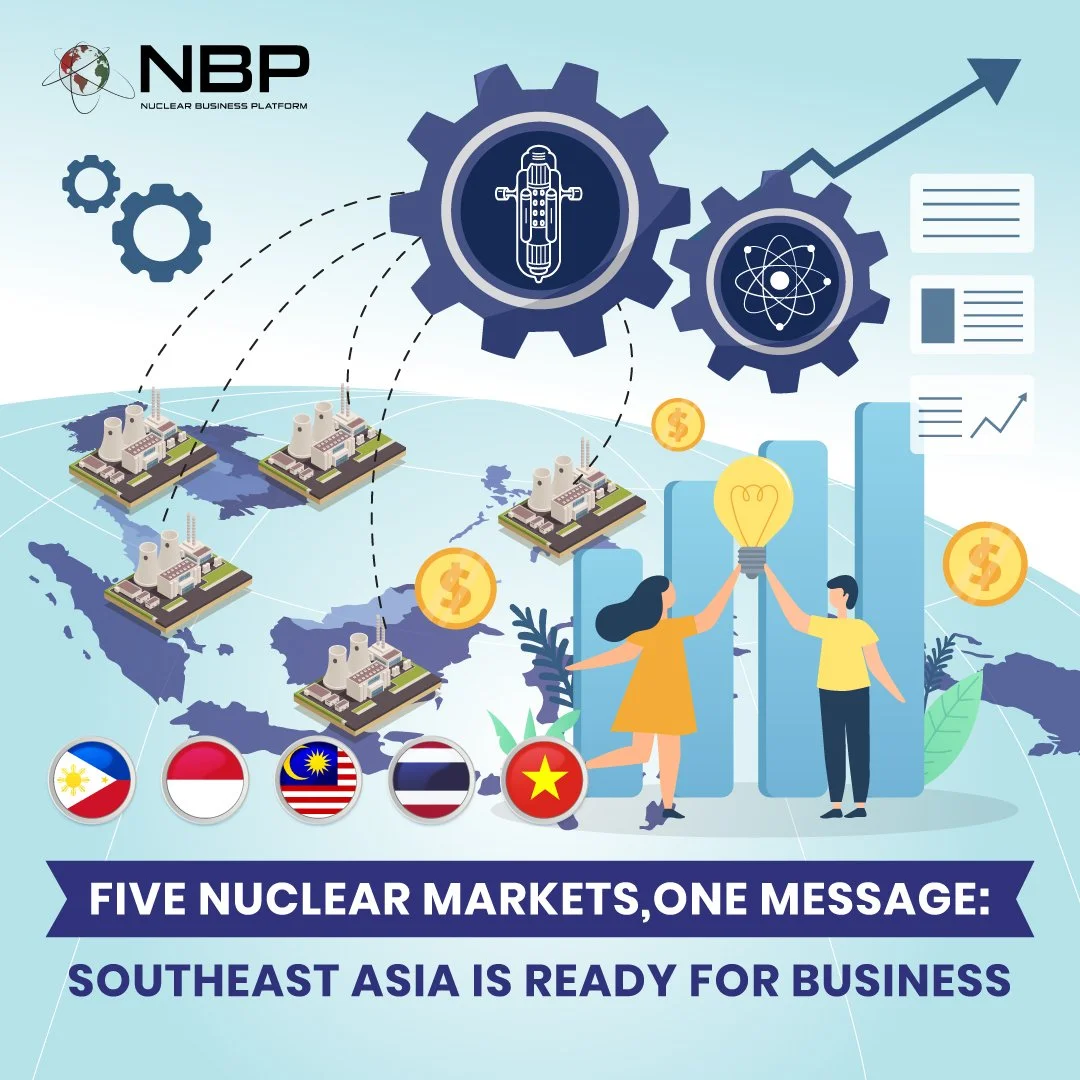
There is a reliable way to assess whether a nuclear market is real or aspirational. Ignore the policy statements and look at the agreements being signed, the money being committed, and the ground being broken. Apply that test to Southeast Asia in 2026 and the conclusion is unambiguous. This region is not preparing for a nuclear market. It is operating one. The deals being signed right now across Vietnam, the Philippines, Indonesia, Malaysia, and Thailand are not diplomatic gestures. They are the commercial architecture of a USD 208 billion industry being constructed in real time, and every agreement that closes without your firm's involvement is a position someone else is building.
Read the Agreements, Not the Announcements
The most commercially useful skill in this market right now is the ability to distinguish between a statement of intent and a binding commercial framework. Southeast Asia has produced both in 2026, and they carry very different implications for business planning.
In Vietnam, the intergovernmental construction agreement signed with Russia for Ninh Thuan 1 in March 2026 is a binding framework. Site clearance is physically underway in Khanh Hoa Province. Population resettlement is in progress. These are not reversible signals. Separately, the four-party MOU connecting Korea Eximbank, Korea Trade Insurance Corporation, KEPCO, and PetroVietnam for Ninh Thuan 2 financing is a live commercial framework, not a statement of interest. It means a financing structure for the second plant is being actively assembled right now, and firms with relevant capabilities that are not yet engaged with these parties are already behind the timeline that matters.
In the Philippines, the USTDA-funded feasibility study worth USD 2.7 million is directing Meralco toward US-designed SMR technology. The tripartite MOU between KHNP, KEXIM, and Meralco is similarly a structured commercial framework, not a courtesy agreement. South Korea has connected technology, export financing, and the off-taker in a single instrument. That is a complete commercial proposition, and Western vendors that have not matched its structural completeness are not competing on equal terms.
In Thailand, the MOU signed between KHNP and the Electricity Generating Authority of Thailand in June 2025 specifically covers SMR technology study, knowledge exchange, and human resource development. The US-Thailand 123 Agreement entered into force in July 2025. Both frameworks are active and both create direct entry points for firms operating within the Korean and US nuclear ecosystems respectively. In Malaysia, the Strategic Civil Nuclear MOU signed with the United States in July 2025 functions as the formal precursor to a 123 Agreement. In Indonesia, ThorCon's Site Evaluation Plan approval from BAPETEN in August 2025 was the first formal regulatory milestone for a non-light-water advanced reactor design anywhere in ASEAN. Each of these agreements has a supply chain implication. The question is whether your firm has mapped them.
The Four Gaps That Cut Across Every Market
Beneath the country-specific deal flow, four structural gaps run simultaneously across all five ASEAN nuclear markets and each represents a commercial opportunity that does not require a vendor selection outcome to access.
The first is financing architecture. Not one of the five active programmes has a fully structured financing solution in place. The World Bank's June 2025 decision to lift its longstanding ban on nuclear project financing opened a multilateral channel that had previously been unavailable to the entire region. Firms with nuclear project finance capability, export credit agency relationships, and multilateral financing experience are in demand across all five markets at once, not sequentially.
The second is regulatory capacity. Every ASEAN market is building its licensing framework and regulatory independence in parallel with vendor engagement, not before it. Firms that contribute to those processes, through safety analysis, regulatory advisory, and licensing documentation support, are shaping the standards against which reactor technologies will be evaluated. That is a strategic position disguised as a service contract.
The third is workforce. A licensed nuclear operator cannot be trained in eighteen months. The lead times for nuclear-qualified engineers, safety inspectors, and regulatory reviewers run in years, and demand across all five markets is concurrent. Training providers, simulation system developers, and university partnership programmes all have immediate and active opportunities across the region that do not depend on any single country reaching a final investment decision.
The fourth is data centre power. Hyperscale operators expanding rapidly across Southeast Asia need firm, low-carbon baseload power. Renewables cannot consistently provide it. SMRs positioned as dedicated power assets for data centre campuses address a demand that grows independently of government nuclear policy and creates a private-sector offtake structure that simplifies project financing significantly. Indonesia and Malaysia are the most immediately relevant markets for this application, but the demand exists across the region.
What the Timeline Is Actually Telling You
Vietnam is targeting commercial operation at Ninh Thuan 1 between 2030 and 2035. The Philippines is targeting first power between 2035 and 2038. Thailand's SMR units target commercial operation by 2037. These dates are not finish lines. They are the end points of procurement, construction, and commissioning cycles that are already running. The engineering contracts, component supply agreements, training partnerships, and regulatory advisory engagements that feed those cycles are being awarded now, not in 2034.
NBP's Asia Nuclear Business Platform (ANBP) 2026 takes place from 24 to 26 November in Hanoi, Vietnam, at the exact moment Vietnam's own programme is transitioning from preparation to active construction and at the exact moment the procurement frameworks across all five ASEAN markets are still open enough to be shaped. The firms that understand what the current deal flow is actually saying will be in Hanoi. The firms that are still treating Southeast Asia as a future market will be reading about the contracts signed by others.