Latin America's $263 Billion Hydrogen Ambition Needs Nuclear to Deliver It
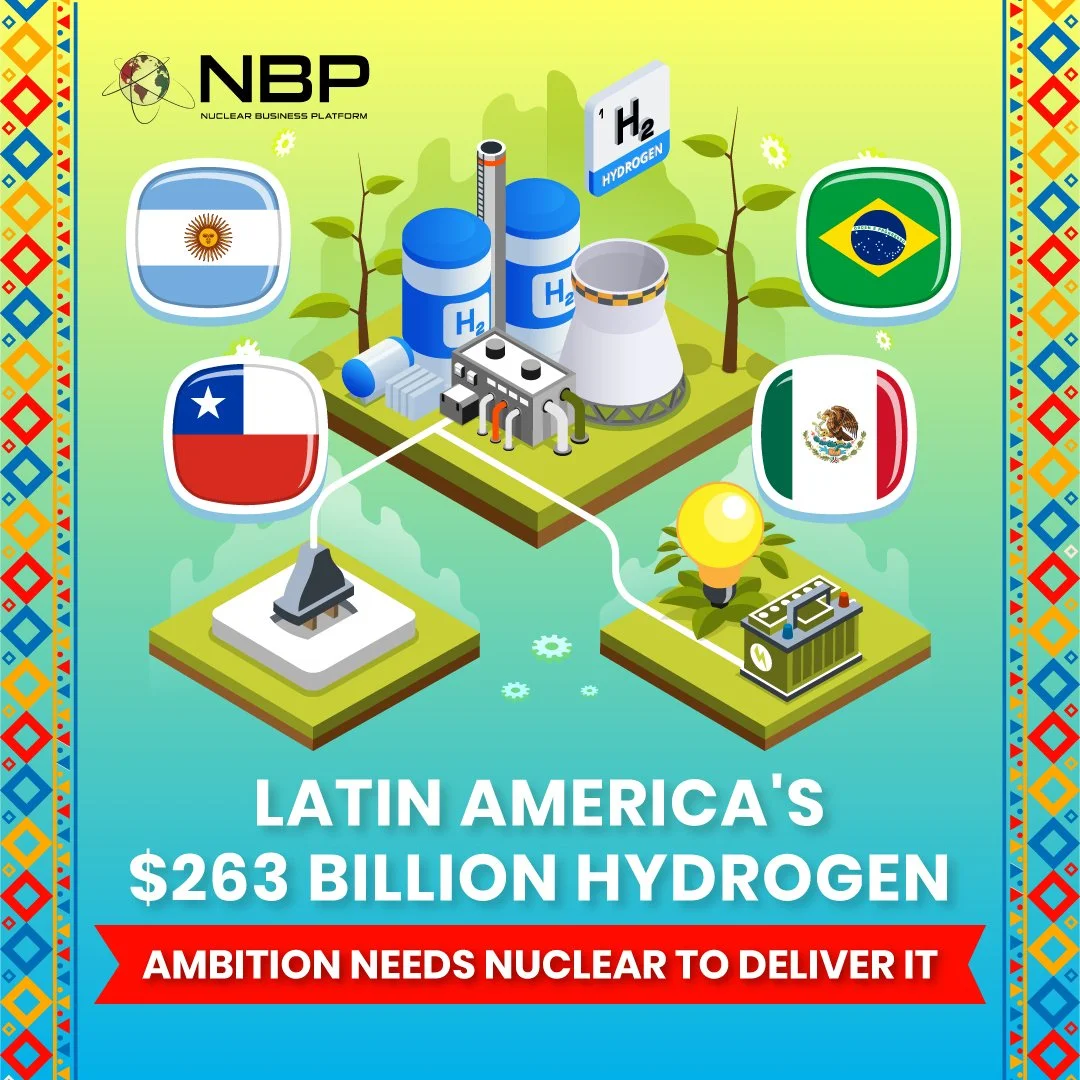
Latin America has positioned itself as one of the world's leading regions for clean hydrogen development. Achieving this, however, will depend on the availability of reliable, low-carbon power sources, and nuclear energy is emerging as a critical enabler in this context. South America alone holds a pipeline of 143 hydrogen projects with a combined potential capital value of approximately $263 billion, according to the Energy Industries Council. Almost all of these projects are green hydrogen initiatives, and the largest among them are oriented toward export markets in Europe and Asia. The regional goals are concrete, and political commitment is deepening across multiple governments. Yet the vast majority of these projects remain at early stages of development, and the reason is not a shortage of policy intent. It is a shortage of the one input that no hydrogen programme can function without, which is sufficiently large volumes of firm, affordable, low-carbon electricity delivered continuously and at an industrial scale. This structural tension sits at the core of Latin America's hydrogen strategy, and it is precisely the gap that nuclear energy is positioned to fill.
The economics and output volumes of any hydrogen facility are directly determined by the cost, reliability, and carbon intensity of its power supply. Producing hydrogen at industrial scale requires continuous electricity input to maximise electrolyser utilisation and maintain cost efficiency. A pipeline valued at $263 billion, targeting export markets with stringent low-carbon certification requirements, therefore depends on an energy system capable of delivering stable and predictable power at scale. Intermittent generation can contribute to this system, but its variability introduces utilisation and cost challenges that become more pronounced at higher production volumes.
Country by Country: The Hydrogen Goals in Numbers
Chile
Chile unveiled its National Hydrogen Strategy in 2020 with an objective to become the world's leading low-cost green hydrogen exporter. The strategy targets 25 GW of electrolyser capacity by 2030 and projects production of up to 1.6 million tonnes per year by 2040. The scale of electrolyser capacity envisioned makes Chile's hydrogen programme one of the most electricity-intensive industrial projects in the Southern Hemisphere.
Argentina
Argentina's 2030 National Low-Emission Hydrogen Strategy, developed in June 2022, targets over 5 GW of electrolysis capacity and more than one million tonnes per year of green hydrogen production by 2030. The government projects green hydrogen exports to reach $15 billion in value by 2050
Brazil
Brazil launched the Guidelines for its National Hydrogen Programme in August 2021, committing to build a low-carbon hydrogen economy. With the largest industrial base in Latin America and deep integration in global energy commodity markets, Brazil's hydrogen programme carries significant scale potential and a correspondingly large appetite for reliable low-carbon power.
Mexico
Mexico's Hydrogen and Energy Transformation Association (H2Mexico) projects cumulative investments in hydrogen and related Power-to-X sectors reaching USD 60 billion by 2050. Several large-scale projects are already proposed, including a USD 10 billion green hydrogen facility planned in Salina Cruz, Oaxaca.
The Nuclear Hydrogen Case: Economics, Scale, and Proof of Concept
The technical and economic case for nuclear-powered hydrogen production is no longer theoretical. At amortised reactors operating in long-term service, nuclear electricity can enable hydrogen production at below USD 2 per kilogram, which is among the lowest production cost thresholds achievable from any low-carbon source. The cost of hydrogen from new nuclear reactors is comparable to the cost of hydrogen from variable renewables in most parts of the world. What nuclear adds, however, is something that wind and solar cannot provide at equivalent scale: continuous, uninterrupted electrolyser operation that maximises facility utilisation rates and delivers predictable output volumes to export-oriented buyers who require supply certainty alongside carbon credibility.
Nuclear power density allows it to supply large-scale, consistent flows of low-carbon electricity and heat to industrial hydrogen hubs, creating genuine opportunities to optimize delivery infrastructure costs and to co-locate hydrogen production with hard-to-abate industrial activities that also require decarbonisation. Meeting net-zero goals through variable renewables alone would require unprecedented volumes of generation capacity and storage infrastructure. Nuclear reduces that system-level burden materially, lowering the overall cost of the hydrogen economy's energy foundation.
Real-world demonstration projects are validating this logic. Nine Mile Point Nuclear Power Station in New York became the United States' first nuclear-powered clean hydrogen production facility, with Constellation Energy initiating hydrogen generation in February 2023. Davis-Besse Nuclear Power Station in Ohio is demonstrating low-temperature electrolysis to validate technical feasibility and commercial potential. Prairie Island Nuclear Generating Plant in Minnesota is pioneering high-temperature electrolysis through a collaboration between Bloom Energy and Xcel Energy. These projects are not pilot experiments in the abstract. They are operational proof points that the nuclear-to-hydrogen pathway delivers at the facility level.
Latin America's Nuclear Assets and the Hydrogen Opportunity
Latin America enters the nuclear hydrogen era with existing nuclear infrastructure and programme pipelines that position the region to act rather than merely plan. Argentina operates three nuclear reactors with decades of institutional knowledge, is developing SMR technology through Invap's ACR-300 programme, and has the CAREM25 modular reactor under development. Brazil operates two reactors at Angra and is advancing Angra 3 toward a 2028 commissioning target alongside a longer-term programme targeting 10 GW of nuclear capacity by 2050. Chile and Mexico, with large hydrogen targets and growing nuclear interest, represent the next logical tier of engagement as the regional hydrogen economy matures.
The convergence of Latin America's $263 billion hydrogen pipeline with the region's nuclear programme expansion defines a market intersection of considerable strategic depth. The hydrogen projects that will succeed in securing European and Asian export contracts will be those that can demonstrate the lowest production costs, the highest supply reliability, and the most credible low-carbon credentials. Nuclear energy strengthens all three dimensions simultaneously. The region's hydrogen ambition and its nuclear energy development are not parallel tracks. They are, structurally and commercially, the same journey.