The Role of Industrial Load in Southeast Asia's Emerging Nuclear Market
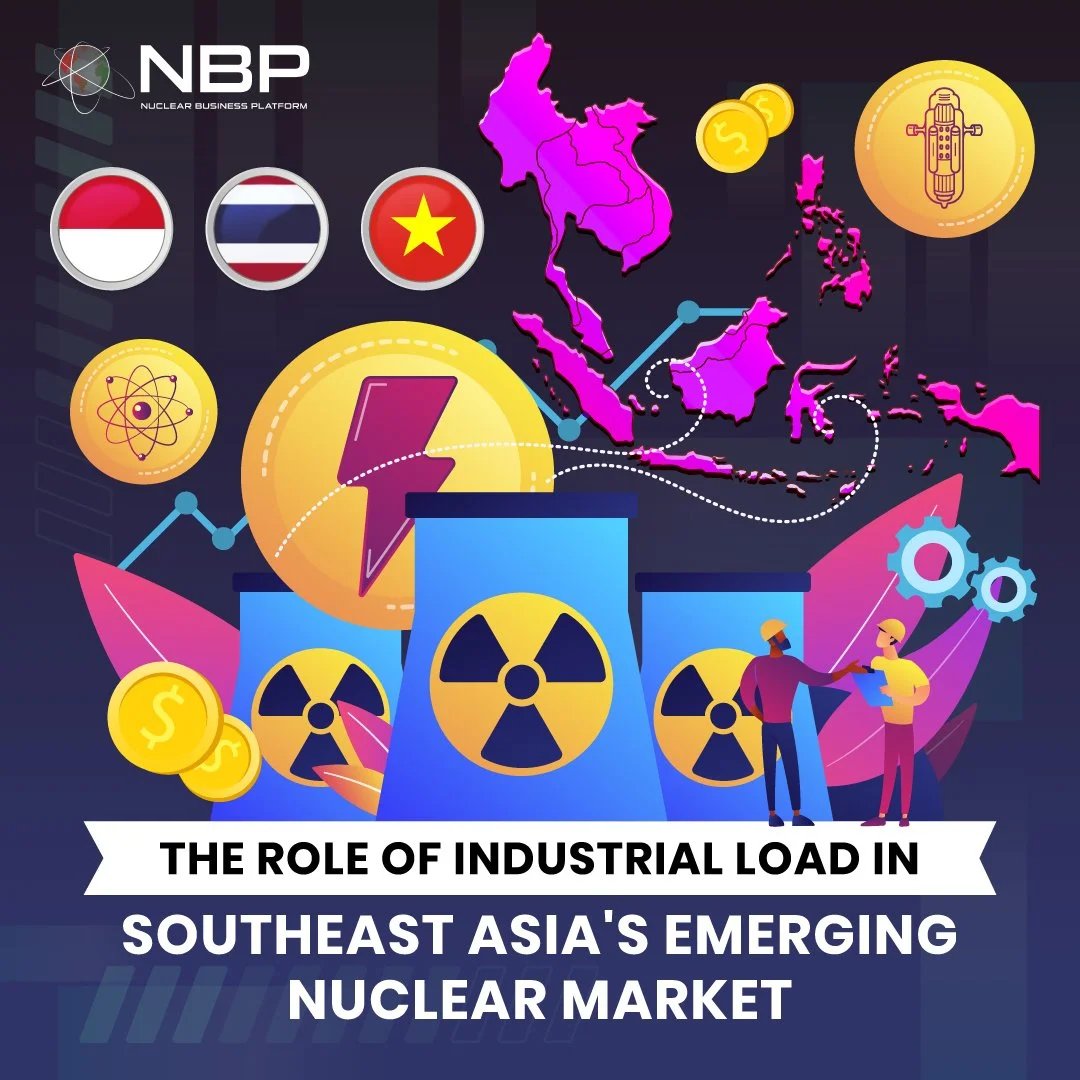
Most nuclear market analysis starts with national energy policy: capacity targets, power development plans, government commitments. Applied to Southeast Asia, that approach explains very little about where reactors will physically go or what size they will be. A more useful starting point is a map of where electricity actually gets consumed in large, continuous quantities across the region. That map points at mining zones, processing plants, industrial estates, and data centre corridors, and it predicts the shape of this market better than any capacity target does.
The Load Is Industrial, and It Does Not Sit Where People Do
Indonesia is the clearest illustration. Its national electricity supply plan includes 500 MW of nuclear capacity by 2034, and the designated host grids are in Sumatra and Kalimantan. Those are not the country's population centres. They are its nickel, bauxite, and aluminium processing regions, industries that require continuous power and have historically run on captive coal plants built on site because the national grid could not reliably serve them.
That detail changes the commercial picture completely. A captive coal plant already exists, already has a dedicated industrial consumer, already has land, and already has a grid connection problem that was solved locally rather than nationally. Replacing it means selling a reactor into a site that already functions as an independent power island with a known, contracted load. The customer is a processing company with a production schedule, and the economic case rests on avoided electricity costs against a specific industrial operation rather than on national tariff policy.
The same pattern shows up elsewhere in the region in different forms. In Vietnam, the demand driver named repeatedly is semiconductor manufacturing, artificial intelligence, and data centre expansion, sectors that need uninterrupted supply and that are being courted as part of an aggressive national growth target. In Indonesia and Malaysia, hyperscale data centre operators are expanding and need firm low-carbon baseload that renewables cannot consistently deliver on their own. Across all these cases, the entity that ultimately makes the power valuable is a private industrial consumer.
Why Geography Sets the Product Specification
The second half of the map is transmission. Archipelagic geography across much of ASEAN produces fragmented, transmission-constrained power pools rather than a single integrated national grid. Many of these grids cannot absorb the sudden loss of a very large generating unit, which caps how much capacity any single reactor can safely contribute without destabilising the system it feeds.
This is why reactor sizing in this region is being driven by grid engineering as much as by energy planning. Designs in the 50 to 300 MWe range fit these power pools, come with smaller emergency planning zones that make siting near industrial estates viable, and support cogeneration applications such as process heat and desalination that a purely grid-connected plant would not monetise. Thailand's programme targets two 300 MW units. Indonesia's near-term target sits at 500 MW. These numbers are consistent with what the receiving grids and industrial loads can actually take.
The conventional gigawatt-scale option remains viable in places with the grid capacity to absorb it, which is why Vietnam's two large plants are proceeding while other markets in the region converge on smaller units. Two distinct product markets are therefore operating side by side in Southeast Asia, separated by grid topology rather than by national preference.
What This Changes for a Supplier
Reading the region through industrial load rather than national policy produces several practical shifts in how a firm should approach it.
The offtake conversation starts earlier and with a different counterparty. A signed power purchase agreement with a mining operator or a data centre developer is one of the most direct ways to make a project's revenue predictable enough to finance, and that agreement does not wait on a state budget cycle or a national tariff decision. Firms with experience structuring industrial offtake, rather than utility offtake, hold an advantage in this region that has little to do with reactor technology.
Siting analysis becomes a commercial capability rather than a technical formality. The question of which industrial sites have the land, the existing grid connection, the water access, and the emergency planning zone footprint to host a small reactor is answerable now, ahead of any vendor selection, and the firms doing that work are shaping where projects eventually land.
Cogeneration changes the revenue model. An industrial host that needs process heat, steam, or desalinated water alongside electricity produces multiple revenue streams from a single asset. In a region with extensive coastal industrial zones and water constraints, that is a material addition to project economics that grid-focused analysis tends to leave out entirely.
The Demand Grows on Its Own Schedule
The most durable feature of this industrial demand is that it does not depend on government nuclear policy moving forward. A nickel processor's power requirement grows with its production. A data centre campus expands on a build schedule set by its operator, not by an energy ministry. Regional power demand across Southeast Asia is projected to double by 2050, and the region needs an estimated $208 billion in nuclear capital expenditure to reach roughly 25 GW of nuclear capacity by mid-century. A substantial share of that projected demand is attached to industrial growth that will continue whether or not any given country hits its stated nuclear timeline.
For a supplier, that means the industrial customer base can be developed in parallel with the government programme rather than downstream of it. The commercial relationships built with processing companies, industrial estate operators, and data centre developers today are relationships with the entities that will eventually sign the offtake agreements that make these projects financeable.
NBP's Asia Nuclear Business Platform (ANBP) runs in Hanoi from 24 to 26 November 2026, at a point when several of these industrial offtake conversations across the region are still forming and the siting decisions that follow from them have not been fixed. For firms whose commercial case rests on industrial load rather than on national grid supply, that is where the counterparties are.