Why South Africa Is the Anchor Point for Africa's Nuclear Buildout
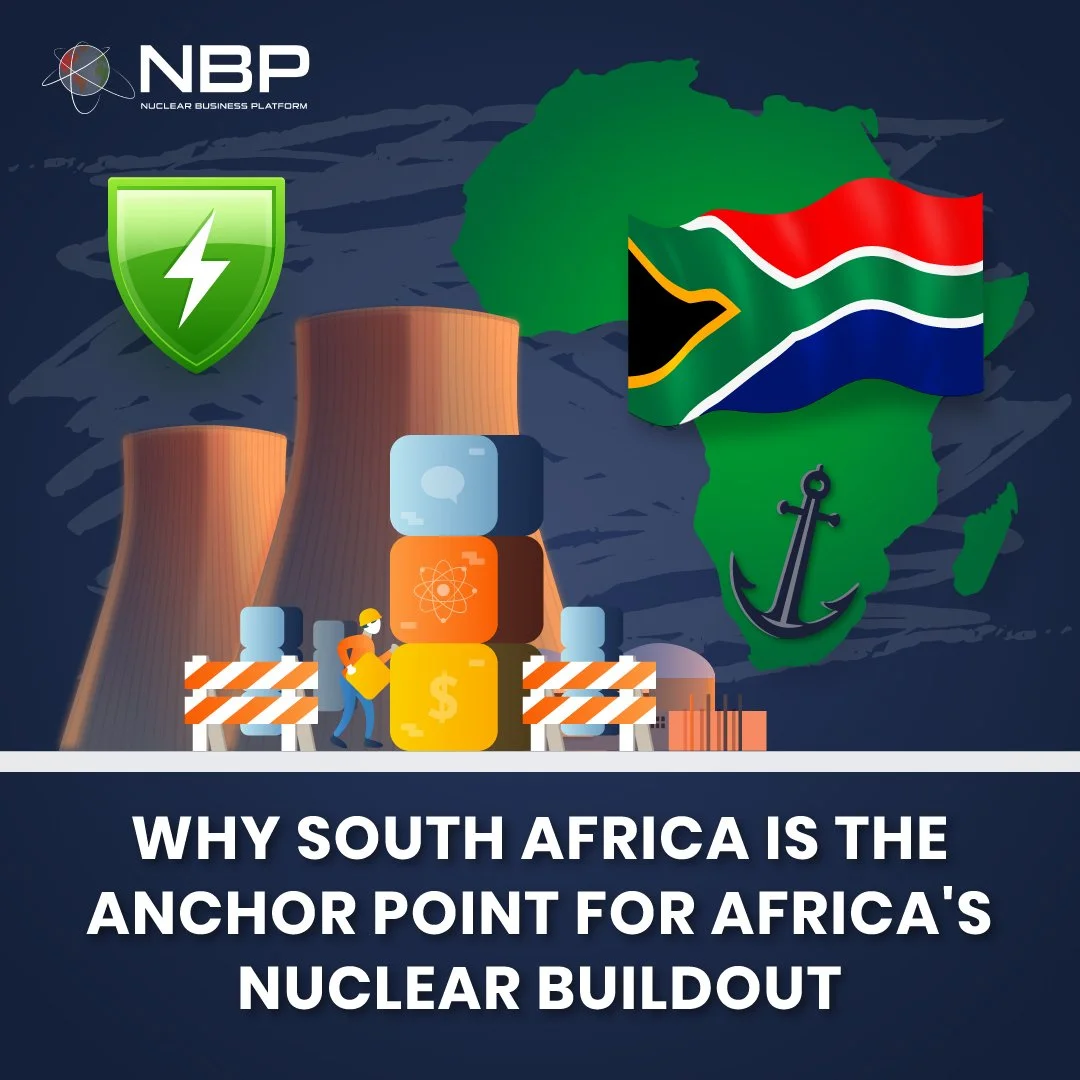
Africa's nuclear landscape spans more than a dozen countries, and no two are at the same stage. Because of that, for anyone doing business across this continent, the practical conclusion is straightforward. Africa's nuclear opportunity behaves as a portfolio of markets at different stages of readiness, each requiring a different partnership model, not a single regional programme engaged with one strategy. Inside that portfolio, one country has already lived through nearly every stage the others are working through now, making it the natural place to anchor a continental strategy.
South Africa Has Already Run the Playbook the Rest of the Continent Is Opening
South Africa is the only African country currently operating commercial nuclear power reactors. The twin pressurised water units at Koeberg, built by Framatome and connected to the grid in 1984 and 1985, have generated power for four decades, and both recently received 20-year licence extensions, taking them to 2044 and 2045. That is four decades of operating experience, safety oversight, and refuelling and maintenance cycles that no other African country currently has.
That experience extends beyond keeping two reactors running. South Africa's National Nuclear Regulator has functioned since 1999, with roots going back to 1948, and already has a working relationship with China's nuclear safety administration to benchmark regulatory practices. In 2013, South Africa hosted the first IAEA Integrated Nuclear Infrastructure Review mission ever conducted in a country with established nuclear power, a distinction that matters directly to the current wave of INIR missions running in Rwanda and sought by Tanzania and Niger. South Africa's regulator has already been through the exercise the rest of the continent is only now beginning.
The country has also negotiated with every major reactor vendor now circling the rest of Africa. Rosatom, Areva/Framatome, Westinghouse, China's SNPTC and CGN, and KEPCO have all submitted proposals, signed cooperation agreements, or bid into South African procurement processes over two decades. Those negotiations did not all end in signed contracts, and South Africa's own build programme was repeatedly delayed by financing gaps, legal challenges, and shifting policy. That history is itself valuable. A country that has already evaluated financing terms, localisation requirements, and proposals from every vendor now competing elsewhere on the continent holds institutional experience no first-time buyer has.
A Continental Supply Chain and Isotope Hub, Not Just a Power Producer
South Africa's relevance goes beyond reactors. Eskom supplies about 90% of South Africa's electricity and roughly 30% of all electricity produced across the continent, through the Southern African Power Pool's extensive interconnections. That grid role gives South Africa a direct stake in how new nuclear capacity gets integrated into regional power markets.
The country's Safari-1 research reactor at Pelindaba is the main supplier of medical radioisotopes in Africa and can supply up to a quarter of the world's molybdenum-99 needs, the isotope behind most nuclear medical diagnostic procedures globally. That is existing, revenue-generating nuclear infrastructure already serving the whole continent, not a future ambition. A new Multipurpose Reactor is now in its detailed design phase, funded with an initial R1.2 billion allocation, targeted to come online around 2032 to 2033 and run alongside Safari-1 rather than replace it.
South Africa is also one of the few African markets actively developing SMR and Generation IV technology with a domestic focus. The Cabinet's decision to revive the Pebble Bed Modular Reactor programme, and Necsa's March 2026 call for expressions of interest in SMR technology partners, sit alongside a separate, privately developed design, the HTMR-100 from STL Nuclear, a pebble bed high-temperature reactor explicitly aimed at the African market rather than at South Africa's own grid alone.
What This Means for Vendors, Financiers, and Regulators Elsewhere on the Continent
None of this positions South Africa as a vendor competing against Rosatom, KEPCO, or CNNC for contracts in Kenya, Ghana, or Egypt. It positions South Africa as the country best to share lessons learned and equipped to partner in those processes: a regulator with decades of licensing experience to share with newer regulatory bodies, a grid operator interconnected into the power pool many new plants will eventually feed, an isotope and research reactor base already serving the continent's medical needs, and a government that has already worked through, at real cost, most of the financing and vendor-selection mistakes a first-time nuclear buyer risks repeating. In addition to these, South Africa is pursuing its own new build program with an ambitious target 5200 MW by 2039.
For technology providers, utilities, investors, and financial institutions building a strategy for Africa's nuclear buildout, that makes South Africa the logical anchor point, not only because it is the largest opportunity by capacity, but because it is the one market that has already absorbed the lessons the rest are about to learn in real time.
NBP's Africa Nuclear Business Platform (AFNBP) 2027, taking place in South Africa in April 2027 and hosted by the South African Department of Electricity and Energy (DEE), provides a timely platform to build on exactly this dynamic.