
Southeast Asia's Nuclear Market Has a Constraint Money Cannot Remove
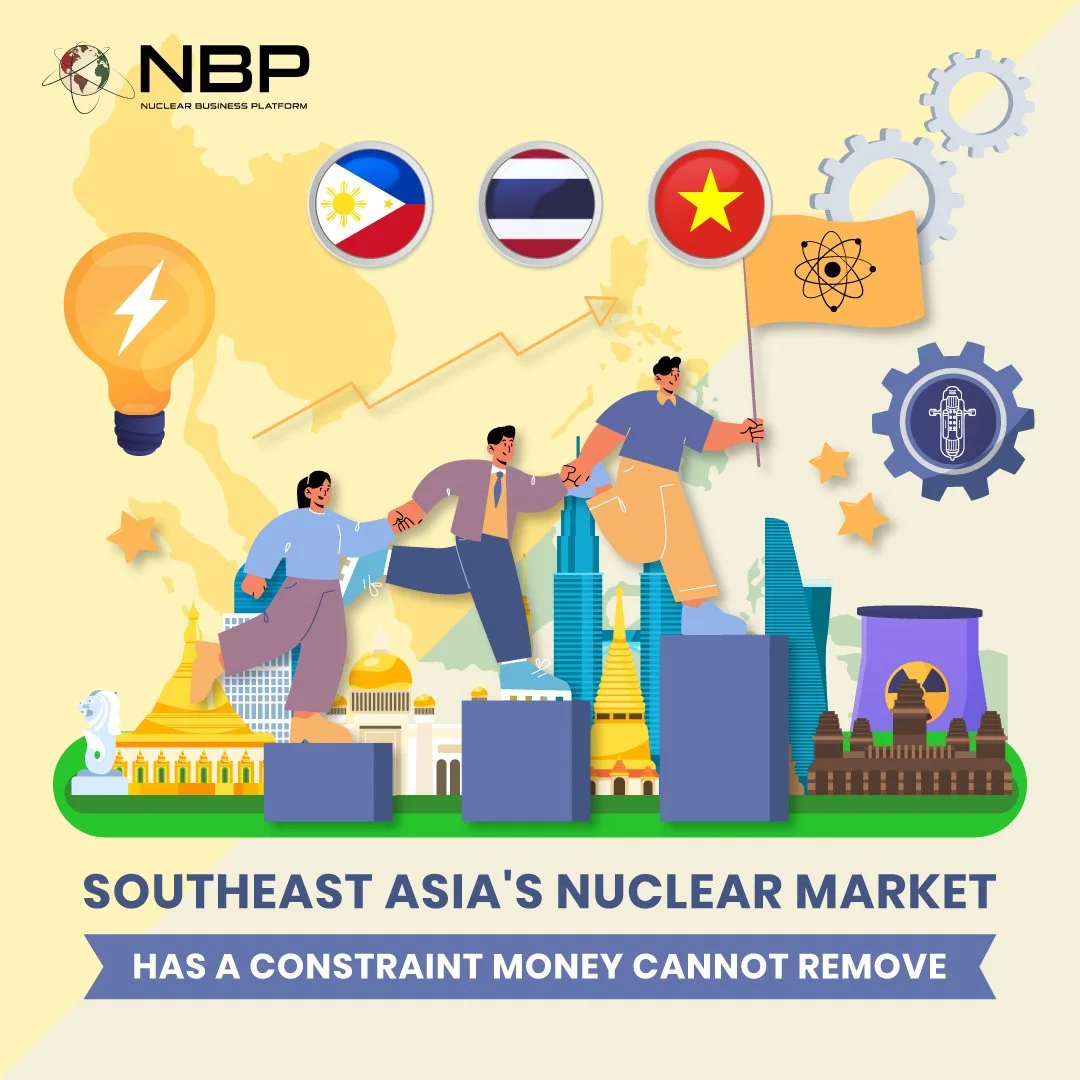
Every one of Southeast Asia's five active nuclear programmes, in Vietnam, the Philippines, Thailand, Malaysia, and Indonesia, is currently signing agreements, lining up financing, and setting capacity targets. Most analysis of this region focuses on that activity: which country has the most advanced deal, which vendor has the strongest financing package. That analysis misses the constraint that actually governs how fast any of these programmes can move, and it is not capital. It is people, and unlike capital, a shortage of trained nuclear personnel cannot be solved by writing a bigger check.
Capital Moves Faster Than People Can Be Trained
A licensed nuclear engineer, a qualified safety inspector, or an independent regulatory reviewer takes years to train, not months. This is true no matter how much financing a project has secured or how quickly a reactor vendor is selected. A country can close a financing agreement in a single negotiating session. It cannot compress the years required to build a regulator that a lender or an international safety body will actually trust to oversee construction and operation.
This is why the lead times attached to Southeast Asia's nuclear programmes look similar across very different countries, even though each one is at a different stage of vendor selection and financing. Vietnam is targeting commercial operation at Ninh Thuan 1 between 2030 and 2035, despite already having a construction agreement and site clearance underway. The Philippines is targeting first power between 2035 and 2038, even with a structured technology-financing-offtake framework already in place. Thailand's SMR units target 2037. None of these timelines are primarily driven by how long it takes to pour concrete or manufacture reactor components. They are driven by how long it takes to build the human and institutional capacity required to run a nuclear programme safely, a process that runs on roughly the same clock everywhere, regardless of which reactor design or financing structure a country picks.
Regulatory Maturity Is Also a Time Problem, Not a Money Problem
The same logic applies to regulatory capacity. Every one of these five markets is building its licensing framework and its regulatory independence at the same time it is negotiating with vendors, not beforehand. That is not a funding gap. Countries in this region can and do hire safety analysts and regulatory advisors right now. What cannot be bought is the track record, the case history, and the institutional muscle memory that make a regulator credible to lenders and international partners. That kind of credibility is built through years of doing the work, not through a single funding round or a well-staffed office on day one.
This means the countries that will actually be ready to operate a nuclear plant on schedule are not necessarily the ones that signed the most binding agreements first. They are the ones that started building workforce and regulatory capacity earliest, in parallel with the commercial deal-making, rather than waiting until financing was fully closed to begin.
Why This Changes Where the Real Opportunity Sits
Most companies looking at Southeast Asia's nuclear market are positioning themselves around the competitive part of it: which reactor gets selected, which financing package wins. That is a zero-sum contest. Only one vendor wins each contract, and firms chasing it are competing directly against a small number of well-funded rivals in every market at once.
The workforce and regulatory capacity gap is a different kind of opportunity entirely. It is not zero-sum, and it does not require picking the winning vendor or the winning country. Every one of the five markets needs training providers, simulation system developers, and university partnership programmes right now, regardless of which reactor technology eventually gets built there. A firm that builds a simulator programme or a licensing documentation practice in one country is not competing for a single contract that only one company can win. It is building a capability that every one of the five markets needs simultaneously and will keep needing for years, since the training pipeline has to run continuously to keep pace with each programme's growth, not just once at the start.
This is also a more durable position than a reactor sale. A vendor selection can be reversed, as it was in the Philippines when Japan's original nuclear partner withdrew and the field reopened. A trained workforce and an established regulatory advisory relationship are not similarly reversible. Once a firm is embedded in a country's training pipeline or licensing process, that relationship tends to persist through changes in reactor vendor, financing structure, or even government.
What This Means in Practice
Southeast Asia's nuclear market is often described as a race. It is more accurate to describe it as five parallel construction projects, all bounded by the same slow-moving constraint of human capacity, running underneath a much faster and more visible contest over reactors and financing. Firms that only track the visible contest are competing in a crowded, winner-take-all field. Firms that build a position in workforce development and regulatory capacity are working against a constraint that every market in the region shares and that no amount of financing can shortcut.
NBP's Asia Nuclear Business Platform (ANBP) runs in Hanoi from 24 to 26 November 2026, and workforce and regulatory capacity building are on the agenda alongside financing and technology. For firms without a reactor to sell, that is the part of the programme worth paying closest attention to.