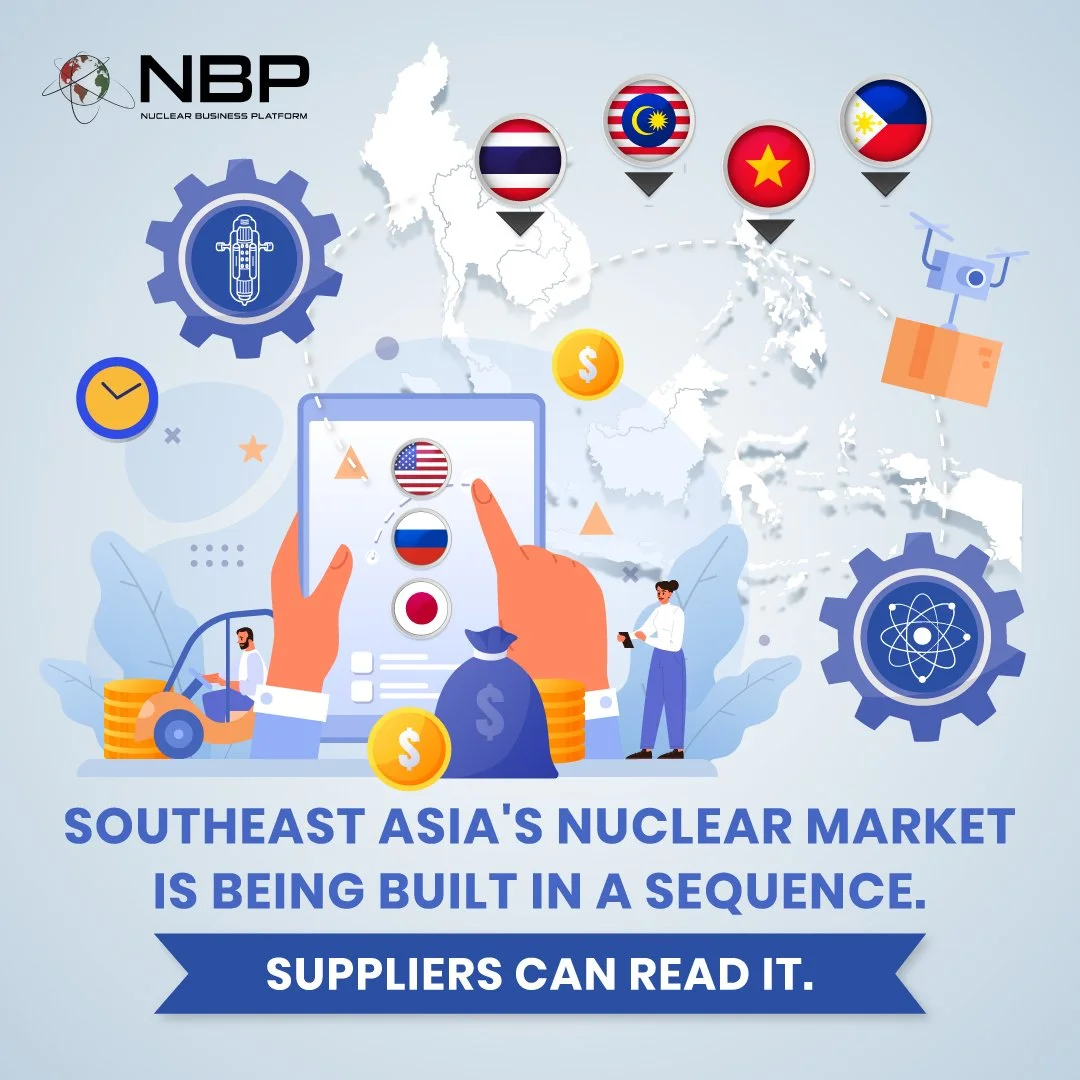
Between June 2025 and March 2026, Southeast Asia's nuclear market logged a run of milestones that look unrelated when read one at a time: a multilateral lending decision, two legal frameworks with the United States, a regulatory approval, a partner withdrawal, a binding construction agreement, and a utility-level technology MOU. Read together, they form a sequence. Each one opens the door to the next kind of buyer need, and that sequence gives suppliers something more useful than a news feed: a way to judge which market needs what, right now.
The Sequence, Step by Step
Step one: the money channel opens. In June 2025, the World Bank lifted its longstanding ban on nuclear project financing. That opened a multilateral route that had been unavailable to the entire region and gave every programme a reason to start building a financing structure.
Step two: the legal door opens. In July 2025, the US-Thailand 123 Agreement entered into force, and Malaysia signed a Strategic Civil Nuclear MOU with the United States that serves as the formal precursor to a 123 Agreement. The Philippines had already put its own 123 Agreement with the United States in place a year earlier. These agreements set the legal basis for nuclear trade and technical cooperation between the countries involved.
Step three: a regulator proves it can review. In August 2025, Indonesia's regulator BAPETEN approved ThorCon's Site Evaluation Plan, the first formal regulatory milestone for a non-light-water advanced design in ASEAN. In December 2025, Vietnam completed the IAEA's Phase 2 Integrated Nuclear Infrastructure Review, a mission conducted when a country is ready to invite bids for its first plant. Both show regulatory systems being tested against real projects.
Step four: the partner field resets. In December 2025, Japan withdrew from Vietnam's Ninh Thuan 2 plant. Within months, a four-party framework linking Korea Eximbank, Korea Trade Insurance Corporation, KEPCO, and PetroVietnam was assembled to explore financing for the project. The sequence can loop: when a partner leaves, the market goes back a step and rebuilds quickly.
Step five: a binding commitment. In March 2026, Vietnam and Russia signed an intergovernmental construction agreement for Ninh Thuan 1. Site clearance and resettlement followed in Khanh Hoa Province.
Step six: utility-level agreements on technology and people. The Electricity Generating Authority of Thailand and KHNP signed an MOU in June 2025 covering SMR technology study, knowledge exchange, and human resource development. In the Philippines, a USTDA-funded study is evaluating US designs for Meralco, while a separate three-way MOU links KHNP, KEXIM, and Meralco. These are the working-level agreements that sit between a legal framework and a construction contract.
What the Sequence Does Not Claim
The countries do not move in lockstep, and the order above is a reading of the pattern rather than a stated government plan, and not every step follows strictly in date order, since the Thailand utility MOU dates from June 2025. Vietnam has moved furthest, reaching a binding agreement within a single year of its programme's revival. Thailand and the Philippines sit at the legal and utility-agreement stages. Malaysia is at the preparatory stage of its legal framework. Indonesia is progressing through a regulatory route of its own. The sequence is most useful as a map on which each market can be located separately.
Matching an Offer to a Step
Each step creates a different buying need, and the region's four structural gaps, financing, regulatory capacity, workforce, and data centre power, line up with them.
Where the financing channel is newly open, the market needs firms with nuclear project finance experience and export credit relationships. None of the five programmes has yet closed a fully structured financing solution, so that need is live across the region.
Where a legal framework has just been signed, the next need is commercial and technical groundwork: feasibility studies, partner identification, and the regulatory and licensing preparation that follows. The Philippine feasibility study is an example of this stage at work.
Where a regulator has passed a milestone, the need shifts to licensing support and safety review capacity, since each new project adds to a reviewer workforce that takes years to train.
Where utilities have signed technology and workforce MOUs, as in Thailand, training providers, simulation developers, and university partnerships have an immediate opening that does not depend on a final vendor choice.
Where a binding agreement is in place, as in Vietnam's Ninh Thuan 1, the primary contractor position is settled, and the opportunity moves to the specialist services layer around it.
Using the Sequence as a Planning Tool
Three practical uses follow. First, sell to the step the market has just completed. A workforce training offer is well timed in a market with a fresh utility MOU. A financing offer is better aimed at a market still assembling its structure. Reversing the two means arriving early or late.
Second, expect compression. Vietnam moved from legislative revival to construction activity within a single calendar year, and it rebuilt its second-plant partner framework within months of Japan's exit. A firm that waits for a clearer signal can find that two steps have passed in the time it took to decide.
Third, watch the next step in each market. A market that has just signed a legal framework will soon need commercial groundwork. A market with a finished feasibility study will need a financing structure. These are readings from the pattern rather than announced plans, but they give a supplier a short list of conversations worth starting early.
NBP's Asia Nuclear Business Platform (ANBP) takes place in Hanoi from 24 to 26 November 2026. It brings together utilities, regulators, financiers, and suppliers from across the region at a time when each market is sitting at a different point on this sequence, which makes it a practical place to find the counterparty for whichever step your offer fits.