
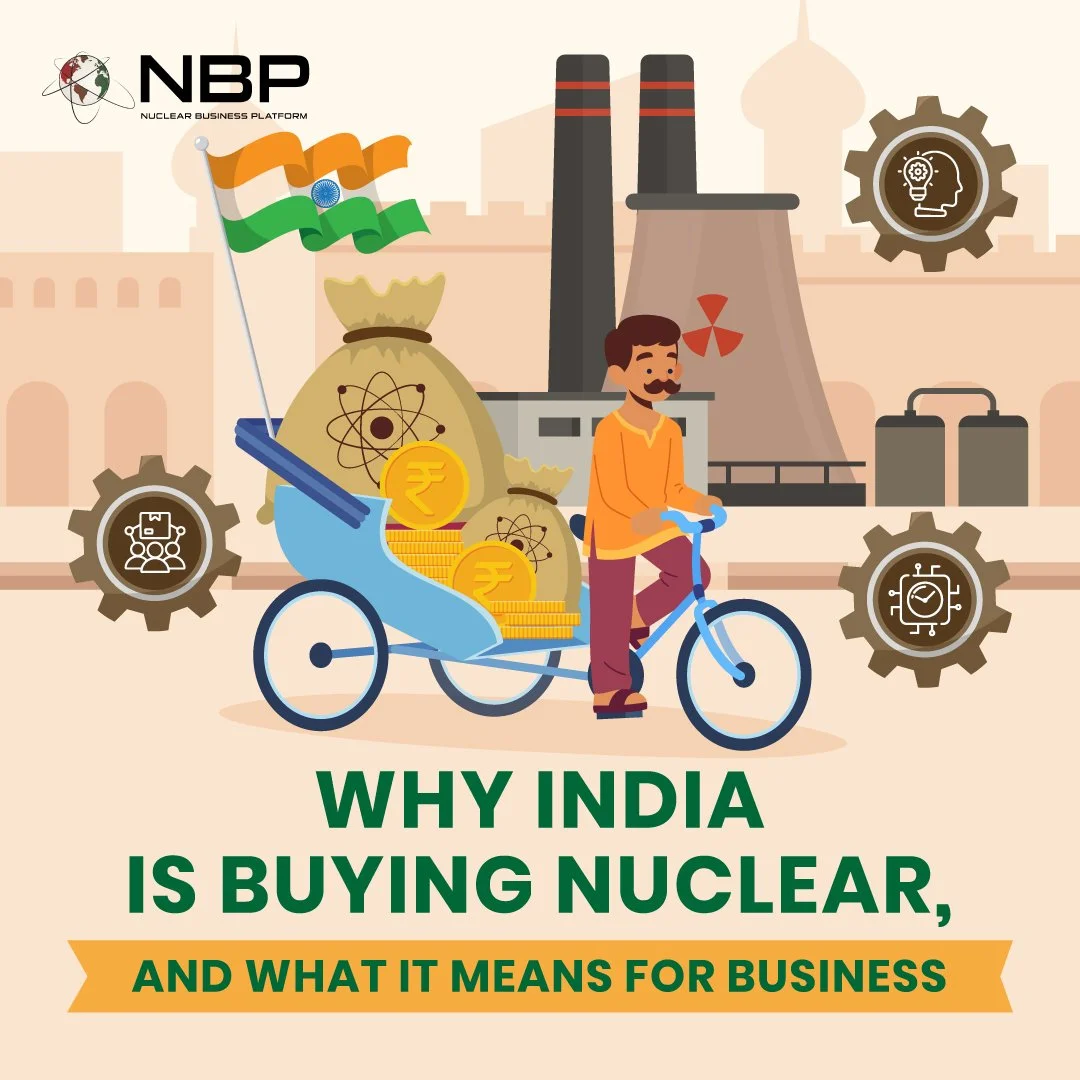
Nuclear power is moving up India's agenda, and companies are moving with it. In late September 2026, Rosatom was reported to be in talks with Adani Group, Reliance, and NTPC, and senior Indian and French officials met to review plans for EPR reactors in India. Companies do not spend time on talks like these without a reason. The reasons are set out in the Indian government's own explanation of its nuclear strategy, and they are easy to follow. Here is what they mean for firms that want to do business in India.
Reason One: Power That Never Stops
Baseload electricity is the minimum, uninterrupted amount of power a grid needs to stay running. It is the backbone of the power supply, keeping hospitals, communication networks, defence establishments, and industries working. Reliable baseload power is essential for economic growth, national security, and disaster resilience.
Nuclear plants generate electricity around the clock. Demand for clean, reliable, and stable baseload power is growing as India works toward its Viksit Bharat goals. For a business, this matters because the demand comes from a basic need. It does not depend on a single project or a passing policy.
Reason Two: A Partner for Solar and Wind
India is expanding solar and wind power, and these sources depend on weather and time of day. Nuclear power works alongside renewable energy while keeping the grid stable.
This explains why nuclear and renewables are often discussed together. A grid with more renewable power has more reason to want a steady source beside it. The same thinking showed up in the India-France meeting, where officials talked about pumped hydro storage as well as reactors.
Reason Three: Less Reliance on Imported Fuel
Nuclear power reduces dependence on imported fossil fuels. India's reactors mainly use natural uranium, which does not need enrichment. The country also holds large reserves of thorium, which it plans to use over the long term through its three-stage nuclear programme.
The government is open about the limits. India's own uranium reserves are of low grade, so some imports are still needed. The goal is self-reliance across the nuclear fuel cycle, from reactor design to fuel fabrication to waste management. The case for nuclear is that it lowers India's exposure to imported fuel, and it does so step by step.
Reason Four: Climate Commitments
Nuclear power is low-carbon electricity that supports India's climate commitments. For a country that wants to grow its economy and cut emissions at once, a steady source of clean power fits both aims.
Different Needs, Different Plants
India's needs vary, and so do the plants that can meet them. Large reactors, from 700 to 1,600 MW, supply steady power to national grids, cities, and industries. Smaller reactors serve other needs. Small modular reactors and micro reactors can serve remote areas, replace retiring coal plants, supply heat for industry, and support hydrogen production.
For suppliers, this means more than one kind of buyer. A utility planning a large plant and an industrial company looking for a smaller one need different products and different partners.
Why the Timing Matters
Three things have come together.
Policy has changed. The SHANTI Act of 2025 and the Nuclear Energy Mission for 2025-26 are measures to speed up capacity expansion, strengthen domestic manufacturing, and allow more private sector participation. Private companies can now build, own, and operate nuclear plants, which was not possible before.
Companies are acting. The reported Rosatom talks and the India-France meeting both took place within days of each other. The draft SHANTI Rules, which set out a faster licensing process with time limits and allow private and foreign partners, are open for public comment.
Building takes years. India operates 24 nuclear reactors with a total capacity of 8.78 GW, and nine more units with 7.5 GW are under construction. India's roadmap expects ongoing projects to reach 22 GW by 2031-32. Any capacity beyond that has to be planned and started well before the date it is needed. Decisions made in the next few years will shape what is available later in the 2030s and beyond.

What This Means for Suppliers
The reasons behind India's nuclear push are long-lasting ones. Steady power, support for renewables, lower fuel import exposure, and climate goals each stand on their own, so demand built on them should outlast any single government decision or project.
Buyers are active now. Talks are under way, rules are being finalised, and relationships formed this year will matter when projects reach the buying stage.
Several entry points are open. These include equipment made in India, engineering and project services, fuel-related supply, and partnerships with Indian companies. Each can be matched to one of the government's own reasons for nuclear power.
Firms will do best when they link their offer to those reasons. A company that shows how its equipment supports steady power, how its services help the grid, how its manufacturing plan builds local capability, or how its fuel work reduces import exposure is speaking the same language as the buyers.
India's case for nuclear power is clear and the timing is now. For firms that want a place in this market, the best starting point is to understand why India is buying and to build the offer around that. For a deeper assessment of entry pathways, the India Nuclear Industry Report 2026 provides the detailed mapping.