Southeast Asia Nuclear Market: Two Investment Pools Are Taking Shape in 2026
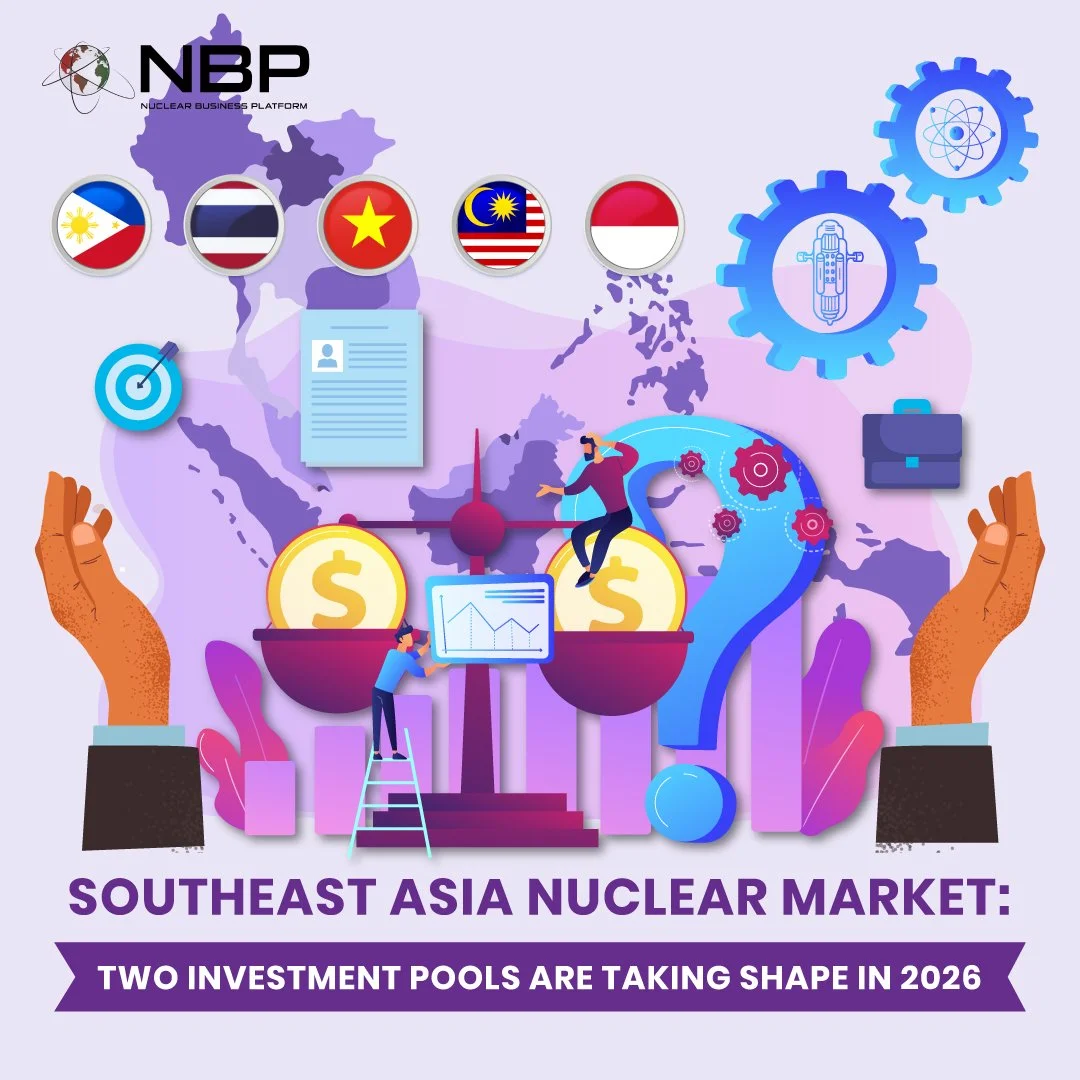
Most companies evaluating Southeast Asia's nuclear market work through it country by country: Vietnam's status, then the Philippines, then Thailand, Malaysia, Indonesia, treated as five separate bets to size up one at a time. A portfolio manager would look at the same region differently, sorting the deal flow by asset class rather than by flag. Done that way, Southeast Asia splits cleanly into two portfolios with very different risk and competition profiles, and most firms active in the region are only positioned in one of them.
The Core Holding: Light-Water and SMR Deployment
The larger portfolio is built on light-water reactor technology, the design family with the deepest global operating history and the most established regulatory precedent. Vietnam's Ninh Thuan 1 uses Russian VVER-1200 units, a pressurized water design already running in Russia. The Philippines is evaluating US-designed SMR technology through Meralco, working inside a light-water framework. Thailand's cooperation with KHNP covers SMR technology built on Korea's proven pressurized water designs. Malaysia's cooperation with the United States targets conventional nuclear technology as its opening step. Indonesia's national power plan target of 500 MW by 2034, aimed at industrial demand in Sumatra and Kalimantan, sits inside this same broad channel.
This is the core holding of the region, and it behaves like one. Regional power demand is projected to double by 2050, with an estimated $208 billion in capital expenditure needed to reach roughly 25 GW of nuclear capacity across the region by mid-century. Every market in this group is competing on comparable terms: financing structures that are not yet fully closed anywhere, regulatory frameworks being built in parallel with vendor engagement rather than ahead of it, workforce pipelines that take years to build regardless of which country is running them, and a wave of data centre and industrial demand that supports project economics across all five countries at once. A vendor or service firm active in this portfolio is exposed to the same structural risks everywhere it operates, financing delay, workforce shortfall, competition from state-backed rivals, because those risks are shared across the whole group rather than isolated to any single market.
That correlation cuts both ways. A financing breakthrough, such as the World Bank lifting its ban on nuclear project financing in 2025, benefits every market in this portfolio simultaneously. A setback in workforce development or regulatory credibility in one country tends to reflect a regional-scale constraint rather than a local one. Firms building a position here should expect returns and risks that move together across markets, which argues for a genuinely regional strategy rather than five disconnected country plans.
The Small, Uncorrelated Position: Advanced Reactor Licensing
A second, much smaller category sits alongside the mainstream portfolio, and it behaves almost nothing like it. Non-light-water advanced reactor technology has reached a live regulatory process in the region exactly once, when Indonesia's regulator, BAPETEN, approved ThorCon's Site Evaluation Plan in August 2025. That approval required evaluating a safety case built on different physics and different operating assumptions than any light-water design, without a regional precedent to draw on. No comparable milestone has been reached anywhere else in Southeast Asia.
That makes this category a small position by definition, dependent on a single live project in a single country, but it is structurally uncorrelated with the mainstream portfolio. The regulatory expertise required is different. The fuel cycle logistics are different. The competitor pool is different and much thinner, since so few firms globally have advanced reactor licensing experience at all. None of the shared regional risks driving the light-water portfolio, financing structure, standard workforce pipelines, conventional fuel supply, apply here in the same way. A firm holding a position in this category is not exposed to the same regional-scale shocks affecting the mainstream group, and it is competing against a far smaller field to do work that very few other firms in the world are currently qualified to deliver.
Indonesia illustrates why this distinction matters at the country level too. Its 500 MW RUPTL target keeps it inside the mainstream light-water portfolio, while its BAPETEN approval for ThorCon simultaneously gives it a foothold in the advanced reactor category. A single country carrying exposure to both asset classes at once is currently unique in the region, and it is a reminder that the two-portfolio structure is a market segmentation, not a fixed map of which countries belong where. Any of the other four markets could open its own advanced reactor track in the future. None has yet.
What This Means for Capital and Business Development Allocation
Treating Southeast Asia as two portfolios rather than one region produces a clearer allocation decision. Most firms should put the bulk of their capital, business development effort, and commercial attention into the mainstream light-water and SMR portfolio, because it spans four to five active markets, carries a larger addressable deal flow, and rewards firms that build genuinely regional capability in financing structure, regulatory advisory, and workforce development rather than country-specific relationships alone.
The advanced reactor category deserves a much smaller allocation, sized appropriately for a position that currently depends on one live opportunity, but it is worth holding rather than ignoring. Competition is thin, the expertise required is scarce, and the category has clear potential to expand if another country in the region moves toward a non-light-water design, the same way Indonesia already has. A firm with genuine advanced reactor licensing or fuel cycle expertise is better served building an early relationship in that space now, while the field is uncrowded, than waiting until a second country reaches a comparable regulatory milestone and the competitive landscape changes.
NBP's Asia Nuclear Business Platform (ANBP) runs in Hanoi from 24 to 26 November 2026, and both portfolios will be represented in the room, from the utilities and financing partners driving the mainstream buildout to the regulators and technology developers working on the region's advanced reactor track. Firms that show up having already sorted their own strategy into these two categories will get more out of those conversations than firms still treating Southeast Asia as one undifferentiated market.