
Vietnam's Nuclear Restart: Eight Years Later, a Harder Road Back
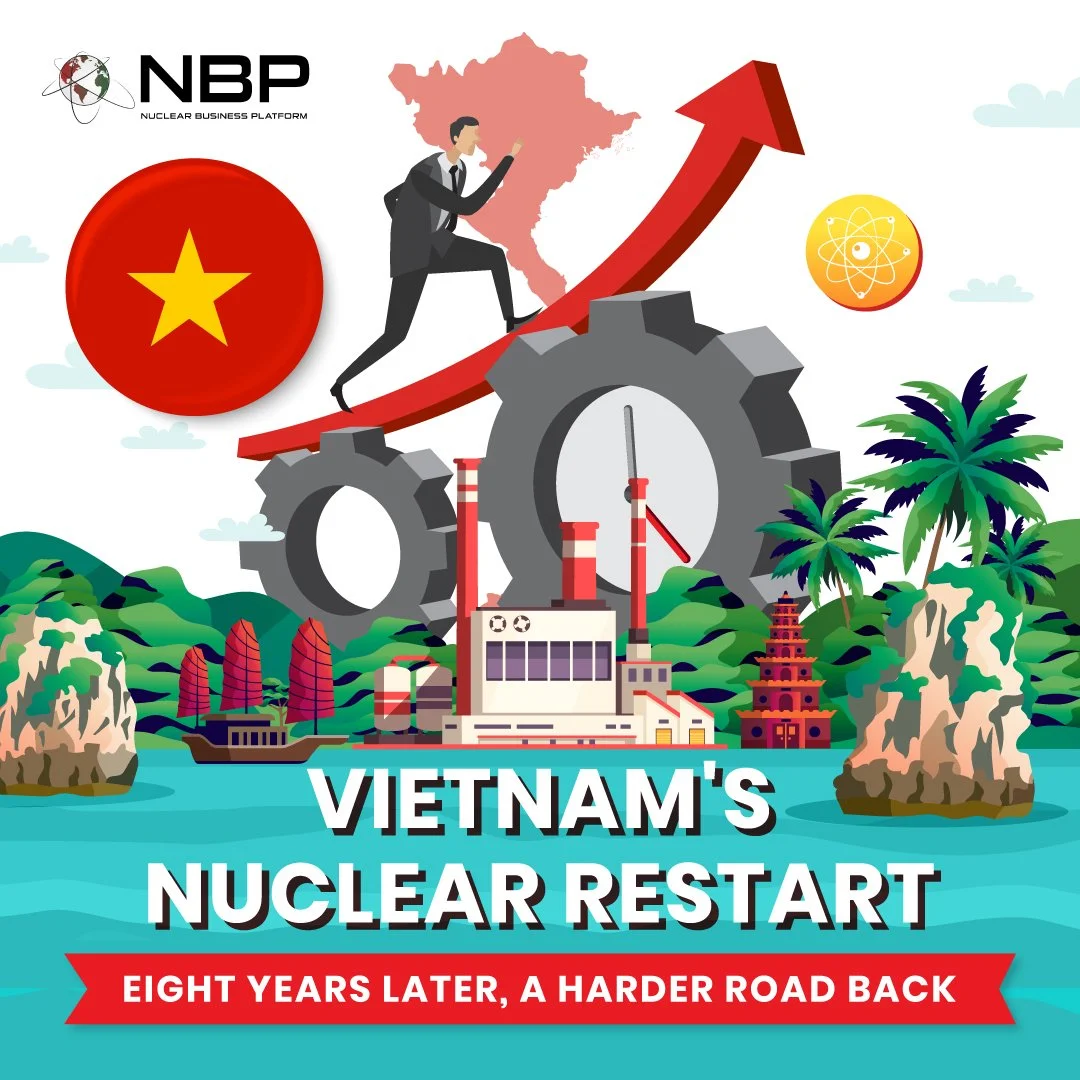
Nuclear programmes are difficult to start. They require years of institutional preparation, regulatory development, workforce training, and public engagement before a single reactor unit reaches financial close. What the industry discusses far less often is how difficult they are to restart. Vietnam cancelled its Ninh Thuan nuclear programme in 2016. It reactivated it in late 2024. The eight years between those two decisions were not neutral time. Capabilities dispersed, institutional memory faded, trained personnel moved to other sectors, and the global nuclear technology landscape shifted significantly. Vietnam is now attempting something that has very few precedents: rebuilding a national nuclear programme from a state of deliberate suspension, while simultaneously committing to one of the most aggressive commissioning timelines in the region. Understanding what that actually requires is more analytically useful than simply noting that the $22 billion programme is back on the table.
What Eight Years of Suspension Actually Cost
When a nuclear programme is cancelled, the immediate losses are visible: contracts are unwound, site work stops, vendor relationships are suspended. The less visible losses accumulate more slowly and are harder to recover. Vietnam's 2016 cancellation dispersed the cohort of engineers, scientists, and regulatory specialists who had been developing nuclear competency in preparation for the original Ninh Thuan programme. Some joined other energy sector roles domestically. Others pursued nuclear careers abroad. The institutional knowledge they carried did not remain packaged and available for retrieval in 2024.
The regulatory framework suffered a comparable erosion. The 2008 Atomic Energy Law, which governed Vietnam's nuclear preparedness through the suspension period, was built for a programme that never reached construction. By the time the National Assembly passed the amended Atomic Energy Law in June 2025, effective January 2026, Vietnam was essentially legislating from the position of a newcomer country with a partial history rather than a country resuming an interrupted programme. The new law introduces comprehensive lifecycle regulation aligned with IAEA standards and strengthens the Vietnam Agency for Radiation and Nuclear Safety (VARANS) as an independent regulator. These are the right reforms. They are also reforms that, in a programme that had continued uninterrupted, would have been embedded in institutional practice rather than newly enacted.
The global technology environment also shifted substantially during the suspension years. The original Ninh Thuan 1 framework was built around Russia's VVER-1200 technology. That relationship has been partially preserved: Vietnam and Russia have finalised a draft intergovernmental agreement on Ninh Thuan 1 and established a roadmap covering nuclear science, workforce training, and research reactor engagement. But the eight years between 2016 and 2024 saw the emergence of a more competitive international vendor field, the maturing of South Korean export capability demonstrated through Barakah, a resurgent French nuclear industry, a more assertive Chinese nuclear export posture, and the early commercial development of SMR technologies that did not meaningfully exist when Vietnam first entered the nuclear conversation. Vietnam is re-entering a market that is structurally different from the one it left.
The Reconstruction Task and Where It Stands
Vietnam's political commitment to the restart is genuine and has moved with unusual speed. The National Assembly's November 2024 decision was followed within months by executive instruction from Prime Minister Pham Minh Chinh directing Vietnam Electricity (EVN) and PetroVietnam (PVN) to advance Ninh Thuan 1 and 2 construction with a target completion by 2030. The Power Development Plan VIII, revised in April 2025, formally integrates the two plants into national energy infrastructure planning with an expected 4,000 to 6,400 MW of nuclear capacity between 2030 and 2035. The legislative, policy, and institutional framework for the programme has been assembled at a pace that reflects serious political will.
What political will cannot substitute for is the time required to rebuild the technical and human infrastructure that supports a functioning nuclear programme. Workforce development is the most acute constraint. Operating a nuclear power plant requires not just engineers but licensed reactor operators, radiation protection specialists, maintenance personnel with nuclear-specific qualifications, and a regulatory body with independent technical capacity to license and oversee all of them. Training pipelines for these roles run in years, not months. Vietnam's cooperation agreements with Korea Electric Power Corporation (KEPCO), the Atomic Energy of Canada Limited (AECL), and the network of partner institutions being assembled through its diversified engagement strategy are the mechanism through which this capability gap is being addressed. The pace at which those programmes produce qualified personnel will be one of the key determinants of whether Vietnam's commissioning timeline of 2031 to 2035 is achievable.
What the Restart Means for the International Industry
For international firms evaluating Vietnam's nuclear programme, the restart context matters as much as the market data. A first-time nuclear entrant brings no legacy expectations and no institutional memory of previous vendor relationships. Vietnam's restart comes with both, and they create a more complex engagement environment than a clean-slate programme would.
The preserved relationship with Russia on Ninh Thuan 1 gives Rosatom a structural head start that will not be easily displaced regardless of competitive positioning from other vendors. The more interesting commercial question is Ninh Thuan 2, where PVN's investor role creates a procurement process that is genuinely open to competition.
Beyond the two initial plants, Vietnam's Power Development Plan VIII projects approximately 8,000 MW of additional nuclear capacity by 2050, with the Ministry of Industry and Trade identifying potential of 25 to 30 GW in the south-central region alone. These figures are long-horizon projections rather than near-term procurement commitments. But they establish the geographic and planning framework within which multi-unit development will eventually be structured, and firms that build credible relationships and reference positions through the Ninh Thuan programme will be best placed to participate in what follows. That trajectory will also be shaped and increasingly internationalised through platforms such as the 11th Asia Nuclear Business Platform (ANBP) 2026, scheduled for 3–5 November in Hanoi, where policymakers, investors, and global vendors are expected to align financing frameworks and clarify partnership pathways.
Vietnam's nuclear restart is not simply a cancelled programme returning to life. It is a country rebuilding institutional capacity under time pressure, managing a more complex vendor landscape than it faced in 2009, and attempting to execute at a pace that leaves limited margin for the delays that characterise first-of-a-kind nuclear projects in emerging markets. The political momentum is real. The execution challenge is equally real. For the international industry, the firms that engage with both of those realities honestly will build more durable positions in this market than those who simply respond to the headline investment figure.