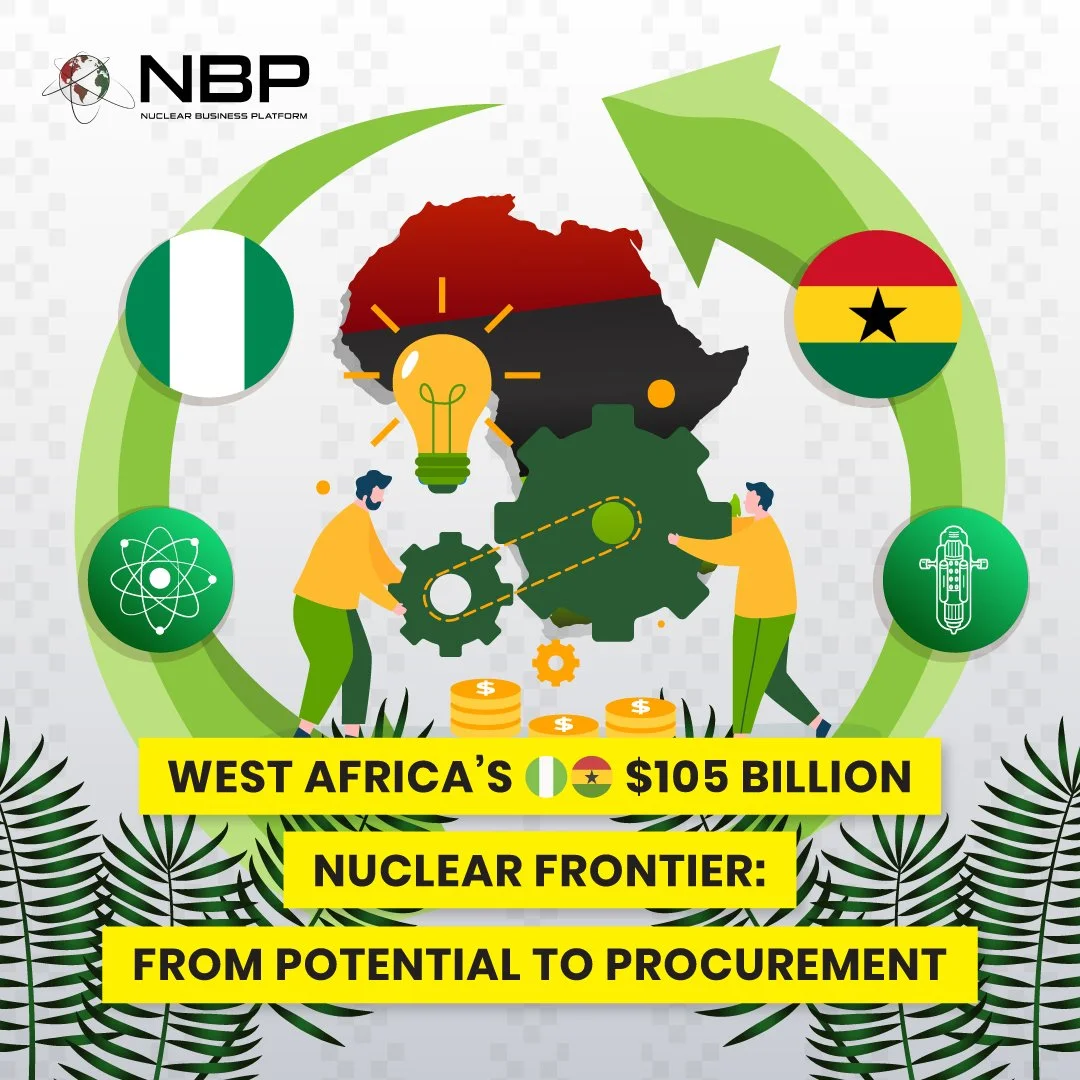
West Africa’s $105 Billion Nuclear Frontier: From Potential to Procurement
For decades, Africa’s nuclear narrative was defined more by potential than by procurement. That equation is now shifting. In West Africa, a commercially credible nuclear cluster is beginning to take shape, anchored by Ghana and Nigeria, counterbalanced by a Russian-led Sahel bloc, and reinforced by the evolving integration of the West African Power Pool (WAPP). For global nuclear vendors, fuel-cycle firms, EPC contractors, and financial advisers, this is no longer a speculative frontier. It is an early-stage market where positioning today will determine relevance tomorrow.
The Nuclear Business Platform (NBP) estimates Africa’s nuclear opportunity at approximately $105 billion through 2035, targeting 15 GW of new capacity. A substantial portion of that capital is concentrating in the West African region. The critical driving force behind this is industrial goals. While solar and wind remain essential for rural electrification, their intermittency limits their ability to support continuous processes such as mineral beneficiation, smelting, and high-value manufacturing. Baseload power remains the missing ingredient for structural industrialisation.
Ghana: A Multipolar Technology Hub
Among west african states, Ghana is the most operationally advanced. Having entered Phase 2 of the IAEA Milestone Approach in 2022, it is now undertaking the preparatory work necessary for contracting and construction. Its strategy is deliberately multipolar. By engaging American, Chinese, and French partners simultaneously, Ghana is maximizing leverage in technology transfer, workforce development, and financing.
In August 2024, Ghana Atomic Energy Commission (GAEC) signed a framework agreement with the U.S.-based Regnum Technology Group and NuScale Power to deploy a NuScale VOYGR-12 SMR plant. The project is structured not merely as an energy asset but as a regional platform. The NuScale Energy Exploration (E2) Center at the Ghana Atomic Energy Commission houses Africa’s first SMR control room simulator, positioning Ghana as a continental training hub for operators and technicians.
In parallel, Ghana is preserving optionality in large-scale reactors. In April 2024, NPG signed a framework agreement with China National Nuclear Corporation (CNNC) for an HPR-1000 (Hualong One) reactor and associated grid upgrades. An additional MoU with France’s EDF explores capacity building and potential deployment of the EPR1200. An early-to-mid 2030s timeline target is on track, contingent on financing structures and final vendor negotiations. For global suppliers, Ghana represents a rare African market where regulatory progress, technology competition, and industrial demand are advancing in parallel.
Nigeria: Institutional Reset and Modular Pragmatism
Nigeria,one of Africa’s largest economies and most populous state, has long maintained nuclear ambitions through the Nigerian Atomic Energy Commission (NAEC). What has changed is structure. Earlier gigawatt-scale ambitions with Rosatom have given way to a more modular, financially pragmatic strategy under the Ministry of Power.
Institutional reform is central. Authorities are prioritizing the establishment of a dedicated owner-operator entity to serve as the commercial backbone of the program, with a one-to-two-year horizon for formal creation. Simultaneously, a new Atomic Energy Bill is advancing to modernize outdated legislation and align Nigeria with contemporary international safety and security standards. On the technical side, site characterization at Geregu and Itu is progressing toward bankable feasibility studies. An INIR Phase 2 mission, approved for the first quarter of 2027, signals intent to move toward contracting and procurement.
Nigeria’s market significance lies in its diversified vendor engagement. It maintains multiple agreements with Rosatom, including a Project Development Agreement, while also formalizing cooperation with CNNC and Korea Hydro & Nuclear Power (KHNP). At the African Nuclear Industry Business (AFNBP) 2025, Nigeria signed an MoU with KHNP covering manpower training, plant development, and resource procurement, including access to the APR-1400 and the innovative i-SMR. This diversification enhances negotiating leverage and reduces single-vendor dependency, making Nigeria one of the continent’s most strategically contested nuclear markets.

The Sahel Cluster: Turnkey Integration and Resource Diplomacy
A distinct model is emerging in the Sahel. Following their formal exit from ECOWAS in early 2025, Burkina Faso, Mali, and Niger (now aligned under the Alliance of Sahel States (AES))have pivoted decisively toward Rosatom. Here, nuclear deployment is embedded within a broader geopolitical and resource framework.
Rosatom’s turnkey offer covers the full lifecycle: infrastructure, reactor design, fuel supply, spent fuel management, and workforce training. In June 2025, intergovernmental agreements with Burkina Faso and Mali committed Russia to assist in establishing national nuclear industries. Niger has moved further, agreeing to construct a 2,000 MW plant with Rosatom. The strategic logic is clear: despite being a major uranium producer, Niger seeks to process its own uranium domestically to break its energy paradox and advance energy sovereignty.
These agreements are closely linked to mining concessions, including a gold mining license in Burkina Faso for Rosatom subsidiary Nordgold and an invitation to develop Mali’s lithium deposits. By coupling reactor deployment with mineral access and offering government-to-government financing, Rosatom has effectively created a closed ecosystem for non-Russian vendors in the Sahel. For Western firms, the region illustrates both competitive exclusion and a broader lesson: mining demand can anchor nuclear baseload in emerging markets.
Regional Integration: The WAPP Multiplier
The West African Power Pool may ultimately be the most transformative enabler. Its goal is a unified regional electricity market allowing seamless cross-border power flows. In November 2025, WAPP achieved full-grid synchronization for four hours, connecting all member states within a single network. Permanent synchronization is targeted for mid-2026.
This milestone is commercially significant. A synchronized grid enables a regional nuclear project model in which a single large reactor can supply multiple countries via interconnectors such as the Ghana–Burkina Faso line. Shared infrastructure, regulatory coordination, and emergency preparedness can reduce the burden on individual newcomer states. For vendors, a regional off-taker pool improves bankability and allows design standardization, critical for SMR economics.
Industrial Catalysts: Mining and Manufacturing
The industrial case remains decisive. In Sub-Saharan Africa, mining accounts for roughly 50% of electricity demand, yet many operations rely on off-grid diesel generation. As ore grades decline and processing intensity increases, energy requirements are rising. Nuclear offers stable, zero-emission power insulated from fossil fuel price volatility and renewable intermittency.
Demand for lithium and cobalt (driven by the global energy transition) now intersects with carbon-border adjustment mechanisms and ESG requirements. Processing these minerals with low-carbon power is becoming a competitive necessity. Co-located SMRs serving remote mining clusters are increasingly plausible. Long-term power purchase agreements (PPAs) with mining conglomerates could bypass fragile national grids and underwrite plant economics. For EPC firms and technology providers, industrial clients may become as important as state utilities.
Commercial Entry Points
Opportunities extend beyond reactor supply. Engineering consultancies are already engaged in pre-feasibility and feasibility studies, geological surveys, and environmental assessments in Ghana and across emerging African programs such as Kenya and Uganda. As countries advance through IAEA milestone phases, demand for nuclear safety, safeguards, and regulatory expertise will intensify.
Legal and financial advisory services are equally critical. Establishing independent regulators, drafting nuclear liability frameworks, and structuring BOO or BOOT models will define project bankability.
Strategic Outlook
West Africa’s nuclear emergence is not rhetorical. Concrete agreements, synchronized grids, feasibility studies, and institutional reforms are converging. Ghana and Nigeria are pursuing multipolar engagement and modular pragmatism; the Sahel is embedding nuclear within resource-backed geopolitics. Together, these trajectories define a competitive landscape where technology, financing, and mineral strategy intersect.
For the international nuclear industry, the imperative is clear: transition from advisory positioning to bankable execution. With a $105 billion continental opportunity through 2035 and mining-driven demand accounting for roughly half of regional electricity consumption, West Africa is evolving into a foundational growth market. Platforms such as the 5th Africa Nuclear Business Platform (AFNBP) 2026, scheduled for 21–23 April in Abuja and hosted by the Nigeria Atomic Energy Commission (NAEC), will play a pivotal role in this transition by aligning procurement pathways, regulatory expectations, and investment frameworks between African stakeholders and global industry.