Three Strategies. One Region. Who Wins Latin America's Nuclear Market?
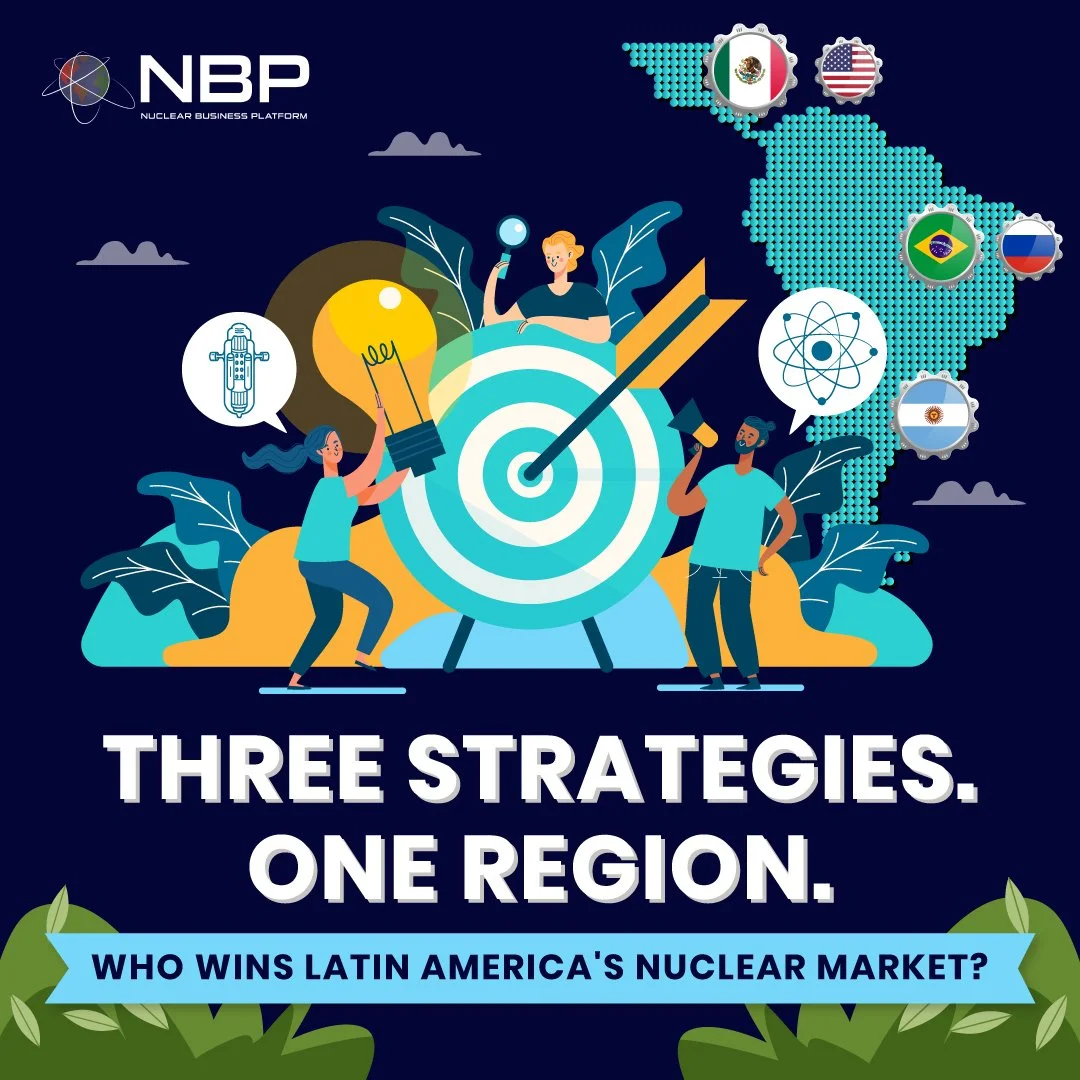
Latin America's SMR market does not yet have a dominant vendor. No technology has been selected, no construction contract has been signed, and no regional standard has been established. That is precisely what makes this market so commercially significant right now. In most emerging nuclear regions, early vendor relationships solidify quickly and late entrants face structural disadvantages that compound over time. Latin America is still in the window where those relationships are being formed, where governments are evaluating technology options rather than executing on committed choices, and where a well-positioned firm can build a regional presence that pays dividends for decades. Three distinct strategies are currently competing for that position: an indigenous development play led by Argentina, a state-backed integration model anchored by Russia through the BRICS framework, and a Western vendor campaign supported by US government financing tools.
Strategy One: Argentina's Indigenous Play for Regional Standards
Argentina has been building nuclear technology capability since 1974, when Atucha 1 became the first reactor connected to the grid in Latin America. INVAP, Argentina's technical project company, has delivered research reactors globally and its track record as a reactor exporter is internationally recognised.
The ACR-300, a 300 MWe SMR design developed by INVAP, is the centrepiece of Argentina's regional strategy. In March 2025, Demian Reidel, chairman of the council of advisors to President Milei, confirmed plans to install four ACR-300 units at the Atucha site with the first unit targeted for 2030. It is important to note that the ACR-300 remains at an early engineering stage, and independent experts have questioned the feasibility of the 2030 timeline — the political commitment is strong, but the technical development pathway is still being defined. If that deployment proceeds, Argentina would become the first country in Latin America to operate a domestically designed SMR at commercial scale.
The CAREM-25, a 29 MWe prototype integral pressurised water reactor under construction at Atucha since 2014, has first criticality targeted for 2028 following delays including a budget-driven suspension in September 2024. The combination of CAREM-25 as a demonstration asset and ACR-300 as a commercial product gives Argentina a two-stage market presence positioning it as a technology source rather than purely a technology recipient within the region.
Strategy Two: Russia's BRICS Framework and the One-Stop Model
Russia's approach to the Latin American SMR market is built around an institutional architecture rather than a single technology or bilateral relationship. Rosatom's competitive advantage globally is its comprehensive service model: technology, construction, fuel supply, operational support, and radioactive waste management delivered through a single state-backed framework. In Latin America, this model is being extended through the BRICS Nuclear Energy Platform, established in October 2024, which aims to share experience, support development of nuclear technologies among member countries, and open access to BRICS financial instruments for nuclear project development.
Brazil is the anchor of Russia's Latin American nuclear strategy. Brazil's Minister of Mines and Energy signalled in May 2025 that an SMR collaboration with Russia is expected. Brazil's National Energy Plan 2050 targets a fivefold increase in nuclear capacity to 10 GW, and Brazil assumed leadership of the BRICS Nuclear Financing Group in December 2025. The June 2025 launch of Brazil's 3 to 5 MWe containerised microreactor programme by Indústrias Nucleares do Brasil and the National Nuclear Energy Commission targets remote mining sites and isolated Amazonian communities where grid connection is impossible.
Strategy Three: The Western Vendor Campaign and Its Financing Tools
The United States and its allied vendor ecosystem are approaching Latin America's SMR market with a combination of technology and structured government-backed financing. The US EXIM Bank's Engineering Multiplier Program (EMP) provides low-interest loans for pre-project development services. The State Department's FIRST programme provides technical assistance and regulatory capacity-building support.
US vendors including NuScale and Westinghouse are the primary beneficiaries. Their competitive positioning is strongest in markets where US 123 Agreements are in place. Mexico, with its existing Laguna Verde operational relationship with General Electric and its Federal Electricity Commission (CFE) engagement in SMR feasibility discussions, represents a natural US vendor market.
The global SMR market is projected to reach USD 300 billion by 2040. Latin America, with its combination of structural energy demand, advancing indigenous capability in Argentina, BRICS-backed financing access through Brazil, and Western vendor engagement across multiple markets, is one of the regions where the early competitive positions being established now will determine commercial outcomes for the next three decades. The vendor competition is active, the market is genuinely open, and the window for establishing first-mover relationships has not yet closed.