
ASEAN's SMR Market Is Open. Four Things Vendors Must Get Right Before It Isn't.
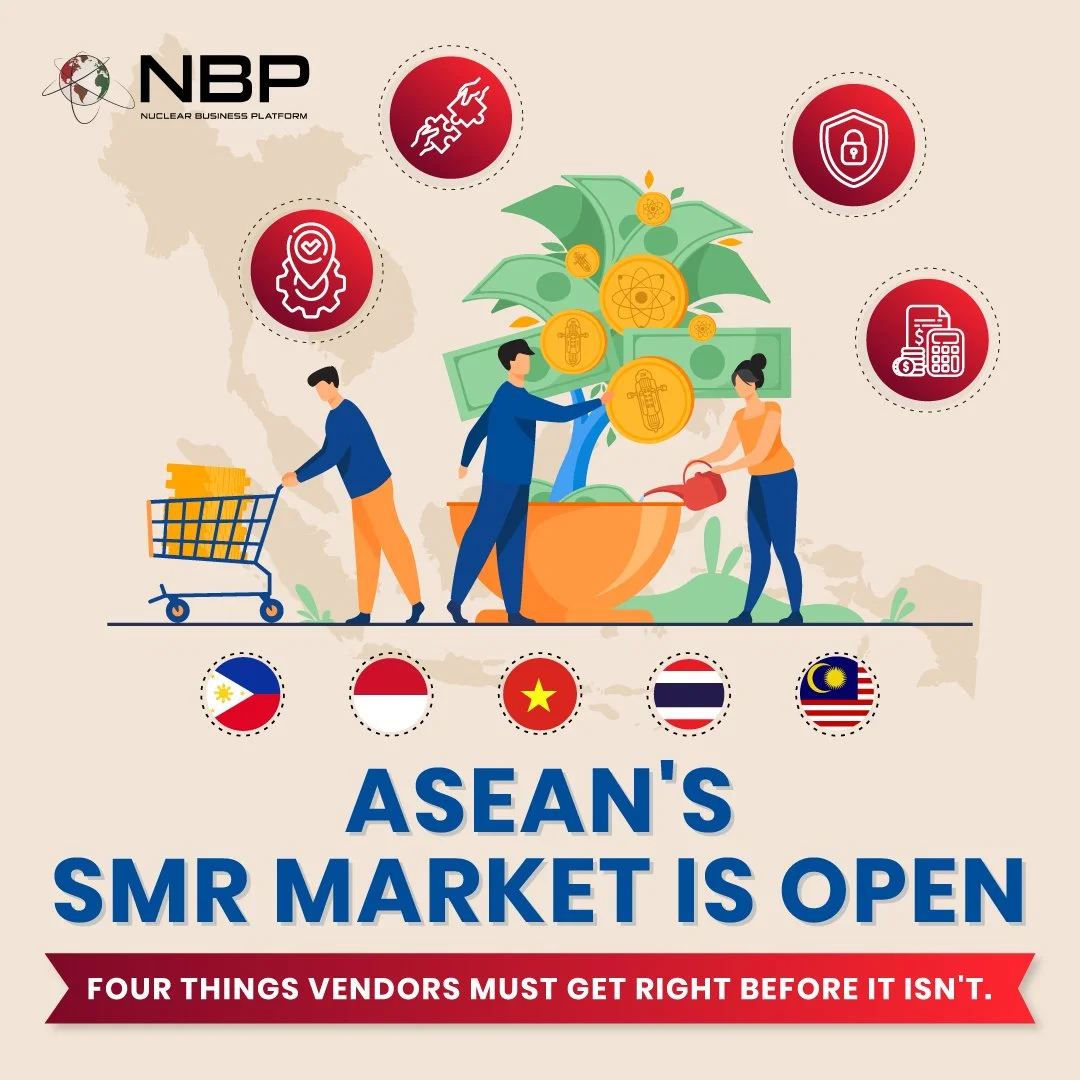
Southeast Asia's nuclear future is increasingly an SMR story. Across the region, governments are pursuing nuclear power for the first time, and few are following the traditional path of large-scale reactors. The Philippines, Vietnam, Indonesia, Malaysia, and Thailand are gravitating toward SMRs because they align more closely with the realities of Southeast Asian energy systems: smaller grids, tighter financing constraints, limited reactor sites, and growing demand for reliable low-carbon power. The Philippines targets 1,200 MW of nuclear capacity by 2032 and 4,800 MW by 2050. Vietnam's revised power development plan calls for between 4,000 and 6,400 MW by 2035. Indonesia has incorporated 500 MW of SMR capacity into its ten-year electricity plan, while Malaysia and Thailand have both identified SMRs as central to their future nuclear ambitions.
Why SMRs Are the Right Fit for ASEAN
The most fundamental reason SMRs suit ASEAN is grid size. Countries like the Philippines and Indonesia are archipelago economies where power grids are fragmented across hundreds of islands. A conventional large reactor producing 1,000 MW or more cannot be absorbed by a grid that does not have that capacity. A 100 to 300 MW SMR unit matches the absorption limits of these smaller grids precisely.
The second reason is financing. A single large reactor project requires a commitment of USD 8 to 12 billion before a single unit comes online. SMRs allow phased deployment: finance one unit, operate it, demonstrate performance, and finance the next on that track record. The third reason is siting: SMRs require a significantly smaller footprint, opening a far wider range of viable deployment locations. The fourth reason is regulatory capacity: SMR designs with standardised modular configurations allow regulators to develop licensing frameworks iteratively, reducing the institutional burden and accelerating the path to first commercial operation.
What International Vendors Must Get Right
The competitive landscape is active and structured. The US is present through FIRST programme support, 123 Agreements, and a USD 2.7 million USTDA feasibility study for Meralco in the Philippines. South Korea has built an integrated KHNP technology plus KEXIM financing model. Russia brings the only SMR with an actual operating track record — the RITM-200, derived from more than 400 reactor-years of icebreaker experience. China offers rapid deployment and state-directed financing. Four things separate vendors who will win contracts from those who will not.
First: financing. The KHNP-KEXIM-Meralco tripartite MoU is the benchmark — technology and financing as a single integrated offer. Vendors that treat financing as post-selection negotiation are misreading how decisions are made here. Second: localisation. Regional manufacturing partnerships for nuclear-grade components are a pre-qualification condition in practice, even when not written into tender documents. Third: regulatory partnership. Vendors contributing to national regulatory frameworks shape the standards their technology will be evaluated against. Malaysia and Thailand are at exactly the stage where this engagement is most valuable. Fourth: fuel supply certainty. Vendors deploying HALEU-dependent designs must arrive with a fully articulated fuel supply chain solution already in place — no assured supply means no credible bid.
The Opportunity Beyond the Reactor
No ASEAN government has a finalised nuclear waste management strategy. No country has a fully built nuclear workforce. Digital instrumentation and control systems represent a high-value manufacturing opportunity. Vietnam sits at the centre of the most significant open procurement window in ASEAN right now, with the vendor field genuinely open and the programme at exactly the stage where early engagement shapes technology selection. For international SMR vendors, the question is not whether the ASEAN market is real. It is whether the right conversations are already happening — and whether they are happening through the right platforms. NBP's Asia Nuclear Business Platform (ANBP) 2026 (24-26 November, Hanoi, Vietnam) is where the structured engagements that convert regional ambition into signed contracts are being built.