Africa: A Key SMR & Microreactor Market
At first glance, Africa is rarely where global nuclear dreams are expected to crystallise. Yet quietly a different reality is taking shape. While advanced economies debate how to retrofit nuclear into mature, congested power systems, Africa is confronting a far more elemental challenge: how to build reliable baseload electricity where grids are small, demand is rising fast, and entire industries are constrained by the absence of power. In that gap lies a market opportunity unlike any other, one that could make Africa the world’s first region to deploy small and micro modular reactors at genuine commercial scale.
This is rooted in industrial economics, infrastructure realities and unmet demand. With more than 600 million people still without electricity and nearly 40 GW of existing generation stranded by grid bottlenecks, Africa is not searching for incremental upgrades. It is searching for systems that work in the conditions that exist today. Small and micro modular reactors, designed to operate close to demand and independent of vast transmission networks, may be arriving at precisely the right moment.
A Greenfield Power Market in a World of Saturation
In Europe and North America, new nuclear projects must fight for space in saturated electricity markets, where demand growth is slow and pricing structures are tightly regulated. Africa presents the opposite profile. Large parts of the continent remain a greenfield power market, defined by structural shortages in baseload capacity and a willingness among industrial users to pay a premium for reliability.
Mining companies, manufacturers etc already spend heavily on diesel generation, absorbing high fuel costs and carbon exposure simply to keep operations running. For these customers, nuclear does not compete against cheap grid power, it competes against diesel, outages and lost productivity. This inversion of the usual market dynamics makes Africa uniquely receptive to modular nuclear systems that can be deployed quickly and scaled gradually.
Small modular reactors, typically producing under 300 MW, and microreactors are particularly suited to this environment. Built in factories and shipped to site, they reduce construction risk and allow power to be delivered directly to where it is needed, rather than waiting decades for continent-wide grid upgrades.
Industrial Demand Is Leading the Case for Nuclear
The strongest drivers of Africa’s emerging SMR market are industrial rather than residential. The continent is a global repository of the minerals required for the energy transition such as lithium, cobalt, copper and rare earths. Yet many of these resources are located in remote, landlocked regions where grid extension is prohibitively expensive.
Today, these mines operate vast diesel farms, vulnerable to fuel price volatility and supply disruptions. Micro modular reactors offer a fundamentally different proposition: Many SMR concepts enable longer refuelling cycles (typically between three and seven years) minimising downtime and reducing related costs. Some designs aim to eliminate the need for refuelling altogether during a reactor’s lifespan, which can extend up to 30 years. The Nuclear Energy Agency (NEA) suggests that micro-SMRs could be competitive with diesel generation in these remote regions, particularly as environmental, social, and governance (ESG) mandates become stricter for global commodity traders.
A similar logic is emerging in the digital economy. As Africa attracts investment in data centres and artificial intelligence infrastructure, operators are demanding power with near-perfect reliability and a low-carbon footprint. In markets where grid stability remains uncertain, SMRs can be deployed behind the meter, providing dedicated, uninterrupted power independent of public utilities.
Governments Are Moving from Talk to Execution
What distinguishes Africa’s nuclear trajectory today from previous decades is the shift from aspiration to preparation. Several countries are no longer asking whether nuclear is viable, but how it should be deployed.
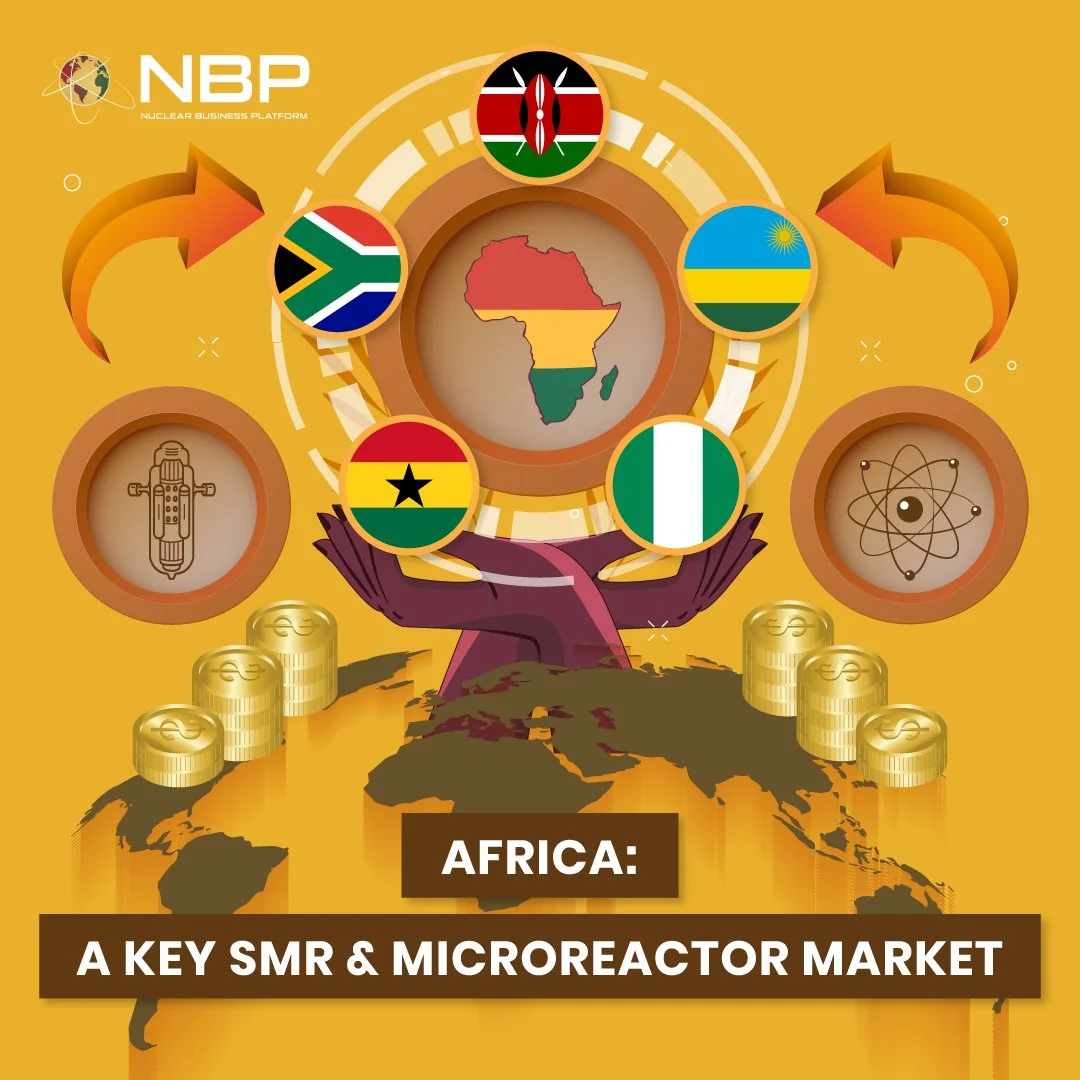
Ghana: Signed a framework agreement with Regnum Technology Group and NuScale Power which could lead in the future to deploy up to 12 NuScale VOYGR-12 SMR modules. Each unit will initially generate 50 MW, scalable to 77 MW, delivering nearly 924 MW in total. Launched West Africa’s first NuScale Energy Exploration Centre (E2 Centre) in Accra, featuring full-scale simulation and a welding certification lab, with U.S. government support and academic linkage to Texas A&M University. Targeting 1,000 MW of nuclear capacity by 2034 and negotiating a U.S. “123 Agreement” for long-term civilian nuclear cooperation.
South Africa: exploring HTMR-100, a locally designed high-temperature SMR. Backed by local firms and Chinese partners, with a financing target of nearly US$500 million. Koya Capital and Stratek Global are leading fundraising and project execution.
Rwanda: Positioning itself as an East African microreactor testbed, with agreements signed with NANO Nuclear Energy (U.S.) and Dual Fluid (Canada–Germany) to pilot 2–10 MW microreactors for off-grid communities and specialised industries.
Nigeria: Advancing regulatory preparedness by modernising nuclear frameworks and joining the U.S.-backed FIRST program, focused on readiness for advanced nuclear and SMR deployment.
Kenya: Targeting its first nuclear plant by 2034. Hosted Africa’s first IAEA-led SMR School in May 2025 and initiated national SMR feasibility studies.

A New Arena of Global Nuclear Competition
Africa’s modular nuclear potential has not gone unnoticed by global powers. Russia’s flagship El-Dabaa project in Egypt remains the continent’s largest nuclear undertaking. The United States is expanding engagement through SMR partnerships, regulatory support and workforce training, while China is aggressively positioning itself as both a domestic nuclear superpower and a future exporter.
This competition is accelerating technology transfer, financing creativity and political attention. For African governments, it creates leverage: the ability to diversify partners, negotiate localisation, and embed nuclear into broader industrial strategies.
Why Africa Could Scale First
The paradox of Africa’s energy deficit may be its greatest advantage. With power systems still being built, modular nuclear can be integrated without displacing entrenched incumbents. Rapid demand growth means reactors do not need to compete for market share; they can meet unmet needs. For industrial users already paying high prices for unreliable power, SMR economics are often more compelling than in mature markets.
Research into SMR economics shows that while First-of-a-Kind (FOAK) units face high overnight capital costs, Nth-of-a-Kind (NOAK) deployments benefit from standardisation and factory learning. As a result, NOAK units are expected to achieve a Levelized Cost of Electricity (LCOE) competitive with natural gas and renewables, particularly when the value of 24/7 reliability is factored in.
Africa’s market structure supports phased SMR deployment, enabling limited early revenue generation and operational validation, improving cash-flow timing and risk management. Development banks and regional power pools are beginning to explore financing models aligned with this modular approach.
A Continental Test Case for the Nuclear Future
Africa is often portrayed as a late adopter of advanced energy systems. In the case of small and micro modular reactors, it may prove to be the opposite. By aligning nuclear technology with real-world constraints (weak grids, dispersed demand and acute industrial urgency) the continent is shaping a market that increasingly resembles the future global norm rather than an exception.
If successful, Africa will not simply import small modular reactors. It will demonstrate how they can be deployed at scale, financed creatively and integrated into economies where energy is not a convenience but a catalyst for industrial transformation. Projections from the Nuclear Business Platform suggest the continent could generate as much as 15 GW of nuclear energy by 2035, a figure that underscores both the scale and depth of unmet demand.
That momentum will be tested and refined at the 5th Africa Nuclear Business Platform (AFNBP) 2026, scheduled for 21–23 April in Abuja, Nigeria, and hosted by the Nigeria Atomic Energy Commission. The high-level gathering is expected to convene policymakers, investors, global vendors and regional stakeholders to align investment frameworks, secure long-term partnerships and clarify procurement pathways. In doing so, Africa may move from being a promising market for modular nuclear to becoming its first true proving ground, and a blueprint others may soon follow.