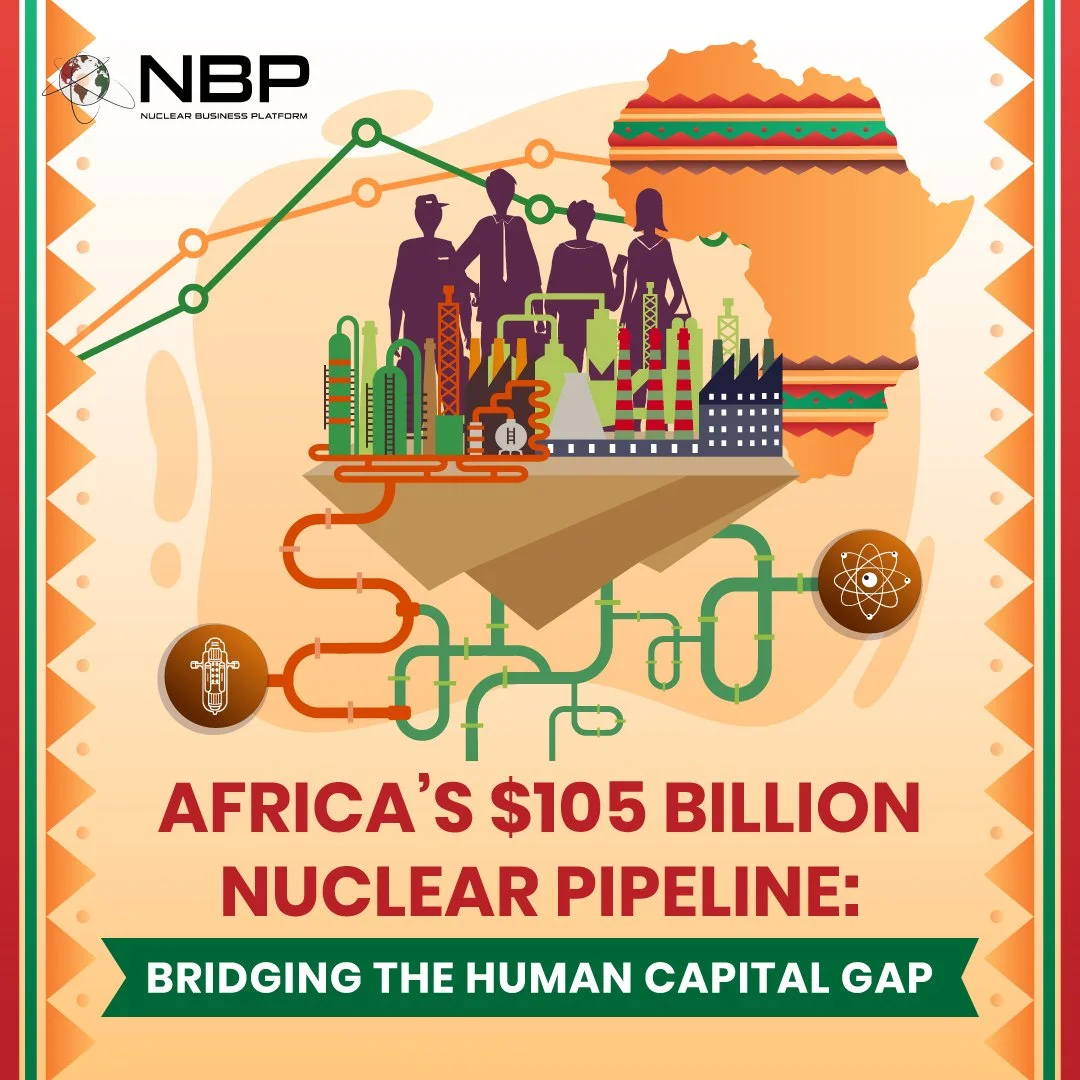
Africa’s $105 Billion Nuclear Pipeline: Bridging the Human Capital Gap
Africa’s nuclear energy ambition has moved decisively from policy intent to institutional execution. Projections indicate the continent could add up to 15,000 MW of nuclear capacity by 2035 with an investment pipeline of approximately $105 billion. The financing frameworks are maturing, technology choices are crystallising around Small Modular Reactors, and political commitments are deepening across a growing number of nations. Yet one of the most consequential variables in this entire equation is not the reactor design, the financing structure, or the regulatory framework. It is the workforce, and the workforce gap is the single greatest systemic risk to the delivery of every megawatt in that pipeline.
The global nuclear sector is already operating in a tightening labour market. 46% of surveyed nuclear companies report hiring difficulties causing operational bottlenecks and project delays. 25% of the global nuclear workforce is over the age of 55, compressing the available pool of experienced professionals at precisely the moment Africa’s build programme is accelerating. For African nations, most of which are newcomer markets developing nuclear capability from a relatively low baseline, the challenge is compounded: domestic talent must be built from the ground up while simultaneously competing for international expertise that is already in short supply globally.
The Financial Cost of Getting the Workforce Wrong
The connection between workforce readiness and project viability is financial and direct. Labour shortages in technical and vocational roles are projected to be 35% higher by 2030 than they are today. When a nuclear construction project is delayed by the absence of specialist welders, nuclear-grade pipefitters, or project managers experienced in multi-billion-dollar mega-projects, costs compound rapidly. Interest During Construction on a $30 billion project can run to billions in a single year of delay, particularly in African markets where interest rates can exceed 12%. Fixed site overheads continue accruing regardless of construction progress, and commissioning delays mean utilities cannot begin recovering investment through electricity revenues.
Projects staffed predominantly by expatriate expertise cost 10% to 20% more in direct labour alone, with payments in foreign currency compounding balance sheet risk. Labour productivity in recent nuclear builds has been found to be up to thirteen times lower than industry expectations. And for Africa’s first-of-a-kind projects, investing in the right workforce from the outset is the primary mitigation against this risk. The support training process area alone is projected to account for approximately 36% of total operational nuclear personnel, reflecting the scale of knowledge transfer embedded in every project in the pipeline.
Who Is Moving: Africa’s Nuclear Tiers
THE ANCHORS: SOUTH AFRICA, GHANA, EGYPT
South Africa remains the continent’s only operational nuclear nation, with a mandate for 5,200 MW of new capacity by 2039 under IRP 2025 and a revived Pebble Bed Modular Reactor programme under Necsa signalling indigenous SMR ambition with regional export potential.. Ghana is establishing itself as a continental training hub through the US-led FIRST programme, housing Africa’s first SMR control room simulator at the NuScale Energy Exploration Centre, a development with a significant multiplier effect for operator training across West Africa. Egypt anchors the North African pipeline with El Dabaa under active construction.
THE FAST MOVERS: KENYA, RWANDA, ETHIOPIA, UGANDA
Kenya targets its first 1,000 MW plant in Siaya County by 2034, with a long-term ambition of 20,000 MW by 2040. Rwanda has completed its IAEA INIR Phase 1 mission, currently has 234 specialists in training, and is on course for an operational SMR by the early 2030s. Ethiopia formally launched its programme in September 2025, committing to 2,400 MW through two reactors under a comprehensive agreement with Rosatom covering feasibility through to human resource development. Each of these nations is building the regulatory, institutional, and human capital infrastructure that underpins credible project delivery.
SMRs, Grid Synchronisation, and the Regional Multiplier
The pivot to SMRs across Africa’s pipeline is as much a workforce strategy as a technology choice. Designed for factory fabrication and modular on-site assembly, SMRs shift the labour profile away from the massive civil construction workforce that characterises gigawatt-scale builds, making workforce planning more targeted and training investment more efficient. In November 2025, the West African Power Pool (WAPP) achieved full grid synchronisation, allowing a single reactor in Ghana or Nigeria to supply electricity across multiple neighbouring nations through existing interconnectors. By spreading construction costs and electricity output across a regional customer base, the financial case for each nuclear project strengthens considerably and workforce training investments become continental assets rather than purely national ones.
The Human Capital Imperative Is the Market
The $105 billion nuclear pipeline in Africa will be built by people. The quality, availability, and cost of those people will determine whether each project delivers on schedule, within budget, and to the safety standards that nuclear demands. Training firms, simulation technology providers, vocational certification bodies, regulatory consultancies, STEM education partners, and specialist engineering recruiters are not peripheral to Africa’s nuclear story. They are structurally embedded in its critical path. Platforms such as the Africa Nuclear Business Platform’s 5th Edition (AFNBP 2026), hosted by the Nigeria Atomic Energy Commission (NAEC) in Abuja, Nigeria, from 22–23 April 2026, are where stakeholders converge to shape the deals and partnerships that will ultimately determine how this human capital is developed, deployed, and sustained across the continent.
Africa’s nuclear workforce gap is not an obstacle standing between ambition and delivery. It is the most consequential chapter of the $105 billion story, the one that determines whether 15,000 MW of clean baseload power reaches the grids of a continent that needs it, and whether the economic dividends of that capacity are captured domestically or exported alongside the foreign expertise that built it. The nations that build the deepest human capital foundations now will not only commission their plants on schedule, but they will define the training models and supply chain relationships that shape Africa’s nuclear industry for the next sixty years.