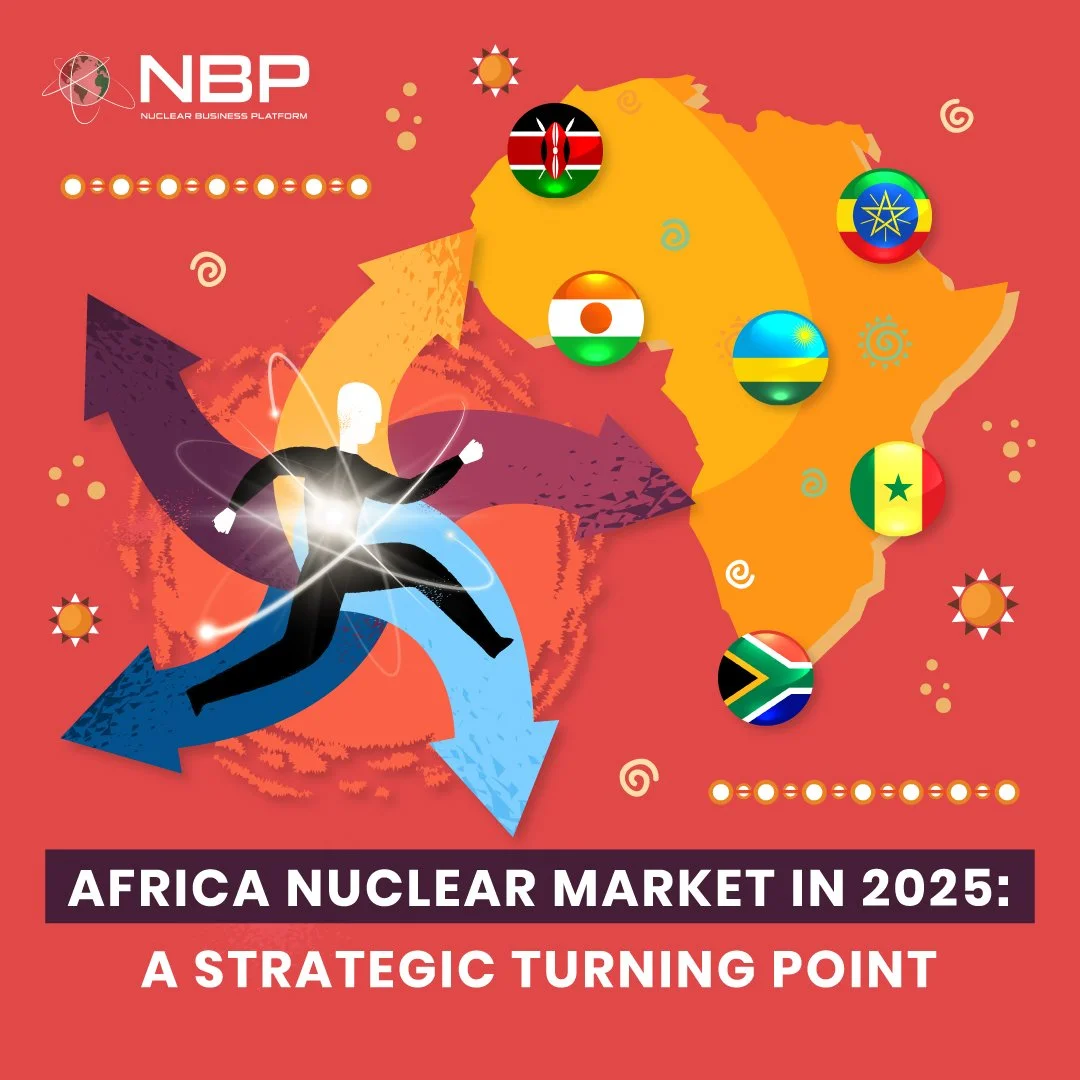
Africa Nuclear Market in 2025: A Strategic Turning Point
In 2025, Africa’s nuclear energy sector entered a defining new era — propelled by firm policy commitments, clearer procurement pathways, and a decisive shift from long-standing feasibility studies to concrete execution. With almost 600 million Africans still lacking access to electricity, the urgency has never been greater. Driven by rapid urbanization, demographic growth, and accelerating industrial demand, the continent’s total electricity-generating capacity is forecast to grow 47% by 2030 and nearly sevenfold by 2050, underscoring the scale of the investment challenge ahead.
As national roadmaps become clearer and technology partnerships mature, Africa is emerging as one of the most compelling and strategically significant nuclear growth markets globally. Against that backdrop, 2025 delivered a series of landmark milestones — not only promising in their ambition but commercially transformative for investors, EPC firms, technology providers, and governments alike. Below are the key developments and their implications.
1, South Africa: Anchoring the Continent’s Nuclear Future (5,200 MW Mandate)
South Africa entered 2025 with its most decisive nuclear commitment to date. The Integrated Resource Plan (IRP) 2025 introduced in October by Minister of Electricity and Energy Dr. Kgosientsho Ramokgopa was formally declared binding government policy, eliminating the uncertainty that derailed previous procurement cycles. The plan mandates 5,200 MW of new nuclear capacity by 2039, with the first 1,200 MW targeted by 2036, defining a long-term, predictable procurement schedule essential for global EPC participation.
The IRP is part of a wider R2.2 trillion (USD $128 billion) national energy investment strategy covering nuclear, gas, and renewables equivalent to nearly 30% of GDP and intended to support a 3% GDP growth target by 2030. The energy mix includes 16 GW of gas-to-power, 34 GW of wind, and 25 GW of solar PV, confirming nuclear as the stabilizing baseload backbone. Strategically, the government has identified Thyspunt, Bantamsklip, and Duynefontein as pre-approved nuclear sites, accelerating the path to construction once vendors are selected.
Moreover, in a move that signals industrial ambition, South Africa is reviving its Pebble Bed Modular Reactor (PBMR) program (previously shelved) under the stewardship of Necsa to lead R&D and SMR development for both domestic deployment and regional export.
IRP 2025 is therefore both an energy roadmap and an economic intervention, requiring bidders to meet stringent local content, training, and industrialization requirements as South Africa simultaneously secures large-scale reactor deployment and develops indigenous SMR capabilities for future domestic use and regional export.
2, Ethiopia: Fast-Tracking 2,400 MW Capacity through Strategic Alignment
Momentum around Ethiopia’s energy transition reached a decisive turning point in September 2025, when Prime Minister Abiy Ahmed formally launched the nation’s nuclear energy program and confirmed plans to deploy 2,400 GW through two 1,200 MW reactors. With commissioning targeted between 2032 and 2034, Ethiopia has positioned nuclear power as a central pillar of its future energy mix.
Driving the initiative is a comprehensive agreement with Rosatom, signed during bilateral talks in Moscow. The accord gives Rosatom a broad mandate — from feasibility assessments and infrastructure build-out to HR development and joint working groups. By leveraging an integrated vendor model, Ethiopia is de-risking its rollout, though this structure does grant early advantage to Rosatom and may raise barriers for future competitors.
In October 2025 the Council of Ministers approved the establishment of the Ethiopian Nuclear Energy Commission (ENEC), responsible for nuclear oversight across power generation, healthcare, and industrial applications. The appointment of Dr. Sandokan Debebe as Chief Commissioner underscores strong top-level commitment.
3, Kenya: From Feasibility to Pre-Procurement, with Vendor Diversification
Kenya’s nuclear ambitions entered a decisive operational stage in July 2025, when the Nuclear Power and Energy Agency (NuPEA) issued a Request for Information (RFI) to global reactor vendors. This marked the country’s transition from feasibility discussions to formal pre-procurement evaluation. The government aims to deploy an initial 1,000 MW nuclear unit, with a broader, long-term target of more than 20,000 MW by 2040. The program is positioned as essential for enhancing energy security, particularly as Kenya continues to rely on electricity imports from Ethiopia during peak demand periods.
Significant progress has also been made in siting preparations. NuPEA identified eight candidate locations within Siaya County near Lake Victoria, including Ugambe, Sirongo, and Dagamoyo. The proximity to Lake Victoria is strategic, ensuring adequate cooling water availability to sustain a large-scale nuclear power program.
Capacity development and knowledge partnerships are also accelerating. In September 2025, Kenya signed a Memorandum of Understanding (MoU) with the Korea Atomic Energy Research Institute (KAERI), targeting research capability expansion and support for the Kenya Nuclear Research Reactor (KNRR). This partnership reinforces Kenya’s intent to strengthen human capital and technical readiness.
Notably, Kenya is pursuing a vendor diversification strategy. By opening the RFI process to global bidders while simultaneously cultivating domestic technical competence, Kenya avoids premature lock-in to a single vendor or technology. This structure improves future negotiating leverage, enables stronger regulatory oversight, and better positions the country to select an optimal financing and technology model for its first nuclear power plant.

4, Niger: Confirming the BOOT Model and Resource Security
In 2025, Niger’s nuclear ambitions moved from concept to concrete policy. Presidential approval and publication of the national nuclear white paper formally elevated nuclear power to state-level strategic priority. The roadmap calls for 2 × 1,000 MW pressurized water reactors (PWRs) by 2032, signaling a preference for proven, large-scale technology. The site has been decided already.
On the financial front, the government will look at a Build-Own-Operate-Transfer (BOOT) model, shifting upfront risk and capital cost to private investors while maintaining long-term control through eventually assuming plant ownership. Institutional readiness is progressing in parallel: the regulatory authority is operational, and work is underway to establish the plant operator, aligning with IAEA-recommended infrastructure sequencing.
Niger’s strategy also leverages its unique natural advantage. As one of the world’s major uranium producers, the country’s cooperation agreement with Russia suggests a mutually beneficial model potentially linking nuclear power deployment to uranium resource access—a structure comparable to strategic commodity-exchange frameworks used in other emerging nuclear markets.
5, Continental Diplomacy: The Tripling Declaration and Emerging Markets
Momentum for nuclear development across Africa accelerated in 2025, marked by a significant diplomatic advancement at COP30 in Belém, Brazil. During the conference, Rwanda and Senegal joined the Declaration to Triple Nuclear Energy Capacity by 2050, expanding the number of African signatories and reinforcing nuclear energy as a legitimate pathway for climate action, electrification, and industrialization across the continent.
This elevated political alignment carries financial weight. By signaling stability and long-term sector endorsement, the declaration strengthens investor confidence and is expected to ease access to support from Development Finance Institutions (DFIs), export credit agencies, and sovereign investment partners, especially for early regulatory development and feasibility stages.
The commitments made by Senegal and Rwanda also accelerate the continental shift toward Small Modular Reactors (SMRs) as the preferred technology for emerging and fragmented grids. Senegal’s plans under Vision Senegal 2050 formally position SMRs as the optimal deployment route—offering scalability, reduced upfront capital exposure, shorter build times, and compatibility with moderate grid capacities. Rwanda’s alignment builds on its existing institutional base, notably the Rwanda Atomic Energy Board, active since 2020 in research, training, and foundational nuclear governance.
Moving Ahead: A Market on the Cusp of Transformation
Africa’s nuclear energy landscape is entering a defining moment, and the coming years “especially 2026” will be pivotal for shaping large-scale investment, technology deployment, and long-term energy security. With clear policy direction, vendor engagement, and financing structures now emerging across the continent, nuclear energy is transitioning from planning to executable strategy. This shift is strengthening investor confidence, reducing sovereign and political risk, and creating a predictable market environment attractive to global technology providers, EPC companies, financiers, and nuclear fuel-cycle stakeholders.
According to the Nuclear Business Platform (NBP), Africa has the potential to deploy 15 GW of nuclear capacity by 2035, representing a commercial opportunity estimated at over USD 105 billion across construction, manufacturing, component supply, training, safety regulation, and long-term operations. The next major catalyst in this trajectory will be the 5th Africa Nuclear Business Platform (AFNBP) 2026, scheduled for 21–23 April in Abuja, Nigeria, hosted by the Nigeria Atomic Energy Commission (NAEC). This high-level gathering will convene policymakers, investors, global vendors, and regional stakeholders to align investment frameworks, secure long-term partnerships, and refine procurement pathways. Africa’s nuclear sector is no longer a distant aspiration — it is now an actionable and investable frontier.