
India’s $214 Billion Nuclear Opening: How the SHANTI Act Dismantles Monopoly to Unlock Global Investment
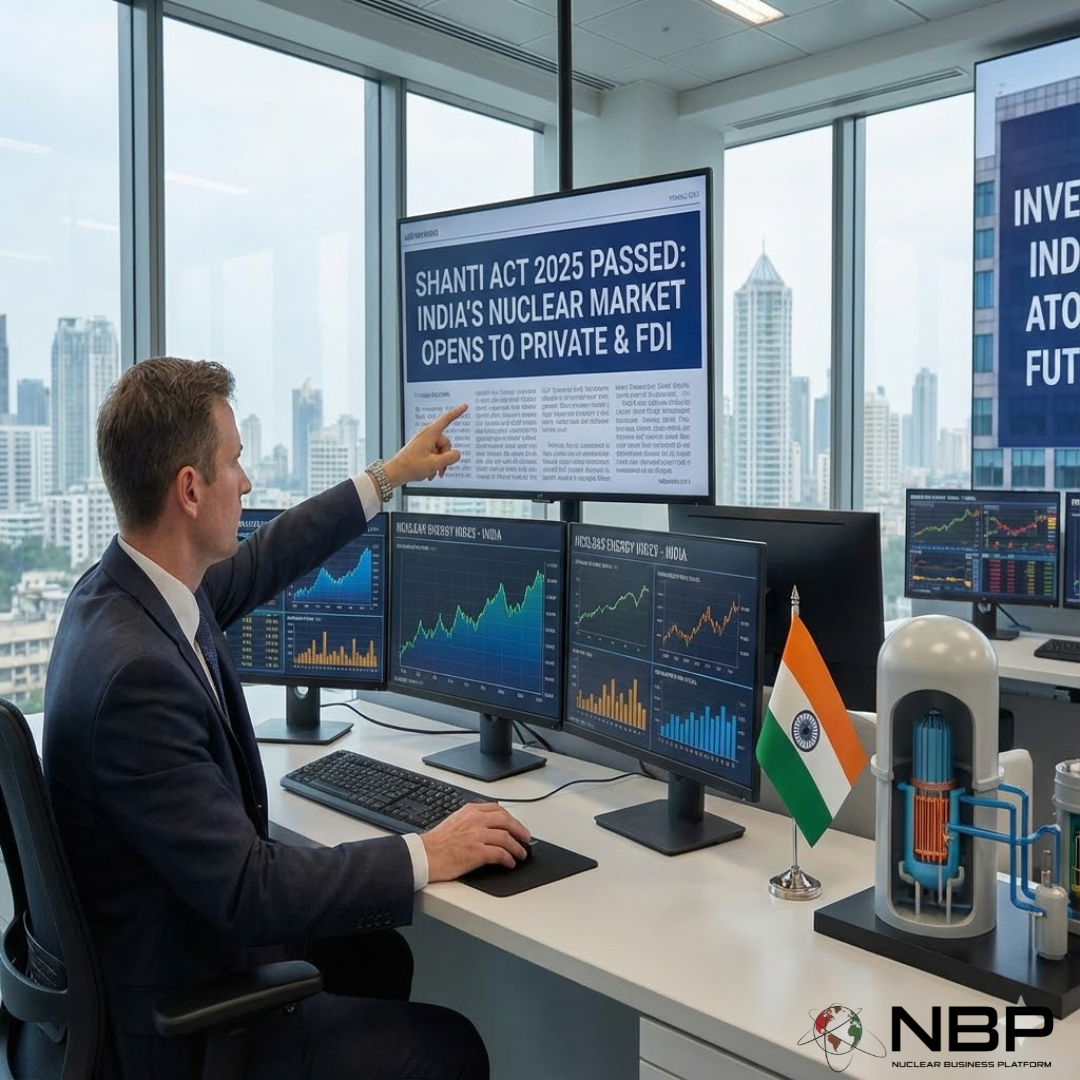
With presidential assent granted by President Droupadi Murmu, the Sustainable Harnessing and Advancement of Nuclear Energy for Transforming India (SHANTI) Bill has completed the formal legislative process. Passed during Parliament’s Winter Session, the legislation consolidates the legal framework governing India’s civil nuclear sector and provides for the participation of private entities within a regulated structure.
This final step matters. For international nuclear vendors, investors, EPC firms, and technology partners, presidential assent eliminates residual political and legal ambiguity and converts a long-discussed reform into an enforceable market reality. What is now in place is the most consequential restructuring of India’s nuclear sector since independence—one that dismantles a state monopoly, redefines liability, and repositions India as an investable nuclear market aligned with global norms.
The reform does not merely liberalise an industry. It redraws the boundary between sovereign control and market participation in one of the world’s most capital-intensive energy sectors.
From Closed System to Market Architecture
For more than six decades, India’s civil nuclear programme functioned as a tightly controlled ecosystem shaped by the Atomic Energy Act of 1962, which replaced the earlier 1948 framework and established the legal foundations of the country’s nuclear enterprise. The Act vested sweeping authority in the Central Government to regulate atomic energy for peaceful purposes, ensuring strict control over research, development, and the use of nuclear materials. While this architecture was essential in the early years for strategic stewardship and safety, it also structurally limited market participation.
Incremental amendments to the Atomic Energy Act in 1986, 1987, and later in 2015 signalled India’s gradual recognition of this constraint. These changes permitted greater participation by government companies and select joint ventures in nuclear power generation, reflecting an intent to expand capacity while preserving sovereign oversight. Yet ownership and operational control of nuclear power plants remained effectively confined to Nuclear Power Corporation of India Ltd (NPCIL) and BHAVINI. Private firms—domestic or foreign—continued to operate at the margins, restricted to construction contracts and component supply, without ownership rights, operational authority, or long-term revenue visibility.
SHANTI decisively moves beyond this incrementalism. It replaces a state-dominated model with a regulated market architecture in which private companies, joint ventures, government enterprises, and authorised entities are permitted to construct, own, operate, and decommission nuclear facilities, subject to licensing and safety authorisation. Private participation in nuclear fuel transport is allowed, while the state retains sovereign control over strategically sensitive activities such as uranium enrichment, spent fuel management, and heavy water production. This is not deregulation; it is deliberate market formation—one that preserves strategic control while enabling scale, capital mobilisation, and technology partnership.
The reform is driven by necessity as much as intent. India’s stated objective of expanding nuclear capacity from 8.8 GW today to 100 GW by 2047 under the Viksit Bharat strategy implies cumulative investment requirements of approximately $214 billion. SHANTI acknowledges a structural reality long recognised by global industry: expansion at this magnitude cannot be delivered through public capital and state operators alone. By correcting legacy legal constraints embedded in earlier nuclear laws, the Act creates the conditions for sustained private investment, international collaboration, and industrial-scale deployment aligned with global nuclear market practices.
Liability Reform: Aligning India with Global Nuclear Practice
Among SHANTI’s provisions, liability reform carries the greatest significance for international participation. The Civil Liability for Nuclear Damage Act of 2010 had been widely regarded as incompatible with global nuclear norms, particularly due to its statutory provision allowing operators recourse against equipment suppliers. This feature complicated insurance coverage, constrained project finance, and effectively deterred foreign reactor vendors.
SHANTI removes supplier liability and replaces the earlier flat operator liability cap of ₹1,500 crore with graded caps linked to reactor capacity, rising to ₹3,000 crore for large reactors. The government has emphasised that victim compensation remains protected through a multi-layered mechanism, while negligence and penal provisions continue to apply.
The international signal was immediate. Two days after Parliament cleared SHANTI, the United States enacted its National Defence Authorisation Act (NDAA), directing the U.S. Secretary of State to engage India under the U.S.–India Strategic Security Dialogue to assess implementation of the 2008 Indo-U.S. nuclear agreement and align India’s domestic liability regime with international standards. The timing underscored how closely global stakeholders were tracking India’s reform trajectory.
For American and French nuclear companies that have remained commercially constrained despite long-standing interest, SHANTI materially lowers entry barriers. More broadly, it signals that India is prepared to operate within internationally recognisable risk-sharing frameworks.

Regulatory Architecture: Strengthening Credibility Through Institutional Authority
SHANTI grants statutory status to the Atomic Energy Regulatory Board (AERB), significantly strengthening India’s nuclear regulatory framework. The AERB is empowered to inspect facilities, investigate incidents, issue binding directions, and suspend or cancel operations in cases of non-compliance. Safety oversight is embedded across the entire lifecycle of nuclear facilities—from construction and operation to transport, decommissioning, and waste management. The Act also establishes an Atomic Energy Redressal Advisory Council and a specialised nuclear disputes tribunal, adding clarity and formal dispute-resolution mechanisms to the regulatory ecosystem.
For international industry, this institutional architecture provides regulatory predictability and confidence. A unified, legally empowered regulator, supported by dedicated adjudicatory bodies, creates a stable operating environment for a diversified operator landscape. Clear licensing authority, lifecycle oversight, and enforceable safety standards position India’s nuclear sector to operate in line with globally recognised regulatory practices.
SMRs: Where Reform Meets Global Industrial Logic
SHANTI coincides with a strategic pivot in India’s nuclear roadmap toward parallel deployment of large reactors and small modular reactors (SMRs).
At Tarapur, the Bhabha Atomic Research Centre (BARC) is developing a 200 MW Bharat Small Modular Reactor and a 55 MW SMR for energy-intensive industries, remote regions, and replacement of retiring fossil-fuel plants. A 5 MW high-temperature gas-cooled reactor planned at BARC’s Visakhapatnam campus is intended to support hydrogen production, linking nuclear power with emerging clean-energy value chains.
For global industry, the appeal of SMRs lies in standardisation, serial manufacturing, and continuous deployment. SHANTI enables precisely this model by allowing private capital, manufacturing scale, and long-term order visibility—conditions essential for SMR economics.
Market interest is already emerging. The Adani Group has reportedly held discussions with the Uttar Pradesh government on deploying eight 200 MW SMRs. Tata Power, the Naveen Jindal Group, and Indian Railways have indicated intent to participate in nuclear projects under the new framework.
Supply Chains: From Strategic Programme to Industrial Platform
One of SHANTI’s most underappreciated implications lies in supply-chain transformation. If India is to position itself as a competitive SMR manufacturing base, nuclear components must transition from bespoke procurement to industrial-scale production. The Department of Atomic Energy has initiated localisation of critical elements, including reactor pressure vessel steel forgings and precision control drive assemblies. Domestic qualification of low-alloy nuclear-grade forgings marks a significant breakthrough in addressing persistent construction bottlenecks.
Engineering firms are also expanding their role. Engineers India Limited (EIL) has entered nuclear system design and structural engineering under a memorandum of understanding with NPCIL. This reflects a broader shift: nuclear power is evolving from a state-contained strategic programme into a multi-firm industrial category involving EPC contractors, fabrication specialists, and high-precision manufacturers.
The emerging deployment model is structurally significant. Private companies contribute capital, land, and utilities, while NPCIL retains responsibility for licensing, design authority, fuel supply, and operational safety—preserving sovereign oversight while enabling industrial scale.
International Collaboration and Technology Integration
SHANTI strengthens India’s positioning within the global nuclear ecosystem and reinforces its long-standing bid for membership in the Nuclear Suppliers Group (NSG), which governs nuclear trade estimated at $40 billion annually. The earlier liability framework had projected India as commercially hostile to foreign suppliers; the new law corrects that perception.
Technology collaboration is already expanding. The U.S. Department of Energy has approved SMR technology transfer through Holtec International, enabling Tata Consulting Engineers, Holtec Asia, and Larsen & Toubro to participate in a transnational nuclear manufacturing corridor. Holtec’s plan to deploy up to 200 SMRs in India positions the country as a potential global manufacturing hub.
Parallel engagements with Russia’s Rosatom on thorium-linked SMRs and floating nuclear plants, and with French partners on reactor co-design, reinforce India’s emergence as a strategic nuclear partner rather than a closed domestic market.
A Message to the Global Nuclear Industry
For international developers, suppliers, and long-horizon investors, SHANTI represents a structural correction long overdue. It aligns India’s nuclear framework with global investment norms, unlocks industrial participation, and converts a market of theoretical scale into one with executable architecture.
Parliament and the President have articulated intent with clarity. The commercial value of this reform will now be determined by the speed, coherence, and discipline of implementation.
Executed decisively, SHANTI can enable India to operate its nuclear sector at an industrial scale, anchor global supply chains, and contribute meaningfully to energy security, decarbonisation, and advanced technology leadership. More than reforming a domestic industry, it positions India as an active, credible participant in the global nuclear economy.