From Policy to Power: Africa’s Nuclear Market Readiness
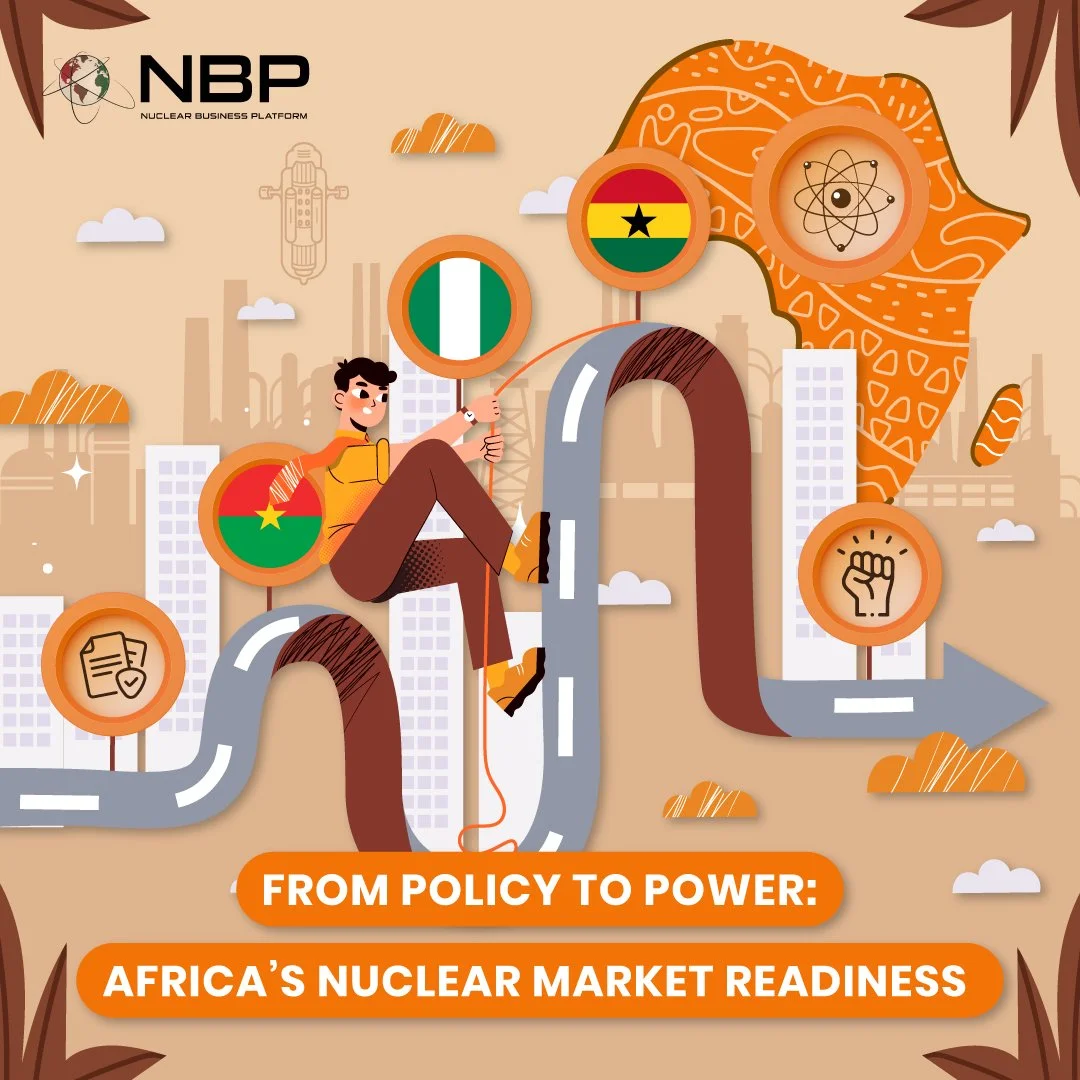
Africa’s nuclear energy discussion is shifting toward execution. What is changing is not political interest, but the emergence of countries that are beginning to convert policy intent into institutional capacity and market readiness. Ghana, Nigeria, and Burkina Faso are significant not only on their own terms, but because they reflect different stages of nuclear development now visible across the continent.
As electricity demand accelerates and grid reliability becomes a constraint on industrial growth, nuclear energy is increasingly assessed as a strategic component of long-term energy planning rather than a theoretical option. Projections cited by the Nuclear Business Platform (NBP) indicate that Africa could add up to 15,000 MW of nuclear capacity by 2035, representing an investment opportunity of approximately USD 105 billion. The core question is no longer whether nuclear power is being considered, but which national programs are progressing from policy frameworks to executable, bankable markets. Taken together, Ghana, Nigeria, and Burkina Faso provide a cross-section of how Africa’s nuclear sector is developing at different levels of preparedness.
Ghana: Moving from Planning to Construction Readiness
Ghana currently represents one of the most advanced nuclear power programs on the continent. Dr. Stephen Yamoah, Executive Director of Nuclear Power Ghana (NPG), emphasized that the country is in the mid-to-late stage of Phase 2 of the IAEA Milestone Approach, with the transition to Phase 3 now clearly in sight. As the designated owner-operator organization, NPG is coordinating closely with institutions such as the Ghana Atomic Energy Commission to consolidate regulatory, technical, and institutional readiness.
Crucially for industry observers, Ghana has moved well beyond conceptual planning. All key institutions and regulatory bodies are now in place, and engagement with international vendors is no longer exploratory but targeted. Specific reactor technologies and project delivery models have been identified, and discussions are underway to ensure that the chosen structure is commercially and technically manageable for both Ghana and its vendor partners.
Public engagement has also emerged as a defining pillar of Ghana’s strategy. Dr. Yamoah underscored that without social acceptance, even the most technically sound nuclear project risks failure, a recognition that aligns closely with global best practice. From a project development standpoint, Ghana is now approaching the critical phase of site investigation and characterization, a step that signals genuine momentum toward construction readiness.
Under the NBP categorization, Ghana falls within Tier 1 countries, those with firm government commitment and defined timelines to start or expand nuclear power programs. This classification is increasingly reflected in the program’s operational posture rather than mere policy intent.
Nigeria: Scale, Sovereignty, and a Broadening Nuclear Portfolio
Nigeria’s nuclear ambitions are driven by scale. With a population approaching 250 million and persistent electricity shortages constraining industrial growth, nuclear energy is being framed as a necessity rather than an option. Mr. Awwal Bisallah of the Nigeria Atomic Energy Commission (NAEC) reaffirmed that the country is fully aligned with the IAEA Milestone Approach and has been methodically working through the 19 infrastructure issues required for deployment.
Nigeria’s first Integrated Nuclear Infrastructure Review (INIR) mission in 2015 marked an important baseline, and the country has since advanced into more concrete preparatory activities. Two sites (Geregu in Kogi State and Itu in Akwa Ibom State) have been identified for the country’s first nuclear power plants, with preliminary feasibility studies and extensive site characterization already underway.
From a market perspective, Nigeria stands out for its breadth of international engagement. The country has signed multiple agreements with Rosatom, including a Project Development Agreement, while also formalizing cooperation with China National Nuclear Corporation (CNNC) and Korea Hydro & Nuclear Power (KHNP). This diversified vendor engagement reflects both Nigeria’s strategic leverage and its desire to avoid over-dependence on a single technology pathway.
While large-scale reactors remain central to Nigeria’s long-term vision, there is a notable pivot toward Small Modular Reactors (SMRs). In the context of Nigeria’s evolving grid architecture and decentralization policy, SMRs are increasingly viewed as a practical means of accelerating nuclear deployment while mitigating grid stability risks. Like Ghana, Nigeria remains officially technology-agnostic, maintaining what officials described as an “open door” policy as SMR technologies mature toward commercial readiness.
Nigeria, too, is classified as a Tier 1 country under the NBP framework, reflecting firm political commitment and a defined trajectory toward nuclear power deployment.

Burkina Faso: A Newcomer with Strategic Intent
Burkina Faso represents a different, but increasingly relevant, category within Africa’s nuclear landscape. As Mr. Amadou Traoré of the Burkina Faso Atomic Energy Agency (ABEA) stated that the country is a newcomer, having formally launched and operationalized its national nuclear agency (ABEA )only in December 2025. Yet despite its early-stage status, Burkina Faso’s program is marked by strong political backing and a pragmatic, step-by-step approach aligned with the IAEA Milestone framework.
Currently classified as a Phase 1 country, Burkina Faso is focused on building the foundational elements of a nuclear program. These include human capacity development, the establishment of a robust legal and regulatory framework, and sustained public awareness efforts to secure long-term social acceptance. Strategic partnerships are already taking shape, most notably through a memorandum of understanding with Rosatom focused on training and technical assistance, as well as a newly secured IAEA Technical Cooperation project scheduled to commence in late 2026.
Under the NBP categorization, Burkina Faso falls into Tier 2, countries where governments are supportive of nuclear power and actively developing infrastructure, even if deployment timelines remain longer-term. From an industry standpoint, Burkina Faso exemplifies a new wave of African nuclear entrants that are laying institutional groundwork before advancing toward procurement.
The Next Two to Three Years: From Frameworks to Bankability
Across the African nuclear landscape, the next two to three years are shaping up as a critical transition period, one in which national programs will be tested on their ability to convert frameworks and political intent into bankable, execution-ready propositions. While the pace and depth of progress differ across countries, the direction of travel is increasingly clear.
For Ghana, the near-term agenda is firmly anchored in construction readiness. Key priorities include concluding site characterization activities in line with regulatory requirements and consolidating ongoing feasibility work into a comprehensive Feasibility Study Report. Parallel to this, Ghana is deepening its grid integration analysis to determine the specific transmission upgrades required to absorb nuclear generation reliably. Preparations are also underway to invite an IAEA Integrated Nuclear Infrastructure Review (INIR) Phase 2 mission in 2027 (an important external validation step before entering the contracting phase). Although the country’s original 2030 commissioning target is now viewed as unrealistic, a revised early-to-mid 2030s timeline is emerging as credible, contingent largely on financing structures and the successful conclusion of vendor negotiations.
Nigeria’s trajectory over the same period is focused on institutional consolidation and legal modernization as prerequisites for large-scale investment. A central priority is the formal establishment of a dedicated owner-operator entity, envisioned as the commercial backbone responsible for constructing and operating future nuclear plants. Officials have described the creation of this body within the next one to two years as critical to unlocking progress across the entire program. At the same time, the government is pushing forward a new Atomic Energy Bill to replace outdated legislation and align Nigeria’s legal framework with contemporary international safety and security standards. On the technical front, site characterization activities at Geregu and Itu are advancing toward a bankable feasibility study, while preparations for an INIR Phase 2 mission (now approved for the first quarter of 2027) signal Nigeria’s intent to move decisively into the contracting and procurement phase.
Burkina Faso, while at an earlier stage, is also entering a formative and time-sensitive window. Over the next two to three years, the country’s focus will remain on building the institutional and human foundations required to sustain a future nuclear power program. The immediate priority is the finalization of a clear national roadmap, which officials expect to define in the near term, followed by targeted capacity-building efforts supported by recently secured IAEA Technical Cooperation projects. Strategic partnerships, including ongoing cooperation with Rosatom, are expected to evolve from broad framework agreements into more focused technical and developmental engagements. While Burkina Faso is not yet approaching bankability in the conventional sense, the decisions taken during this period will determine the speed and credibility with which it can progress toward site selection, feasibility studies, and eventual investment readiness.
Taken together, these trajectories underscore a broader continental pattern: Africa’s nuclear programs are moving at different speeds, but all are converging on a shared inflection point where governance quality, institutional clarity, and early technical rigor will shape long-term market outcomes.
Beyond Power: Capability, Sovereignty, and Regional Integration
An important theme cutting across the discussion was the recognition that nuclear development is as much about capability and sovereignty as it is about megawatts. Nigeria, in particular, is reassessing its reliance on international training pathways. The growing “replacement crisis,” where new trainees merely offset retirements rather than expanding the overall talent pool becomes a major issue. In response, there is a push toward African-led nuclear education.
Non-power nuclear applications are also gaining renewed attention. Nigeria’s plans to revitalize its Gamma Irradiation Facility and pursue a new Multi-Purpose Research Reactor underscore how nuclear infrastructure can support food security, healthcare, and industrial development, often strengthening the political and economic case for nuclear power itself.
A Market Taking Shape
Africa’s nuclear energy landscape is no longer defined solely by aspiration. As Ghana and Nigeria move toward construction readiness and Burkina Faso lays foundational groundwork, the contours of a future nuclear market are becoming visible. Beyond these near-term movers, a broader tier (Kenya, Uganda, Rwanda, Ethiopia, and Tanzania) is steadily advancing feasibility studies, human-capacity development, and institutional frameworks, signalling depth and continuity in the continental pipeline. Established forerunners such as South Africa and Egypt meanwhile continue to anchor the market, offering reference experience, regulatory maturity, and lessons from execution that newer entrants are actively studying.
Platforms such as the 5th Africa Nuclear Business Platform (AFNBP) 2026, scheduled for 21–23 April in Abuja, Nigeria, and hosted by the Nigeria Atomic Energy Commission, will be pivotal in this phase, helping align procurement pathways, regulatory expectations, and investment frameworks between African counterparts and global industry. The coming years will determine which national programs translate intent into infrastructure and which stakeholders position themselves early enough to become part of Africa’s emerging nuclear ecosystem, rather than late entrants to a market already taking shape.