
ASEAN SMR Market 2026: A Realistic Map of Southeast Asia's Nuclear Opportunity
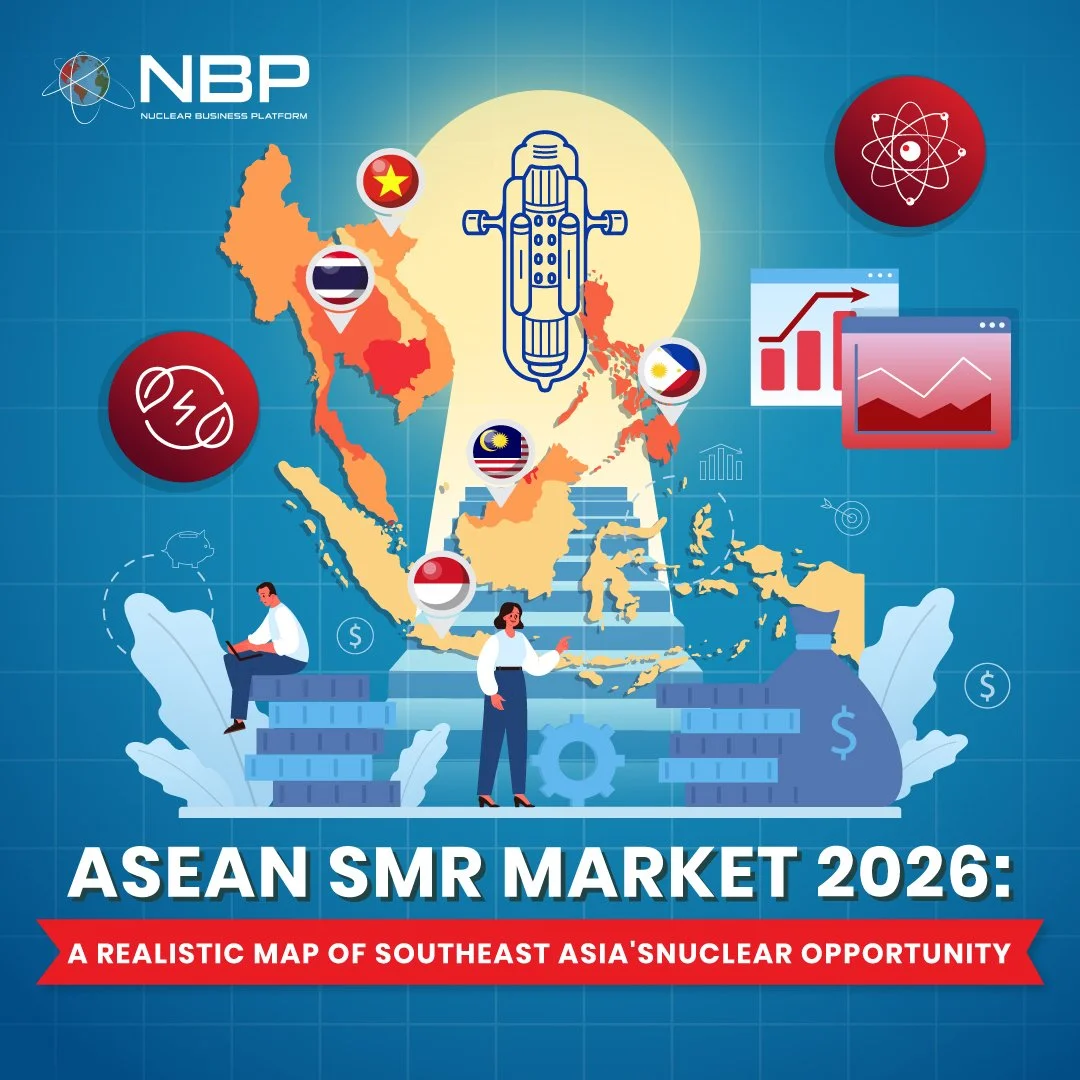
Southeast Asia is regularly described as one of the most promising SMR markets in the world. That is true, but it is also an oversimplification that creates a false picture of how to engage with it commercially. ASEAN's nuclear ambitions are real and growing, but the region is not a single procurement environment with a common timeline, a shared regulatory framework, or a uniform vendor preference. It is a collection of distinct national markets, each at a different stage of readiness, each shaped by its own financing logic, grid requirements, and geopolitical partnerships. For international SMR vendors, the difference between reading the region accurately and reading it as a bloc could determine whether market entry produces results or burns resources on the wrong priorities. This article maps the four active procurement environments in ASEAN, identifies what each one requires from vendors right now, and examines the cross-cutting supply chain opportunities that run across all of them.
The Philippines: The Most Advanced Western-Aligned Procurement
The Philippines has moved faster than any other ASEAN country to turn SMR goal into structured commercial engagement. Under President Ferdinand Marcos Jr., the country has set a target of 1,200 MW of nuclear capacity by 2032, expanding to 4,800 MW by 2050. The legal and strategic framework supporting this is already in place. A 123 Agreement with the United States is active, covering nuclear cooperation and the commercial conditions for US technology transfer. Multiple US government agencies, including the Department of State, the US Trade and Development Agency (USTDA), the Department of Energy, the Nuclear Regulatory Commission (NRC), and the Department of Commerce, are engaged with Philippine counterparts on regulatory development, commercial partnerships, and workforce preparation.
The most commercially significant development in the Philippine market is the USTDA-funded feasibility study worth USD 2.7 million, directed at helping Manila Electric Company, known as Meralco, assess and deploy US-designed SMRs. The study will evaluate leading US technologies, identify viable sites, and produce an implementation roadmap. Simultaneously, Meralco has signed a tripartite MOU with Korea Hydro and Nuclear Power (KHNP) and the Export-Import Bank of Korea (KEXIM) to explore both technical and financial pathways for nuclear assets. The US and South Korea are therefore both present in the Philippine market with structured commercial frameworks, not just diplomatic intentions.
For international vendors, the Philippine market in 2026 is in the site evaluation and feasibility stage, which is where front-end engineering and design services, regulatory advisory support, and environmental impact assessment capabilities are most in demand. The vendor competition between US and Korean technologies is substantive, and the final technology selection will depend substantially on how each vendor's financing package and localisation commitment compare when the feasibility study findings are published.
Indonesia: Industrial Demand Driving an Unconventional Entry Point
Indonesia's SMR market is structured differently from the Philippines, and understanding that difference is essential for vendors approaching it. The country's ten-year electricity supply plan, RUPTL 2025 to 2034, integrates nuclear energy with a target of 500 MW by 2034 through two 250 MW SMR units. The Sumatra and Kalimantan grids have been identified as the primary deployment locations because these regions are the centres of Indonesia's industrial growth and mining operations, sectors that need reliable baseload power and are currently dependent on diesel and coal generation that is both expensive and carbon-intensive.
The most prominent project in Indonesia's pipeline is the ThorCon Molten Salt Reactor, a 500 MW floating power plant design. ThorCon received approval for its Site Evaluation Plan from Indonesia's nuclear regulator BAPETEN in July 2025 for a site on Kelasa Island. This is a meaningful regulatory milestone. It means that an advanced, non-light-water reactor design has cleared its first formal safety evaluation hurdle in a Southeast Asian regulatory environment, which has implications beyond Indonesia alone. It establishes a precedent for how ASEAN regulators can approach Generation IV technology assessment, and it signals that Indonesia is not restricting itself to conventional reactor designs despite being a newcomer market.
For international vendors, Indonesia's industrial deployment context creates a specific set of commercial requirements that differ from grid-scale procurement. Mining operators and industrial cluster developers are the end customers in this market. They evaluate nuclear power through a capital cost, reliability, and offtake structure lens that is more similar to how they evaluate any industrial energy infrastructure investment. Vendors that can structure their SMR offering around an industrial power purchase agreement model, with credible cost projections and demonstrated reliability data, will find this market more accessible than those approaching it through a conventional utility procurement route.
Vietnam: Re-entry at Scale with an Open Vendor Field
Vietnam's reintroduction of nuclear energy into its revised National Power Development Plan 8 (PDP 8), effective April 2025, is the most significant nuclear policy development in Southeast Asia this decade in terms of sheer scale. The country targets between 4,000 and 6,400 MW of nuclear capacity between 2030 and 2035. State-owned utility EVN has been designated investor for the first project and Petrovietnam for the second, maintaining state control over the primary capital allocation while leaving the vendor selection genuinely open.
For international vendors who have not previously engaged in Vietnam, this is one of the few remaining procurement windows in the region where early structured engagement can meaningfully influence technology selection.
Malaysia and Thailand: The Feasibility Stage Opportunities
Malaysia and Thailand are both in advanced feasibility study stages, and they represent a different category of commercial opportunity than the Philippines, Indonesia, and Vietnam. Neither has reached procurement, but both have made commitments specific enough to make current engagement commercially meaningful rather than speculative.
Malaysia has targeted 1.2 GW of SMR capacity by 2035. Thailand's Power Development Plan 2024 targets two 300 MW SMR units totalling 600 MW, with construction beginning in 2032 and commercial operations expected by 2037.
For vendors, feasibility stage markets require a different approach than active procurement markets. The most valuable contributions at this stage are regulatory capacity building, workforce training, and site characterisation services, areas where vendors can build institutional relationships and demonstrate technical competence without requiring a procurement contract to exist. Control room simulators, nuclear engineering curriculum development partnerships with local universities, and expert secondment programmes are all commercially viable at this stage. They generate revenue and build the kind of trust and familiarity that procurement decisions draw on when they eventually open.
The Cross-Cutting Opportunities That Run Across All Four Markets
Beyond the country-specific dynamics, there are four supply chain and services segments where demand is active across the entire ASEAN SMR market simultaneously, and where firms that establish regional capability will be better positioned than those approaching each market individually.
The first is HALEU supply chain development. Several advanced SMR designs require High-Assay Low-Enriched Uranium, and no ASEAN country has domestic fuel production capability. Securing reliable HALEU supply chains is a prerequisite for deploying these designs, and firms that can contribute to fuel security solutions are addressing a constraint that affects every market in the region.
The second is modular manufacturing and logistics. SMRs are factory-fabricated systems whose economics depend on standardised production. International vendors that establish regional manufacturing partnerships within ASEAN industrial zones, producing nuclear-grade components including valves, pumps, and control systems locally, reduce costs and strengthen local content credentials that procurement processes increasingly require.
The third is waste management consulting. No ASEAN government has a finalised long-term waste management strategy for nuclear power. Firms that provide early-stage consulting on intermediate storage, deep geological repository planning, and end-of-life cost estimation are filling a gap that every programme in the region will eventually need to address, and doing so before procurement creates relationships that persist through the full project lifecycle.
The fourth is the geopolitical dimension. The ASEAN SMR market is a primary arena for competition between the United States, South Korea, China, and Russia. Each brings a distinct package: the US offers FIRST programme support and 123 Agreement frameworks; South Korea offers the integrated all-in-one model with KEXIM financing backed by the Barakah reference; China offers rapid deployment capability and state-directed financing; Russia offers the only SMR technology with an actual operating track record, the RITM-200 derived from over 400 reactor-years of icebreaker experience. For ASEAN governments, this competition is leverage. For vendors, it means that technology alone does not determine outcomes. Financing structure, localisation commitment, and long-term partnership credibility matter at least as much as reactor specifications. The firms that understand this, and build their ASEAN engagement strategy around all four dimensions rather than technology alone, are the ones that will convert the region's nuclear ambition into signed contracts.
Crucially, this evolution is already taking shape on industry platforms such as the upcoming 11th edition of Asia Nuclear Business Platform (ANBP) 2026, scheduled for 3–5 November in Hanoi, Vietnam. It is within these high-level forums that policymakers, investors, and vendors are actively refining the financing and partnership models required for the region, while building the deep-rooted relationships that ultimately determine market access.