
Five Core Lessons ASEAN Teaches Every Country Planning an SMR Programme
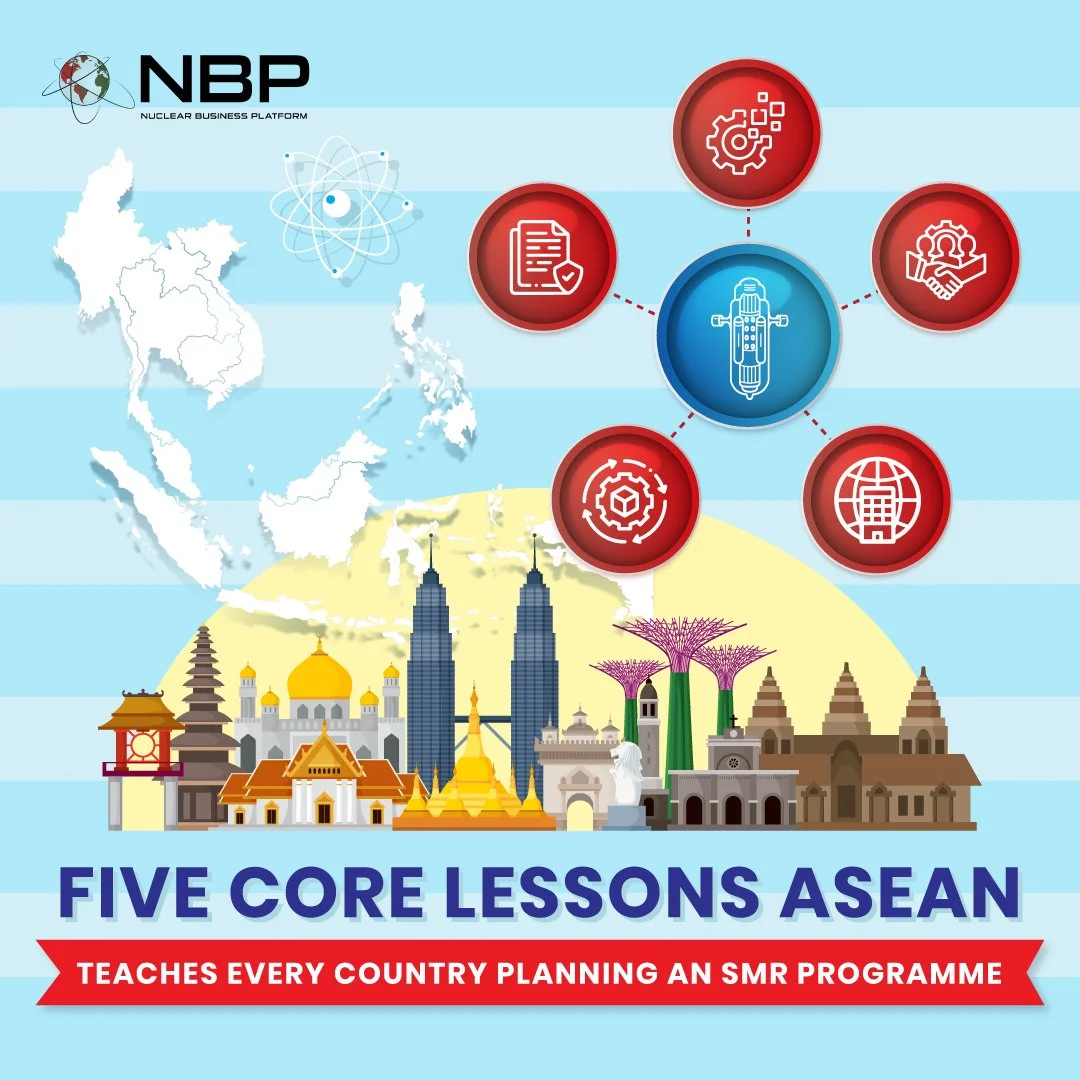
ASEAN is not a single nuclear market. It is six countries at different stages of readiness, with different grid needs, different financing structures, and different vendor relationships, all moving toward Small Modular Reactor (SMR) adoption on independent timelines. That complexity is precisely what makes the region instructive. The lessons that emerge from watching the Philippines, Indonesia, Vietnam, Malaysia, Thailand, and Singapore navigate this terrain carry direct relevance for any government or utility now designing its own nuclear entry strategy. This article identifies the five most important of those lessons and examines what each one means in practical terms.
Lesson 1: Regulatory Readiness Is Not a Formality. It Is a Precondition.
The single most consistent finding across ASEAN's SMR markets is that regulatory capacity determines deployment pace more reliably than political will or vendor availability. The Philippines moved faster than any other ASEAN country toward structured commercial engagement, and the primary reason is that it built its regulatory foundations early. The 123 Agreement with the United States, the engagement of PhilAtom with the US Nuclear Regulatory Commission (NRC), and the parallel involvement of the US Department of Energy (DOE), State Department, and Trade and Development Agency (USTDA) gave the Philippines a legal and institutional framework that vendors could engage with commercially. Without that framework, the USTDA-funded USD 2.7 million Meralco feasibility study would not have been possible.
Indonesia's experience with ThorCon reinforces this from a different direction. ThorCon received approval for its Site Evaluation Plan from BAPETEN, Indonesia's nuclear regulator, in July 2025. That single milestone — the first formal safety evaluation of a Generation IV molten salt design in a Southeast Asian regulatory environment — took years of preparation. For countries now beginning their SMR planning, the lesson is direct: the regulatory preparation must begin before the vendor selection, not after it. Countries that treat licensing as a downstream task will discover that it becomes the binding constraint on their entire programme.
Lesson 2: Technology Selection and Financing Are One Decision, Not Two.
Every ASEAN government that has progressed beyond feasibility studies has learned that the reactor choice and the financing package are inseparable. Meralco's tripartite Memorandum of Understanding (MoU) with Korea Hydro and Nuclear Power (KHNP) and the Export-Import Bank of Korea (KEXIM), signed in March 2026, is the clearest illustration. KHNP and KEXIM presented themselves as a combined offer: technology and state-backed financing through a single relationship. South Korea's ability to reference the Barakah project in the UAE as evidence of on-time, on-budget delivery gave that combined offer credibility that pure technology comparisons cannot replicate.
The United States operates through a different model, using the FIRST (Foundational Infrastructure for Responsible Use of SMR Technology) programme framework, 123 Agreements, and EXIM Bank instruments to support its vendors, but the principle is identical: the financial structure is part of the product. China offers state-directed financing at scale. Russia's Rosatom brings vertically integrated financing alongside the only SMR technology with a genuine operating track record, the RITM-200 derived from more than 400 reactor-years of icebreaker experience. For any government now evaluating SMR vendors, the practical implication is that the evaluation framework must assess financing terms, localisation commitments, and long-term fuel supply arrangements alongside reactor specifications. Separating those assessments produces an incomplete picture and a weaker negotiating position.
Lesson 3: Grid Architecture Determines SMR Viability Before Economics Do.
Vietnam's target of 4,000 to 6,400 MW of nuclear capacity between 2030 and 2035 is the most ambitious nuclear re-entry in Southeast Asia this decade. Indonesia's initial deployment is targeted at 500 MW across two units of 250 MW each, directed specifically at the Sumatra and Kalimantan grids because those regions serve industrial growth and mining operations dependent on reliable baseload power. Thailand's Power Development Plan targets two 300 MW units. Malaysia targets 1.2 GW of nuclear capacity, expected post-2035.
These are not arbitrary numbers. They reflect the grid architectures each country is working with. Indonesia's industrial grid context means the commercial case for its SMR deployment is built around mining and industrial offtake, not household electricity demand. The financing structure, the site selection logic, and the vendor requirements that follow from that context are fundamentally different from what a national grid-scale deployment would require. Countries designing their SMR programmes must map their grid architecture and demand profile before selecting a reactor size or vendor. The fit between reactor output and grid absorptive capacity is a commercial constraint that no amount of political commitment can override.
Lesson 4: Supply Chain Gaps Are Programme Risks, Not Procurement Details.
No ASEAN country has domestic fuel production capability for the advanced SMR designs that require High-Assay Low-Enriched Uranium (HALEU). None has a finalised long-term waste management strategy for nuclear power. None has the full range of nuclear-grade component manufacturing capability that a mature SMR supply chain requires. These are not details to be resolved during construction. They are programme risks that determine whether deployment timelines are achievable and whether lifecycle costs are within the projections used to justify the investment.
The ASEAN experience shows that governments which identify these gaps early and build international partnerships to address them — through HALEU supply agreements, modular manufacturing arrangements, and waste management consulting engagements — create more bankable projects than those that treat supply chain as a vendor responsibility. The SMR model shifts significant manufacturing to the factory rather than the site, and the economics of that model depend on standardised supply chains operating at scale. A country that addresses supply chain gaps as part of its programme design, rather than leaving them to individual vendors, holds a stronger position in every subsequent procurement negotiation.
Lesson 5: Early Engagement Shapes Outcomes. Late Engagement Accepts Them.
Vietnam's reintroduction of nuclear into its revised National Power Development Plan 8 (PDP 8), approved April 2025, created one of the few remaining procurement windows in the ASEAN region where early structured engagement can meaningfully influence technology selection. State-owned utility EVN and PetroVietnam have been designated as investors, the vendor field is open, and the capacity targets are defined. For international vendors and service providers who have not previously engaged in Vietnam, this is the entry point. The equivalent window in the Philippines has largely closed: the competitive positions of US and South Korean vendors are already established, and new entrants face a significantly higher barrier to influencing technology selection.
Malaysia and Thailand, both in advanced feasibility study stages, represent a different but equally time-sensitive opportunity. At the feasibility stage, the most valuable contributions are regulatory capacity building, workforce training, and site characterisation services. These are not contingent on a procurement contract existing. They generate revenue, build institutional relationships, and establish the technical familiarity that procurement decisions draw on when they eventually open. This broader regional momentum is already taking shape on industry platforms such as the upcoming 11th edition of the Asia Nuclear Business Platform (ANBP) 2026, scheduled for 3–5 November in Hanoi, Vietnam, where policymakers, investors, and vendors are actively refining the financing and partnership models required for the region's next phase of SMR deployment. The ASEAN lessons for any country now planning its SMR entry can be understood across the six markets: the vendors and partners who establish substantive engagement before procurement decisions are made are the ones who shape those decisions. Those who arrive after the framework is set are negotiating against a structure they had no hand in building.