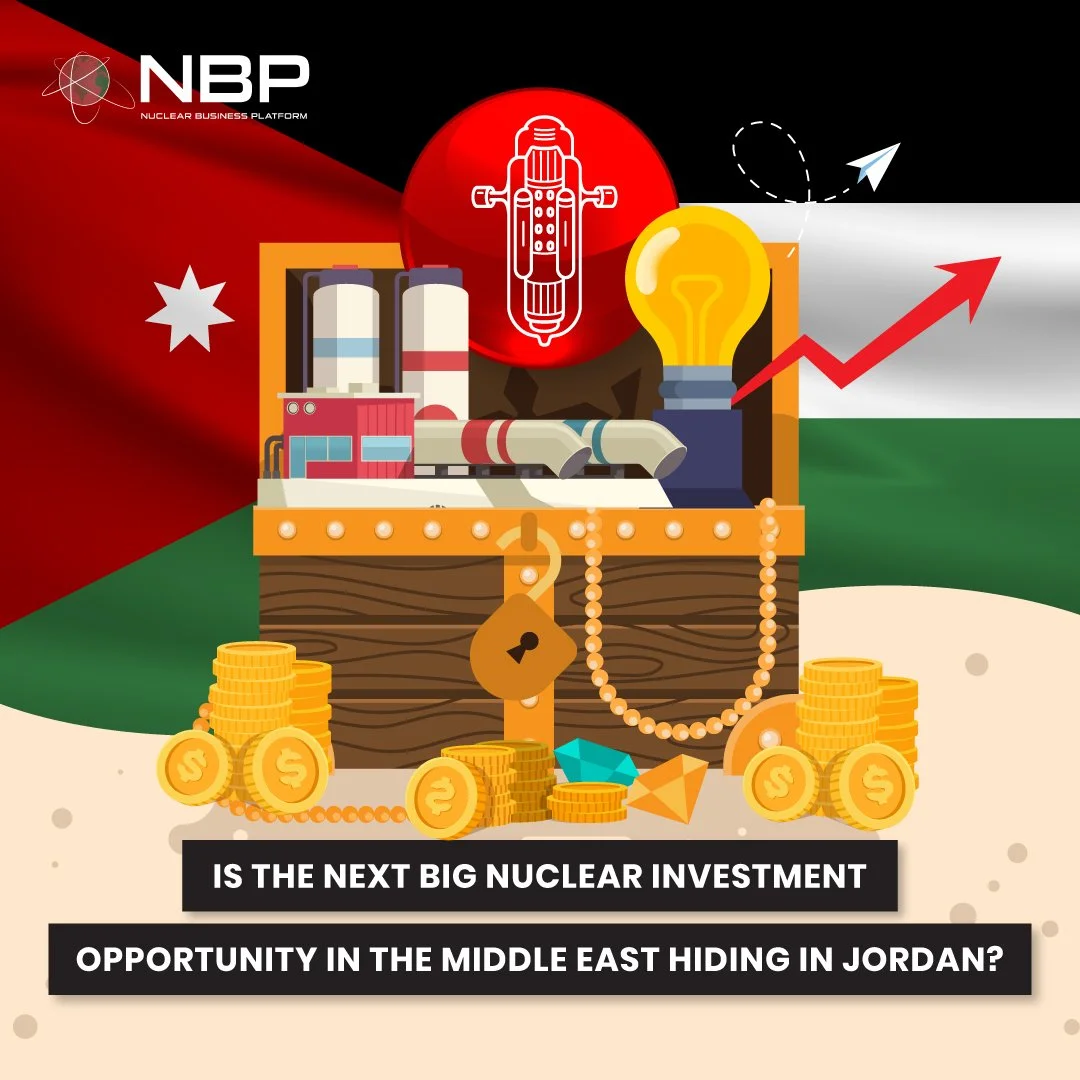
Is the Next Big Nuclear Investment Opportunity in the Middle East Hiding in Jordan?
Jordan is entering a decisive phase in its pursuit of energy and water security, driven not by long-term aspirations but by urgent national needs and years of deliberate groundwork. The combination of population growth, industrial expansion, and escalating water scarcity has rendered incremental solutions inadequate, necessitating transformative infrastructure. Within this context, nuclear power—particularly small modular reactors (SMRs)—has emerged as central to the Kingdom’s strategy.
This transition represents more than an energy-sector reform; it reflects a structural economic realignment. For global nuclear vendors, investors, and service providers, Jordan has become one of the most commercially promising SMR markets in the Middle East. The country’s policy maturity, readiness, and decade-long engagement with vendors have created a rare environment where discussions can move quickly from feasibility studies to actionable planning.
A Market Defined by Urgency: Energy and Water Challenges
Jordan’s nuclear ambitions are grounded in national necessity. With nearly 96% of its energy imported, the country faces structural vulnerability: fluctuations in global fuel markets directly affect electricity prices, industrial competitiveness, and household affordability. At the same time, Jordan’s water scarcity ranks among the most severe globally. Per capita water availability has dropped far below international scarcity thresholds, and reliance on deep aquifers requires energy-intensive pumping. The Kingdom’s future water supply, particularly through desalination and large-scale conveyance, will depend on reliable, affordable, long-term electricity.
This dual pressure has reshaped infrastructure planning. Jordan’s outlook beyond 2030 emphasizes the need for a baseload, predictable, and scalable energy system capable of supporting the water–energy nexus underpinning national development. Nuclear power fulfills these requirements, and SMRs represent the most practical deployment pathway, aligning with grid capacity, geography, and water strategy.
Why SMRs Are Better Suited to Jordan’s Needs
SMRs are uniquely suited to Jordan’s grid size, capacity-factor requirements, and planned desalination scale-up. Their modular design allows capacity to be added in phases, matching evolving demand patterns while integrating with water projects along the Red Sea–Dead Sea and Aqaba–Amman corridors. Unlike large reactors, SMRs are compatible with the national grid, avoiding issues of overcapacity. Their thermal and electrical outputs can be tailored for co-generation with desalination facilities, providing a strong synergy between energy and water production. Units can be added progressively as industrialization expands, ensuring scalability that aligns with the Kingdom’s economic growth. Furthermore, SMRs offer long-term economic predictability, delivering stable pricing for both electricity and water. Their siting flexibility allows deployment in semi-remote areas that can be connected to future water pipelines. Together, these features position SMRs not merely as a technological choice but as a nation-building instrument that integrates energy, water security, economic competitiveness, and sovereign resilience.
A Decade of Vendor Engagement Has Matured the Market
Jordan’s SMR readiness is the result of over a decade of structured preparation by the Jordan Atomic Energy Commission (JAEC), which has built technical, legal, and human-resource foundations for nuclear power. Unlike countries where past vendor engagements are largely symbolic, Jordan has used these interactions to cultivate a sophisticated buyer perspective.
The Kingdom has engaged with multiple vendors and technologies, including KAERI and KA-CARE (SMART), Rolls-Royce (PWR-based SMRs), X-energy (high-temperature gas-cooled reactors), CNNC (HTR-PM), NuScale (modular light-water reactors), Rosatom (SMR cooperation), and other NPP vendors through earlier large-reactor studies. Each engagement has contributed meaningful data that now informs feasibility studies, shortlisting, contractual modelling, and infrastructure planning. This depth of preparation makes Jordan one of the most technically prepared SMR customers globally, lowering risk and accelerating deployment timelines for investors and vendors.
JAEC’s Present Direction: Commercially Focused SMR Shortlisting
JAEC is currently in a critical phase of its nuclear program, focusing on narrowing down the list of viable SMR technologies. This effort is far more structured than earlier explorations, reflecting the Kingdom’s shift from conceptual interest to actionable planning. The process involves comprehensive technical and economic evaluations with multiple SMR vendors, alongside parallel studies to integrate desalination and electricity requirements. Financing models and contractual structures are being assessed, while preparations for Binding Information Sheets (BIS) or Requests for Proposal (RFP) are underway. National stakeholders from energy, water, and regulatory agencies are actively engaged to ensure alignment across sectors. The Integrated Advisory Group (IAG) has reinforced this approach, recommending a parallel SMR deployment track to meet demand projections and water security objectives. This strategy recognizes that SMRs are the optimal entry point given grid limitations, while preserving the possibility of deploying large reactors after 2030 as the grid and industrial base expand.
Desalination as the Core Commercial Anchor
For Jordan, nuclear energy serves a dual purpose: electricity generation and securing the nation’s water supply. The Kingdom’s water scarcity transforms nuclear power from a conventional energy asset into a critical survival tool. As major desalination projects accelerate, they will require constant baseload power, predictable long-term pricing, and thermal integration beyond electricity production—capabilities that no other energy source can reliably provide. This water–nuclear linkage creates multiple commercial opportunities for SMR vendors, EPC firms, and technology integrators. It enables the development of nuclear-powered desalination systems, hybrid nuclear–renewable water systems, thermal desalination technology partnerships, water–energy public-private financing models, and long-term operations and maintenance frameworks for co-generation plants. In essence, the opportunity extends beyond building nuclear reactors; it encompasses the creation and sustainment of a national water economy that depends directly on nuclear energy.
Post-2030 Outlook: SMRs Now, Large Reactors Later
Jordan’s nuclear program exemplifies a market built on necessity, careful planning, and commercial readiness rather than political symbolism. While the deployment of large reactors has been postponed, the Kingdom’s long-term strategic intent remains clear: SMRs serve as the pragmatic entry point, providing scalable, reliable, and grid-compatible baseload power, while additional large reactors can be introduced as demand grows and the grid modernizes. This staged, phased approach reduces risk, builds investor confidence, and ensures that each deployment logically supports subsequent expansion.
The convergence of energy insecurity, severe water scarcity, desalination expansion, and extensive vendor engagement has created one of the Middle East’s most commercially attractive nuclear markets. For reactor vendors, investors, EPC firms, fuel-cycle companies, and technology integrators, Jordan represents a stable, technically mature, and well-prepared market with a clearly defined deployment horizon. Anchored by desalination needs, initiated through SMRs, and eventually complemented by large reactors, Jordan is positioning itself as a model of nuclear-enabled resilience and a destination of serious commercial interest for the global nuclear industry.