Securing the Social Licence: The Key to Africa’s Nuclear Bankability
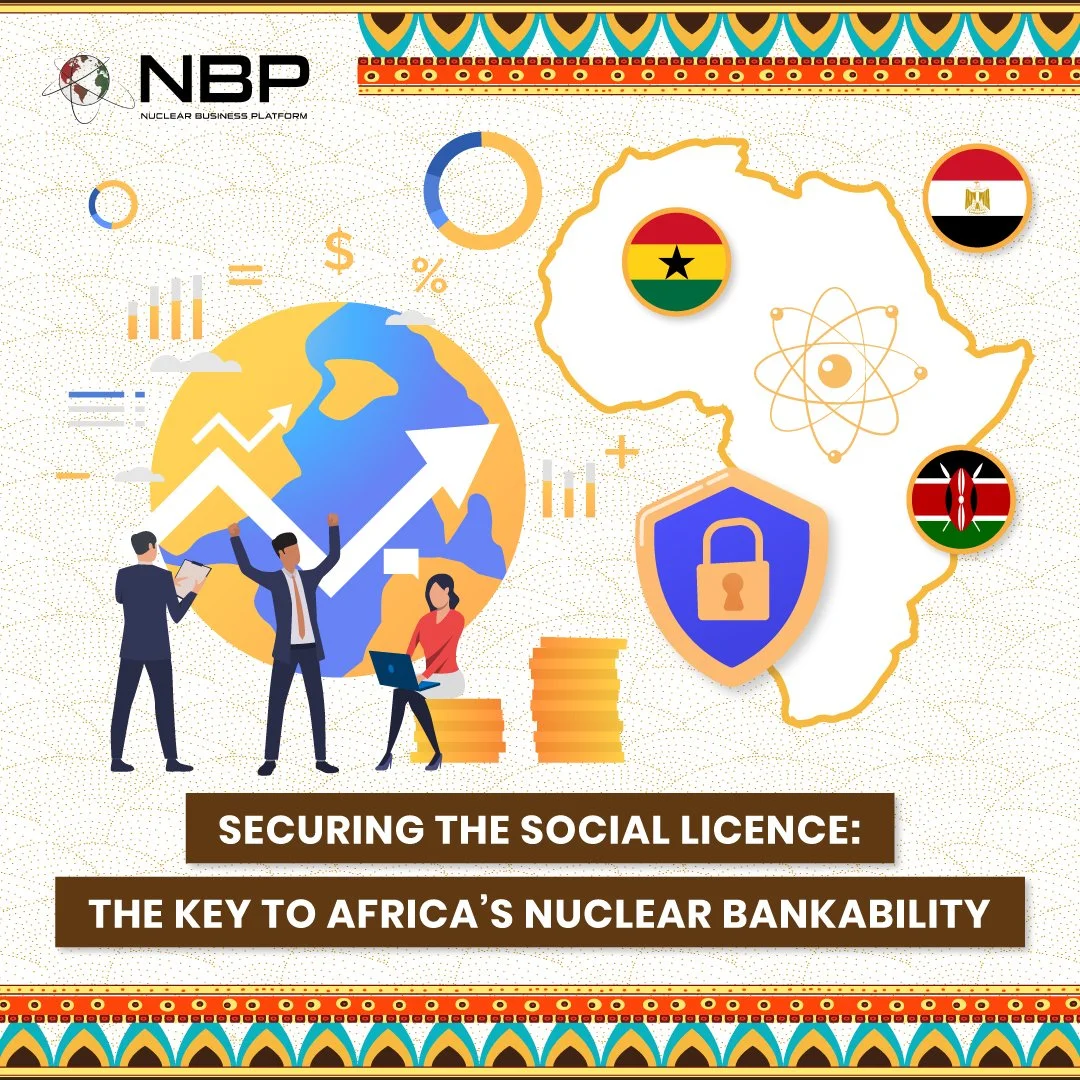
For African nations pursuing nuclear energy as a cornerstone of industrialisation, energy security, and sustainable development, the "social licence to operate" has become the decisive factor in project success. As the continent seeks to expand clean, reliable baseload power to support economic growth and meet rising electricity demand, robust community and stakeholder engagement is no longer optional, it is a strategic imperative for risk mitigation, regulatory approval, investor confidence, and long-term bankability. Drawing on global lessons while adapting them to African socio-political realities, nuclear newcomers such as Egypt, Ghana, and Kenya demonstrate that effective engagement can transform nuclear projects from potential sources of conflict into drivers of shared prosperity.
Global Benchmarks Relevant to Africa
While Africa’s nuclear journey is distinct, global nuclear experience offers valuable insights into how social acceptance can be institutionalised. Mature nuclear markets demonstrate that engagement is most effective when it is continuous, structured, and embedded in governance systems rather than treated as a reactive exercise.
South Korea: Institutionalised Benefit Sharing
The South Korean benefit-sharing model supports nuclear energy supplying over 30% of national electricity through legislated Local Assistance Programs (LAPs) funded proportionally to generation. These include fund support programs managed by local governments for large infrastructure such as roads and utilities, alongside business support programs run by operator Korea Hydro & Nuclear Power (KHNP) targeting education, welfare, and culture. Financial compensation must align with genuine community needs to avoid cronyism perceptions. In 2025, South Korea allocated $103 million in support, including low-interest loans for small and medium-sized enterprises in the nuclear supply chain.
Finland: The Eurajoki Model
The Finnish "Eurajoki Model" in Eurajoki, home to the world’s first deep geological repository for spent nuclear fuel, saw acceptance evolve from economic dependency to genuine community pride. Success rested on stepwise decision-making, expertise-based trust in technical personnel, cultural integration where operators are seen as "good neighbours", and voluntariness through municipal veto power—a right that paradoxically strengthened willingness to host facilities.
African Case Studies: Adapting Engagement to Local Realities
African nuclear programmes are actively translating these lessons into context-specific strategies.
Egypt: State-Led Coordination and Educational Outreach
Egypt’s El Dabaa NPP, featuring four VVER-1200 reactors, is North Africa’s most advanced project. The Nuclear Power Plants Authority (NPPA) and regulator (ENRRA) categorise stakeholders into four groups: public/parliament, ministries, licensees, and media. A cornerstone is educational outreach targeting students, positioning nuclear energy as essential for the "24-hour economy" and industrialisation. Annual reports to the Prime Minister and public reinforce centralised transparency, maintaining national priority status.
Ghana: Legislative Transparency and Institutional Legitimacy
Ghana has rigorously followed the IAEA Milestones Approach. In June 2025, the Ministry of Energy and Green Transition conducted extensive public consultations on the Draft Bill establishing Nuclear Power Ghana Limited (NPGL). Stakeholders from civil society, academia, and media raised concerns over Section 16(1), which grants presidential appointment authority and risks politicising a technical body. This open feedback process strengthens institutional legitimacy before construction begins. Partnerships, including an MoU with the Ghana Journalists Association, combat misinformation through professional media engagement.
Between 2024 and 2025, Nuclear Power Ghana (NPG) and the Ghana Atomic Energy Commission (GAEC) implemented a range of stakeholder initiatives to advance Ghana’s nuclear power programme, with a strong emphasis on engagement and capacity-building. These efforts included collaboration with the IAEA, notably the scheduling of an industry-focused capacity-building workshop in August 2025 aimed at preparing local companies on nuclear quality standards, supplier development, risk management, and procurement, to enable meaningful domestic participation in future plant construction. In parallel, NPG leadership actively engaged the media and the wider public to promote a clearer understanding of the benefits of nuclear power, while laying the groundwork for perception surveys and community outreach programmes designed to strengthen national buy-in and foster informed public discourse.
Kenya: Lessons from Site Selection Challenges
Kenya’s experience illustrates how early-stage stakeholder engagement can materially influence nuclear project bankability and implementation timelines. While Kenya’s 2023–2027 Strategic Plan for nuclear power reflected strong institutional intent, preliminary siting discussions in Uyombo, Kilifi County, revealed engagement gaps that underscored the importance of structured, continuous community consultation. Local concerns emerged around the clarity of risk communication, environmental sensitivities given the site’s proximity to Watamu Marine National Park and the Arabuko–Sokoke Forest UNESCO Biosphere Reserve, and land tenure complexities linked to informal titles and the Community Land Act. These issues, left insufficiently addressed at the initial stage, elevated social and reputational risks and attracted broader scrutiny. In response, in 2025, Kenya’s Nuclear Power and Energy Agency (NuPEA) intensified its stakeholder engagement to advance the country’s nuclear power programme. The agency convened targeted stakeholder validation workshops on nuclear safety conventions, engaged county governments and local communities near potential sites, and strengthened collaboration with key institutions such as government ministries, regulators, county governments, academia, industry, and the public.. NuPEA also expanded public awareness and capacity-building initiatives, focusing on safety, regulatory readiness, and human capital development, ensuring broad national alignment as Kenya moves closer to the implementation phase of its first nuclear power plant

The Global Context: Why Engagement Determines Bankability
The International Atomic Energy Agency (IAEA) defines stakeholder engagement as an integral part of the decision-making process, fostering trust, accountability, and active participation. It is one of the 19 critical issues in the IAEA Milestones Approach. For capital-intensive nuclear power plants (NPPs), where first-of-a-kind (FOAK) large reactors in emerging markets face capital costs of $8,000 to $11,000 per kilowatt, delays caused by social or regulatory friction devastate project economics, nearly two-thirds of the cost per megawatt-hour stems from construction and investment capital.
Strong engagement de-risks projects for private investors, multilateral financiers, green bonds, and pension funds. Conversely, inadequate engagement triggers social unrest, litigation, and political reversals, raising risk premiums and rendering projects unbankable. Regulatory independence and public trust are inseparable: without community acceptance, the social licence to operate—a dynamic, ongoing state of consent—cannot be sustained from pre-feasibility to decommissioning.
Strategic Recommendations for African Nuclear Stakeholders
African practitioners and policymakers should:
Prioritise socio-technical integration by embedding social, behavioural, and political factors in technology and siting decisions from the earliest phases.
Address land rights proactively in customary or informal tenure regions to prevent opposition exploitation.
Safeguard institutional independence, keeping regulators and agencies as autonomous technical entities to avoid credibility erosion from politicised appointments.
Adopt stepwise, participative processes using a "blank map" siting approach with genuine community involvement for sustainable outcomes.
Moving Forward
For Africa’s nuclear goals to succeed—with the Nuclear Business Platform (NBP) projecting the continent achieving 15 GW of nuclear capacity by 2035—stakeholder engagement must be mastered with the same rigour as nuclear science itself. Finland and South Korea prove that empowered, informed, and equitably benefited communities embrace nuclear facilities as engines of growth.
By blending global best practices with deep local insight, African nations can secure the trust required to deliver reliable, low-carbon power for industrial transformation and shared prosperity. Engagement is not a peripheral activity, it is the foundation of enduring value in Africa’s nuclear future.
The 5th Africa Nuclear Business Platform (AFNBP) 2026, scheduled for 21–23 April in Abuja, Nigeria, hosted by the Nigeria Atomic Energy Commission (NAEC). This high-level gathering will convene policymakers, investors, global vendors, and regional stakeholders to align investment frameworks, secure long-term partnerships, and refine procurement pathways. Africa’s nuclear sector is no longer a distant aspiration — it is now an actionable and investable frontier.