Vision 2030 and Nuclear: How Saudi Arabia Is Structuring an Open Global Market
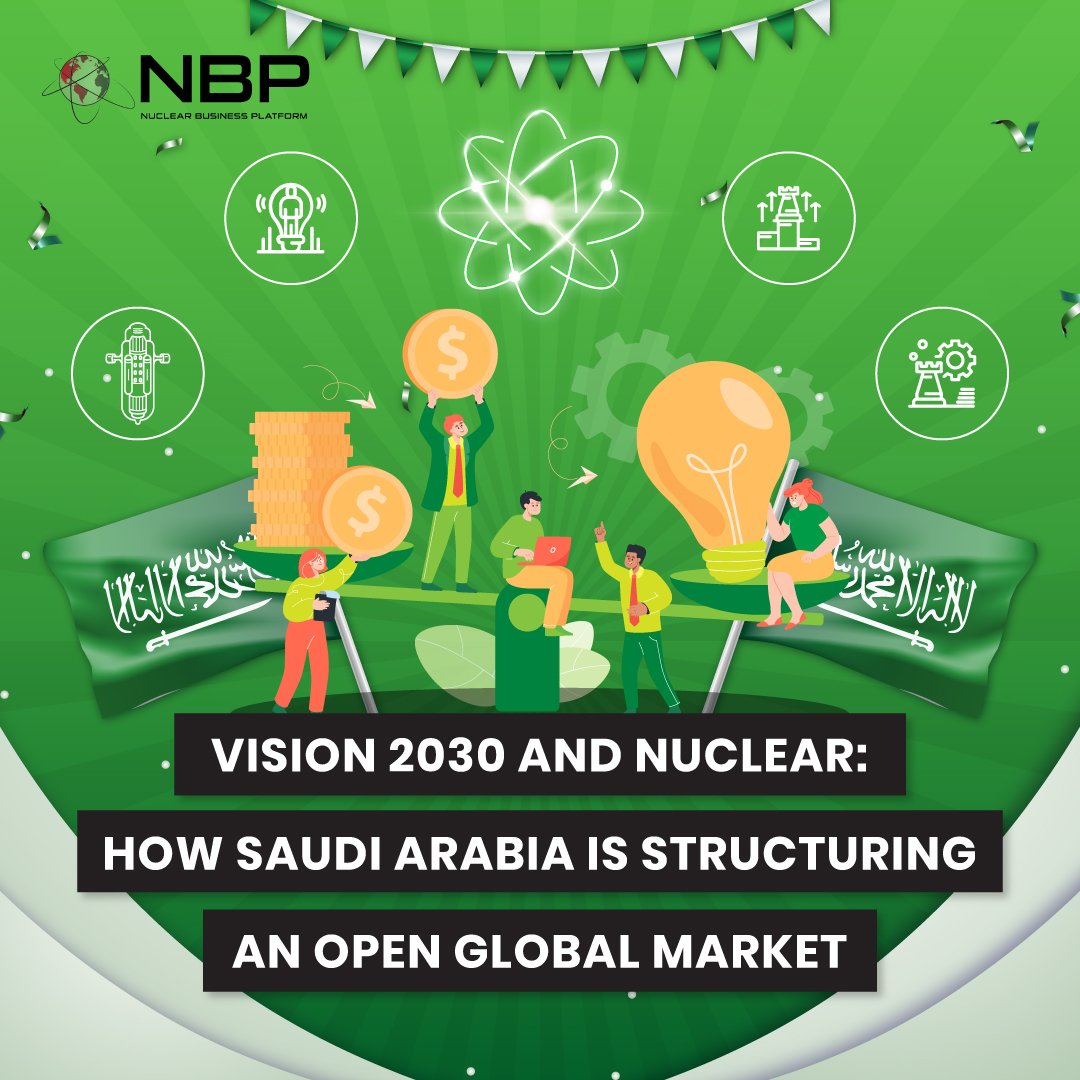
As global demand for nuclear energy accelerates, Saudi Arabia is emerging as one of the most strategically designed nuclear markets in the world. Rather than rushing toward a single reactor award, the Kingdom has opened its programme in a way that encourages sustained competition, institutional readiness, and long-term bankability. Through early investment in regulation, ownership structures, human capital, and international partnerships, Saudi Arabia is shaping a market where global vendors and investors compete on credibility, localisation, financing depth, and lifecycle performance. The result is not uncertainty, but optionality—positioning the Kingdom as a high-value nuclear destination where commercial discipline, rather than political urgency, defines the path to deployment.
A Demand Profile That Makes Nuclear Inevitable
Saudi Arabia’s population has expanded from roughly 4 million in 1960 to more than 35 million by 2024. Energy demand has grown accordingly, with Saudi Arabia now consuming over one-quarter of its own oil production. While electricity demand is projected to rise sharply, oil production is not expected to increase in parallel—placing pressure on export revenues, fiscal stability, and long-term energy security.
This imbalance explains why, as early as April 2010, a royal decree declared atomic energy “essential” to meet growing electricity demand, produce desalinated water, and reduce reliance on depleting hydrocarbon resources. Nuclear power in Saudi Arabia is not framed as a climate experiment or prestige project, but as a strategic hedge against domestic oil consumption and long-term demand growth.
Governance Before Gigawatts
Saudi Arabia’s nuclear trajectory diverges from many emerging nuclear markets in one critical respect: institution-building preceded reactor selection.
The King Abdullah City for Atomic and Renewable Energy (K.A.CARE) was established to oversee treaties, strategy, radioactive waste, and nuclear development. In 2017, the Kingdom formally approved the Saudi National Atomic Energy Project (SNAEP), positioning nuclear energy as a developmental economic project aligned with Vision 2030 rather than a narrow power-generation initiative.
SNAEP is structured around three pillars:
• Large nuclear power reactors
• Small modular reactors (SMRs)
• Uranium exploration and the nuclear fuel cycle
Equally important, Saudi Arabia separated ownership from regulation early. The Saudi Nuclear Energy Holding Company (SNEHC) will develop and operate planned nuclear facilities, while the Nuclear and Radiological Regulatory Commission (NRRC) functions as an independent regulator aligned with international best practices. This institutional clarity was reinforced by a positive Integrated Nuclear Infrastructure Review (INIR) from the IAEA in 2019, which concluded that “significant progress” had been made across legislative and infrastructure readiness.
For investors, this sequencing matters. It reduces sovereign execution risk before a single contract is signed.
A Vendor Landscape Unlike Any Other
Few countries have simultaneously engaged such a broad cross-section of the global nuclear industry.
The US has re-entered the picture following the completion of a civil nuclear cooperation framework in late 2025, opening the door to potential reactor exports. France’s EDF and Areva have conducted feasibility studies around EPR deployment, supported by cooperation agreements on safety and waste management. South Korea has pursued one of the most advanced SMR engagements through the SMART reactor, explicitly designed for electricity generation and desalination, with pre-construction engineering already completed.
China has emerged as a strategic technology partner across multiple fronts—high-temperature reactors, fuel fabrication, uranium exploration, and desalination-linked nuclear applications—while Russia’s Rosatom has proposed VVER reactors alongside cooperation across the fuel cycle, research reactors, and isotope production. Argentina’s INVAP has already delivered tangible infrastructure, constructing a low-power research reactor in Riyadh and partnering on small reactor concepts such as CAREM.
Rather than narrowing the field early, Saudi Arabia has allowed all of these actors to compete on cost, localization depth, technical maturity, and long-term partnership value.
Nuclear Beyond Power: Desalination, Industry, and Hydrogen
Saudi Arabia’s nuclear vision has always extended beyond electrons. From the earliest GCC feasibility studies in 2007, nuclear desalination was treated as a core application. High-temperature reactors, SMRs, and cogeneration models are being evaluated for freshwater production in a country where water security is a strategic constraint.
SMRs, in particular, are positioned as multi-purpose infrastructure. Designs such as SMART integrate electricity production with desalination at competitive costs relative to gas turbines, while offering deployment flexibility for coastal or industrial zones.
Looking forward, nuclear-powered hydrogen—often referred to as “purple hydrogen”—is emerging as a longer-term option. While green hydrogen projects currently dominate Saudi announcements, nuclear-enabled hydrogen production could provide stable, carbon-free baseload supply for industrial clusters as SMR technologies mature.
Fuel Cycle Optionality Without Overreach
Saudi Arabia has also kept its fuel-cycle strategy deliberately flexible. Cooperation agreements with China and Jordan have focused on uranium exploration and skills development rather than enrichment commitments. While speculation around enrichment periodically surfaces in media narratives, official programmes emphasize capacity building, geological assessment, and alignment with international safeguards.
In 2023, the Kingdom reiterated its intention to move from a Small Quantities Protocol to a Comprehensive Safeguards Agreement with the IAEA—another signal aimed squarely at investor and diplomatic confidence.
Why This Strategy Matters to the Global Nuclear Business
For global nuclear vendors and investors, Saudi Arabia represents one of the most deliberately constructed nuclear markets in the world today. Rather than chasing speed, the Kingdom has focused on building the commercial, regulatory, and institutional foundations that determine whether nuclear capital performs over decades.
By establishing clear regulatory authority, future ownership structures, workforce pipelines, and international cooperation frameworks ahead of procurement, Saudi Arabia has created a competitive environment where commercial credibility matters. Vendors are not responding to political urgency, but to a market shaped around bankability, localization, fuel assurance, and long-term operational alignment.
This approach preserves optionality without diluting commitment. Keeping multiple technology pathways open strengthens negotiating power, encourages supplier innovation, and ensures that final decisions are made under conditions of maximum leverage. For financiers, this reduces structural risk; for suppliers, it rewards completeness of offering rather than speed of promise.
Saudi Arabia’s nuclear strategy reflects a broader evolution in how major emerging markets approach nuclear deployment. Commitment is no longer measured by early contract announcements, but by the quality of governance, the durability of partnerships, and the readiness of the ecosystem that will support assets for sixty years or more.