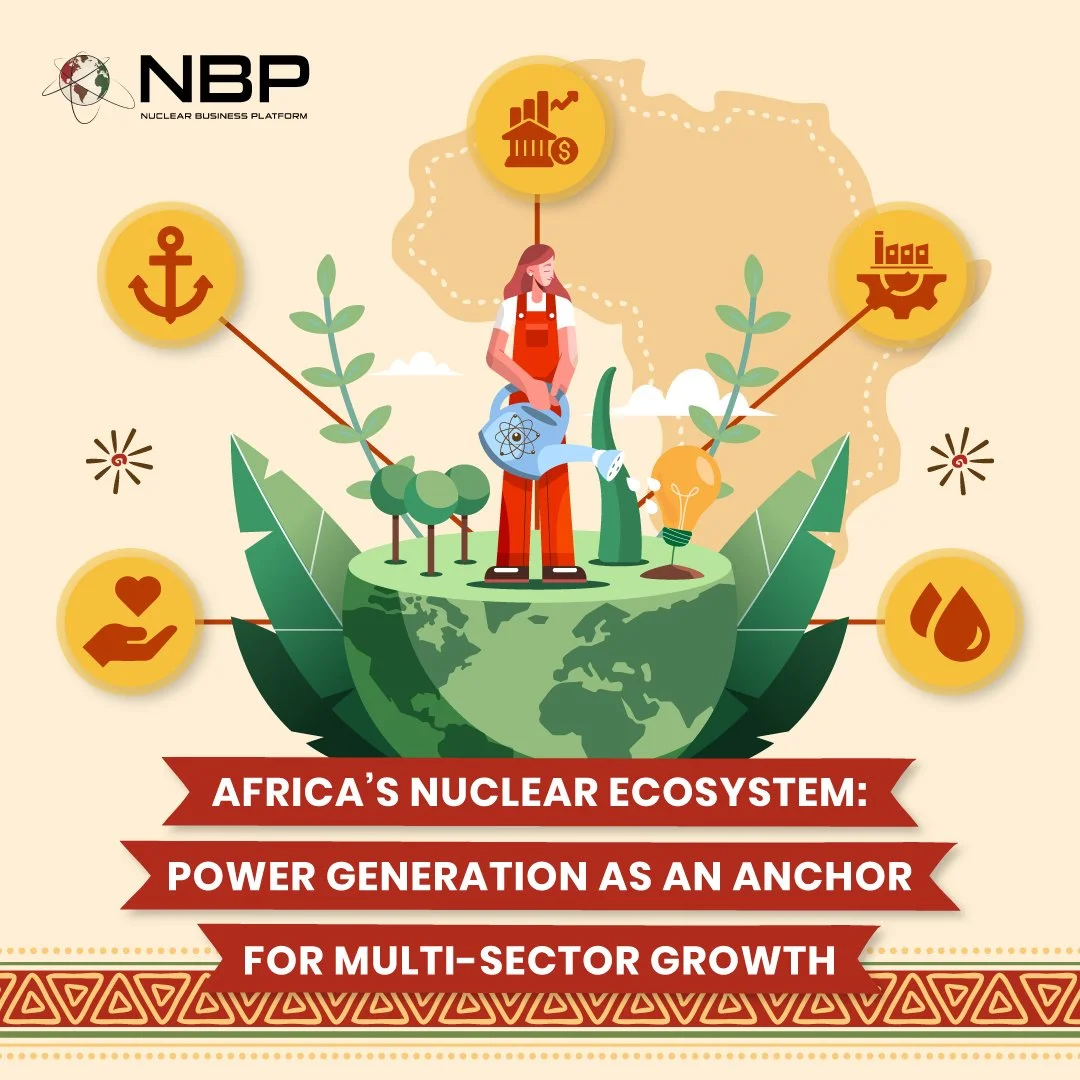
Africa’s Nuclear Ecosystem: Power Generation as an Anchor for Multi-Sector Growth
As Africa confronts the twin pressures of surging energy demand and structural development gaps, nuclear power is increasingly being reconsidered as a long-term electricity solution. Projections from the Nuclear Business Platform suggest the continent could deploy up to 15 GW of nuclear capacity by 2035, underscoring both the scale of unmet demand and the re-emergence of nuclear power in Africa’s energy calculus.
Yet limiting Africa’s nuclear story to power generation alone understates the true size and strategic depth of the opportunity. Across agriculture, healthcare, water security, industry, and research, nuclear technologies are already embedded in critical development systems. Rather than competing with nuclear power, these applications reinforce its economic logic, expand institutional readiness, and build the ecosystem required for sustained nuclear investment.
For governments, vendors, and investors, Africa’s nuclear opportunity is therefore not a single market, but a multi-sector platform, with electricity generation at its core and non-power applications acting as demand multipliers.
Power Generation as the Anchor Market
Electricity remains the foundation of Africa’s nuclear proposition. Rapid urbanization, industrial growth, and electrification targets are pushing many African grids toward structural capacity deficits. Nuclear power offers a dispatchable, low-carbon, high-load-factor solution capable of supporting long-term economic expansion.
Importantly, power projects also serve as the infrastructure backbone for additional nuclear applications. Nuclear desalination, hydrogen production, industrial heat, isotope supply, and research reactors all become more viable and more bankable once a country commits to nuclear electricity. In this sense, power generation is not diminished by non-electric uses; it enables them.
Agriculture: Nuclear as a Productivity and Trade Enabler
Agriculture employs a large share of Africa’s workforce, yet remains highly exposed to climate volatility, pests, and post-harvest losses. Nuclear techniques are already delivering measurable gains in productivity, resilience, and export competitiveness.
Through the Food and Agriculture Organization (FAO) / the International Atomic Energy Agency (IAEA) collaboration, mutation breeding is being deployed in countries such as Nigeria, Ghana, and Sudan to improve staple crops including rice, sorghum, and groundnuts. In 2022 alone, researchers developed 42 new cassava varieties resistant to cassava brown streak disease (one of Africa’s most destructive crop threats).
Similarly, the Sterile Insect Technique (SIT) has moved from pilot to industrial scale. Morocco’s new facility produces 130 million sterile Mediterranean fruit flies per week, protecting high-value citrus exports and reducing pesticide residues, an increasingly critical factor for international market access.
Food irradiation, soil fertility analysis, and water isotope techniques further reduce waste, optimize inputs, and improve compliance with global standards. These applications position nuclear technology not merely as a food security tool, but as a trade and value-chain enabler, directly supporting export revenues and agri-industrial investment.
Healthcare: Building Clinical Infrastructure and Markets
Beyond radiotherapy, Africa accounts for nearly 10% of the global nuclear medicine market, with demand driven by oncology and cardiology diagnostics. The global radioisotope market is projected to reach USD 4.15 billion in 2025, and African countries are increasingly exploring localized production to reduce import dependency.
Medical device sterilization using gamma irradiation adds another commercial layer, improving healthcare safety while creating steady demand for nuclear services. Collectively, these applications demonstrate how nuclear technologies underpin health infrastructure, skills development, and long-term service markets.

Water Security: Nuclear Desalination as a Strategic Add-On
Water scarcity is emerging as a binding constraint on economic growth across North and coastal Africa. Nuclear desalination offers a low-carbon, high-capacity alternative to fossil-fuel-based desalination systems.
For nearly three decades, the IAEA has supported feasibility studies and capacity-building initiatives, with Egypt’s El-Dabaa nuclear power plant increasingly regarded as a potential hub for cogeneration. In April 2025, the IAEA convened a technical meeting on nuclear cogeneration applications, bringing together participants from Egypt and Jordan. Integrating desalination with nuclear power plants enables countries to optimize asset utilization while simultaneously meeting growing electricity and freshwater demands.
While adoption remains at an early stage, successful projects in North Africa could serve as blueprints for other water-stressed African nations—expanding nuclear’s role from power supplier to critical infrastructure provider.
Clean Hydrogen: A Long-Term Nuclear Upside
Africa’s hydrogen strategy is currently led by green and geologic hydrogen projects, with South Africa and Mauritania advancing multi-gigawatt developments. Nuclear-powered hydrogen—often referred to as “purple hydrogen”—remains a longer-term option, closely tied to the commercialization of Small Modular Reactors (SMRs).
Several countries, including South Africa, Ghana, Rwanda, and Morocco, are already exploring SMR partnerships. While not yet deployed at scale, nuclear hydrogen offers a stable, high-capacity, zero-carbon pathway, particularly suited for industrial clusters, remote regions, and grid-constrained systems.
For investors, this represents optionality rather than competition, positioning nuclear as a future stabilizer in Africa’s diversified hydrogen economy.
Industry, Environment, and Quality Infrastructure
Nuclear techniques are quietly becoming indispensable to Africa’s industrialization. Non-destructive testing (NDT) and industrial radiography ensure the integrity of pipelines, manufacturing components, and critical infrastructure. The global industrial radiography market is projected to reach USD 1.35 billion in 2025, with Africa increasingly integrated into this growth.
Environmental applications further extend nuclear’s footprint. Under the IAEA’s NUTEC Plastics initiative, African countries are monitoring microplastics and developing radiation-based recycling methods—illustrating nuclear technology’s role in addressing environmental challenges beyond energy.
Together, these applications embed nuclear science into Africa’s quality control, safety, and environmental governance frameworks, strengthening the institutional foundations required for larger nuclear investments.
Research, Skills, and Institutional Readiness
Sustainable nuclear deployment depends on human capital. Africa is actively investing in training, education, and institutional capacity through IAEA-supported initiatives such as the Regional Research Reactor School, the Marie Skłodowska-Curie Fellowship Programme, and Women in Nuclear (WiN) initiatives.
At the continental level, the African Regional Cooperative Agreement for Research, Development and Training related to Nuclear Science and Technology (AFRA) has prioritized nuclear knowledge management and skills development, ensuring that African countries are not merely technology recipients but active system operators.
This emphasis on indigenous capacity reduces execution risk, improves regulatory confidence, and enhances long-term project bankability.
From Momentum to Market
Africa’s nuclear future is anchored in power generation—but its investment case is strengthened by everything built around it. Agriculture, healthcare, water security, industry, hydrogen, and research are not peripheral applications; they are ecosystem builders that expand demand, deepen skills, and reduce project risk.
For nuclear vendors, financiers, and policymakers, this multi-application landscape transforms Africa from a narrow energy market into a platform opportunity—one where nuclear power is the foundation, and non-electric uses multiply returns over decades.
As Africa’s development trajectory accelerates, nuclear technology is increasingly positioned not just as an energy source, but as strategic infrastructure for growth. That momentum will be tested and refined at the 5th Africa Nuclear Business Platform (AFNBP) 2026, scheduled for 21–23 April in Abuja, Nigeria, and hosted by the Nigeria Atomic Energy Commission. The high-level forum is expected to convene policymakers, investors, global vendors, and regional stakeholders to align investment frameworks, secure long-term partnerships, and clarify procurement pathways—the critical bottlenecks that have historically constrained nuclear execution in emerging markets.