The $128 Billion Roadmap: South Africa’s Nuclear Industrial Strategy
Africa's energy story is undergoing a historic rewrite. For decades, the continent's power sector was defined by chronic shortfall, coal dependency, and missed investment cycles. Today, a new chapter is opening, and its first line is written in South Africa. As the only country on the African continent currently operating a commercial nuclear power plant, South Africa occupies a position that is both singular and strategically consequential: it is the living proof that nuclear energy works on African soil.
That proof is the Koeberg Nuclear Power Station, located near Cape Town. Commissioned in the 1980s and operated by the national utility Eskom, Koeberg's two Pressurised Water Reactors (PWRs) (each of 930 MWe net capacity) deliver a combined 1,860 MWe of clean, dispatchable baseload power. For a country where Eskom supplies approximately 95% of all electricity and around 30% of electricity consumption across the entire African continent, Koeberg is not a legacy asset; it is a live, critical national infrastructure.
Eskom's total installed generation capacity stands at 53.1 GWe as of July 2024, within a Southern African Power Pool (SAPP) with total installed capacity of about 67 GWe, of which 75% is South African. The vast majority of that capacity is coal-fired. Nuclear is the clean outlier, and its role is about to grow dramatically.
Koeberg: A 60-Year Asset Gets Stronger
Koeberg's story is entering a compelling second act. With original 40-year operating licences due to expire, Eskom launched a comprehensive Long-Term Operation (LTO) project to extend the plant's service life by 20 years, through to 2044 and 2045 respectively for its two units. The centrepiece of this programme is the replacement of all six steam generators by the original French designer Framatome, reinforcing the deep, enduring commercial relationship between South Africa and the global nuclear supply chain.
Critically, South Africa's National Nuclear Regulator (NNR) granted a 20-year licence extension for Koeberg Unit 1 in July 2024. This regulatory milestone is a powerful signal for investors and technology vendors alike: South Africa has functional, credible nuclear governance institutions. For any incoming nuclear nation evaluating a regional anchor or benchmarking their own regulatory journey, that track record is invaluable, and it cannot be replicated overnight.
Koeberg's aseismic raft design (engineered to withstand a magnitude 7 earthquake) further underscores the engineering rigour embedded in South Africa's nuclear infrastructure. It is a standard that speaks directly to global safety benchmarks and validates the site's long-term viability.
IRP 2025: A $128 Billion Policy Signal to the World
If Koeberg is the proof of concept, South Africa's Integrated Resource Plan 2025 (IRP 2025) is the business case. Approved by the government in October 2025, the IRP calls for the addition of more than 105 GW of new generation capacity by 2039, and nuclear sits at its strategic core.
IRP 2025 mandates 5,200 MWe of new nuclear capacity by 2039, with the first 1,200 MWe online by 2036. An additional 4,800 MWe of further nuclear deployment is outlined as a forward option. These are procurement-ready targets backed by one of the most important national energy investment programmes in the world: a R2.2 trillion (approximately USD $128 billion) strategy that represents close to 30% of South Africa's GDP, designed to support a 3% GDP growth target by 2030.
The energy mix is deliberately diversified (34 GW of wind, 25 GW of solar PV, and 16 GW of gas-to-power), but nuclear is explicitly designated as the stabilising baseload backbone. To accelerate the path to construction, the government has pre-approved three sites: Thyspunt, Bantamsklip, and Duynefontein. Vendors are being evaluated. The window for strategic positioning is now open.
Equally significant for industry stakeholders, IRP 2025 is structured as both an energy roadmap and an industrial policy instrument. Bidders are required to meet stringent local content, training, and industrialisation requirements. This is a deliberate strategy to build domestic nuclear capacity, and it creates a structured, policy-mandated market for engineering, manufacturing, skills development, and financing partners.

The SMR Goals: South Africa as Regional Exporter
Perhaps the most forward-looking dimension of South Africa's nuclear strategy is the revival of its Pebble Bed Modular Reactor (PBMR) programme under the stewardship of Necsa, the country's nuclear energy corporation. Previously shelved due to funding constraints, the PBMR's resurrection signals industrial ambition that extends well beyond domestic power generation. South Africa is positioning itself not only as a nuclear energy consumer, but as a nuclear technology developer and regional exporter.
Small Modular Reactors (SMRs) are widely regarded as the most commercially scalable nuclear technology for the next decade, particularly for markets with smaller grid capacities or infrastructure constraints, precisely the profile of many emerging African economies. A South Africa-developed or South Africa-endorsed SMR standard, backed by Necsa's R&D capability and Koeberg's operational credibility, represents a unique and commercially transformative proposition for the continent.
A $105 Billion Pan-African Pipeline: South Africa as the Anchor
South Africa's nuclear sector does not exist in isolation. According to the Nuclear Business Platform (NBP), Africa's nuclear sector is projected to add up to 15 GW of new capacity by 2035, representing an investment opportunity of approximately $105 billion. Ghana, Uganda, Nigeria, Rwanda, Kenya, Niger, and Ethiopia have all signalled plans to introduce nuclear power between 2030 and 2037.
In this continental landscape, South Africa's role is uniquely powerful. It is the benchmark. It is the only nation on the continent that can demonstrate operational safety, regulatory maturity, grid integration, and now, an expanding commercial pipeline. For incoming nuclear nations, South Africa offers a living case study: the regulatory frameworks to learn from, the supply chain relationships to leverage, the workforce training models to replicate, and the policy architecture to adapt.
South Africa, in turn, benefits from positioning itself as Africa's nuclear knowledge hub. Regional cooperation deepens the commercial logic for large-scale procurement and pooled demand across SAPP interconnected nations. Shared fuel cycle infrastructure and collective negotiating leverage with global vendors are all within reach. The more South Africa leads, the more the entire African nuclear market coheres around its standards and its institutions.
The Investment Imperative
With Koeberg's licence extension securing 20 more years of baseload output, IRP 2025 mandating over 5 GW of new nuclear capacity within a $128 billion national energy investment framework, pre-approved sites awaiting vendors, and an SMR programme with regional export ambitions, the investment architecture is firmly in place.
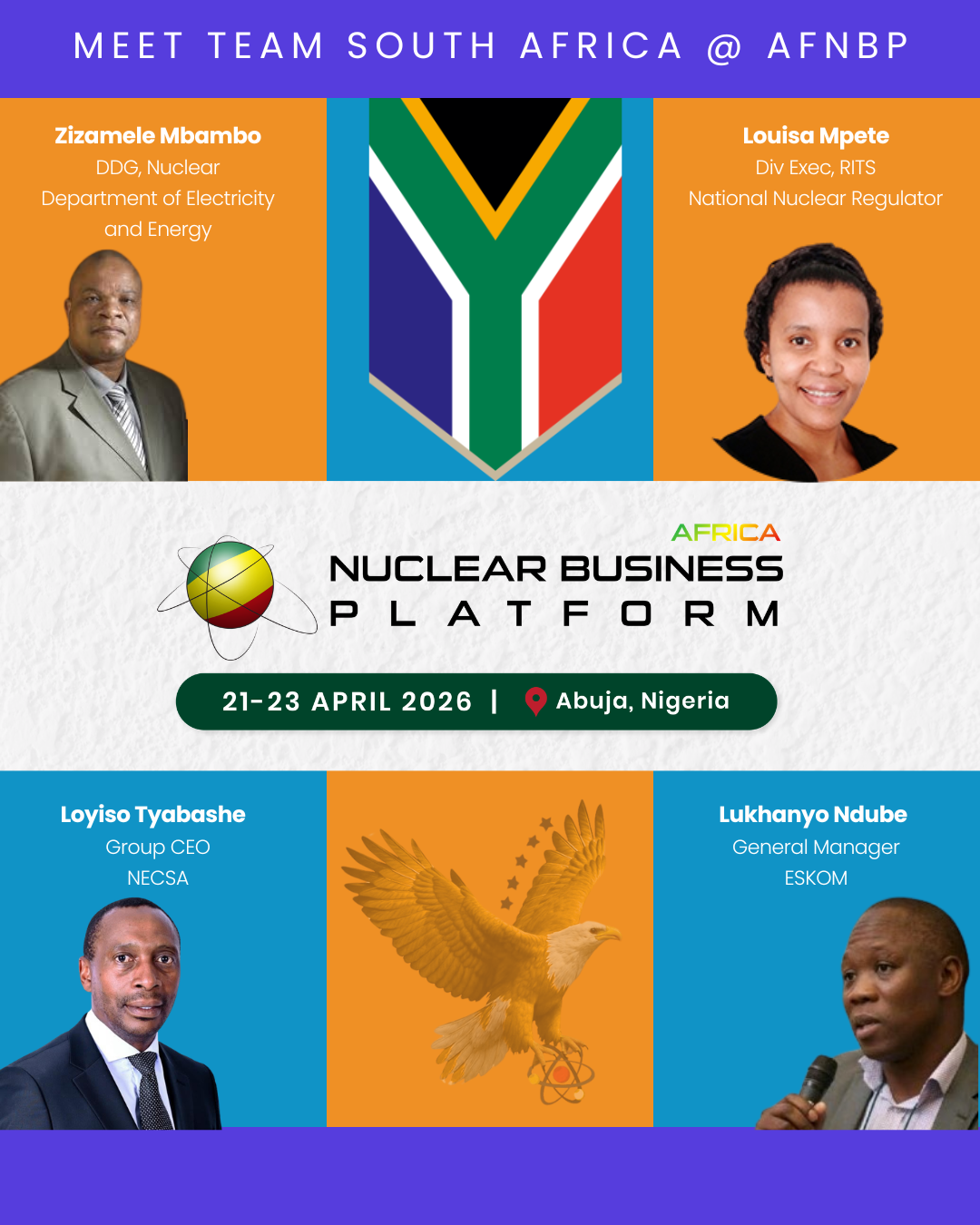
For technology vendors, EPC contractors, financiers, fuel cycle companies, engineering consultants, and skills development partners, the South African nuclear market offers something rare in today's global energy landscape: scale, institutional credibility, and a multiplier effect across an entire continent. Critically, structured engagement between industry and governments is already accelerating this momentum. Platforms such as the Africa Nuclear Business Platform's 5th Edition (AFNBP 2026), hosted by the Nigeria Atomic Energy Commission (NAEC) in Abuja, Nigeria, from 21-23 April 2026, are where vendors, investors, and policymakers converge to shape the deals and partnerships that will define the continent's nuclear decade. The $105 billion pan-African nuclear pipeline begins here, with Africa's only proven nuclear operator.