
The $200 Billion Convergence: Pairing India’s AI Infrastructure with Nuclear Power
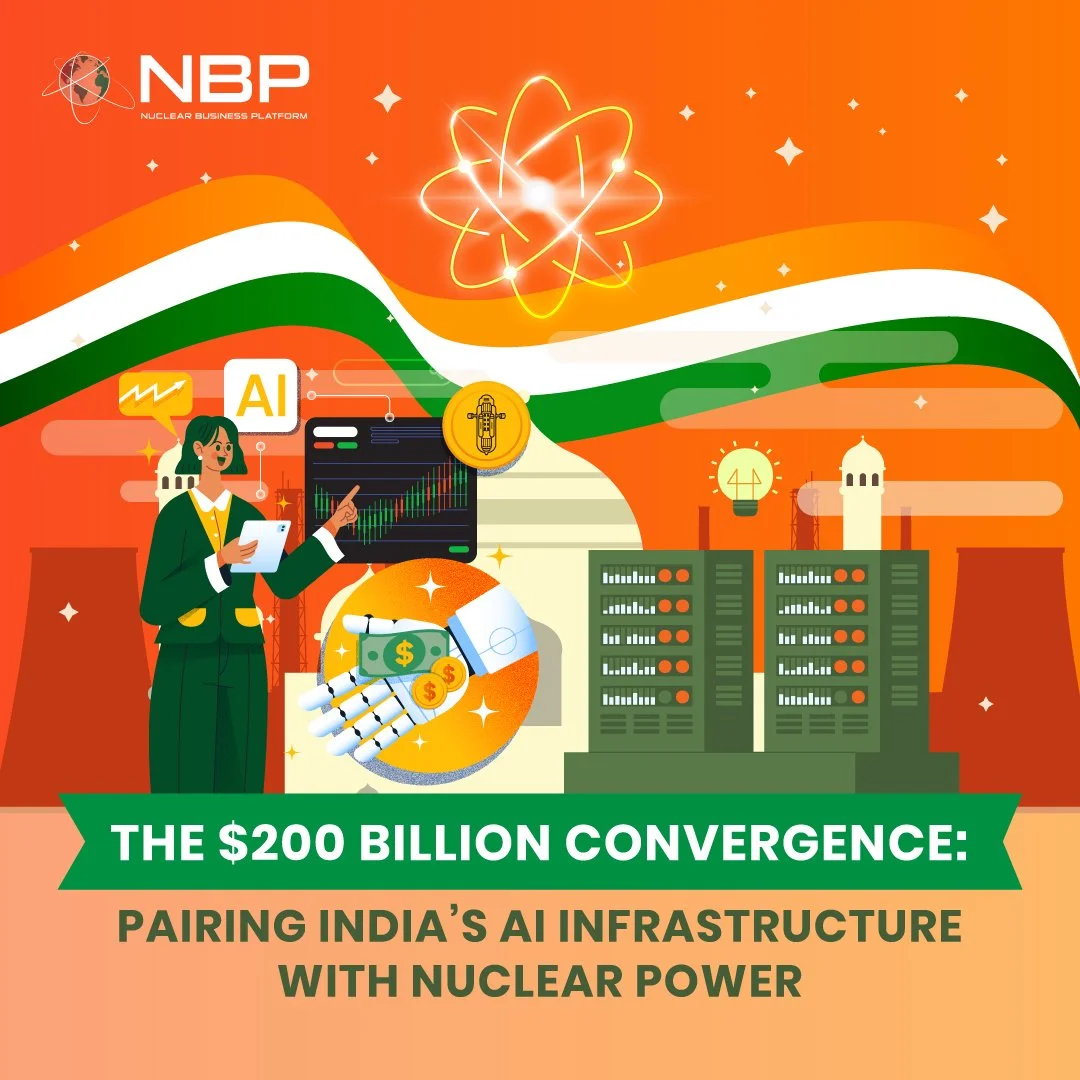
The global AI race is no longer abstract. It is capital-intensive, infrastructure-heavy and increasingly geopolitical. Nowhere is this more visible than in India. Hyperscalers, including Amazon, Microsoft, Meta and Alphabet, have signalled capital expenditure that could approach $700 billion globally this year as AI infrastructure scales at unprecedented speed. A growing portion of that capital is now being channelled toward India.
The numbers are no longer exploratory. Microsoft is committing $17.5 billion to expand data centres and AI infrastructure across India over the next four years, its largest investment in Asia. Google has pledged $15 billion toward a new data centre hub in Andhra Pradesh. Amazon plans to invest $35 billion through 2030, adding to the roughly $40 billion it has already deployed in India since 2010.
Domestic capital is moving in parallel. Reliance has reportedly outlined plans to invest $110 billion into data centres and digital infrastructure. Adani has announced a $100 billion AI-driven data centre buildout over the coming decade. Meanwhile, U.S. asset manager Blackstone has participated in a $600 million equity raise for Indian AI infrastructure firm Neysa.
At the policy level, India has approved $18 billion in semiconductor projects to strengthen domestic chip manufacturing. Washington and New Delhi are edging toward deeper trade cooperation, including the Pax Silica initiative aimed at securing silicon-based technology supply chains.
India is not being positioned as an outsourcing hub. It is being built as a core AI infrastructure market. And that completely changes the energy equation.
AI’s Invisible Constraint: Power
According to Deloitte, India has the highest generative AI adoption rate in Asia-Pacific, with 90% of students and 80% of employees actively using AI tools. That demand is translating into physical infrastructure at scale. Data centre capacity in India is projected to more than triple to approximately 4.5 GW by 2030. This is not incremental. It is equivalent to multiple large-scale power stations dedicated purely to digital infrastructure.
AI workloads are power-intensive and continuous. Model training clusters, inference engines, hyperscale cloud regions and semiconductor fabrication facilities do not operate intermittently. They require stable, high-density baseload electricity.
As long as expansion was modest, energy procurement remained a secondary operational issue. But at this scale, tens of billions in data centre investment and gigawatt-level load growth, power ceases to be background infrastructure. It becomes strategic.
India’s grid is expanding, and renewables are growing rapidly. Yet renewable energy, by definition, introduces intermittency. Grid congestion, transmission bottlenecks and pricing volatility remain structural features of fast-growing markets.
When your AI infrastructure commitments stretch over decades, electricity volatility becomes a financial risk variable. This is where nuclear enters the conversation — not as a climate statement, but as a capital hedge.
The SHANTI Act Changes the Investability Equation
For decades, India’s nuclear sector operated under a state-dominated framework. That has now shifted. The Sustainable Harnessing and Advancement of Nuclear Energy for Transforming India (SHANTI) Act of 2025 represents the most significant reform in the country’s nuclear policy architecture. The Act ends the long-standing state monopoly and allows private sector participation through public-private partnerships, joint ventures and independent power producer models.
Critically, it permits up to 49% foreign direct investment in nuclear projects. While the majority foreign control remains restricted, structured participation through JVs, sovereign funds and technology partnerships is now possible.
In parallel, India is accelerating its Small Modular Reactor (SMR) programme, with a ₹20,000 crore allocation in the 2025–26 budget to deploy five Bharat Small Reactors by 2033. International collaboration with Russia and France further signals long-term commitment.
For Big Tech, this is not about entering a new industry out of curiosity. It is about the emergence of nuclear energy as an investable infrastructure class at precisely the moment when AI energy demand is compounding.
From Power Purchaser to Strategic Stakeholder
Consider the capital alignment. Microsoft’s $17.5 billion commitment. Google’s $15 billion. Amazon’s $35 billion through 2030. Reliance’s $110 billion. Adani’s $100 billion.
These are not short-cycle investments. Data centres are multi-decade assets. AI infrastructure is capital-intensive and geographically fixed. Semiconductor ecosystems require long planning horizons. When the digital asset base becomes long-duration, energy sourcing must match that duration.
Nuclear energy offers 40–60 years of predictable output. Unlike gas or coal, it is insulated from commodity price shocks. Unlike renewables, it delivers continuous baseload generation without intermittency.
For hyperscalers operating on thin competitive margins in cloud services, even small long-term variations in electricity cost compound meaningfully over time. Therefore, participation in nuclear projects, whether via minority equity stakes, long-term power purchase agreements tied to ownership, or structured joint ventures, can provide pricing insulation across decades.
The Strategic Upside Beyond Electricity
The opportunity extends further. First, equity participation in nuclear projects offers exposure to long-lived, sovereign-backed infrastructure assets, traditionally the domain of pension funds and sovereign wealth funds. Early entry under a reformed framework may provide advantageous positioning.
Second, digital integration opportunities are significant. Nuclear facilities increasingly depend on advanced monitoring systems, AI-driven predictive maintenance, cybersecurity frameworks and data analytics platforms. The same firms building AI capacity can supply the digital backbone of these plants.
Third, an integrated AI-plus-nuclear model could become exportable. Many emerging markets face similar pressures: rising digital demand, grid constraints and renewable intermittency. If India becomes a test case for pairing hyperscale AI infrastructure with modular nuclear deployment, early participants gain a template advantage.
Fourth, ESG positioning improves without reliance solely on renewable intermittency. Nuclear energy’s low-carbon profile strengthens sustainability narratives while providing operational stability.
Moving Forward
Nuclear investment is not without risk, long development cycles, capital intensity and regulatory oversight demand patience. But hyperscale AI infrastructure carries similar long-horizon commitments. Data centres, semiconductor fabs and digital sovereignty strategies are not agile experiments; they are decades-long capital deployments. The relevant comparison is therefore not nuclear versus flexibility, but long-duration digital capital versus long-duration energy capital.
As India scales toward becoming a global AI hub, with multi-gigawatt data centre expansion and tens of billions in committed technology investment, electricity moves from operational detail to strategic foundation. Cost stability, baseload reliability and infrastructure control will increasingly shape competitive positioning.
In this context, the 7th edition of the India Nuclear Business Platform (INBP), scheduled for 16–17 June 2026 in Mumbai, assumes particular strategic significance. As the first major global convening following the SHANTI reforms, INBP 2026, under the theme “India’s Nuclear 100: Delivering the $200 Billion Opportunity”, signals that the country’s nuclear sector is transitioning from policy ambition to investment proposition.