
Why Stakeholder Engagement Will Decide Who Wins ASEAN's Nuclear Race
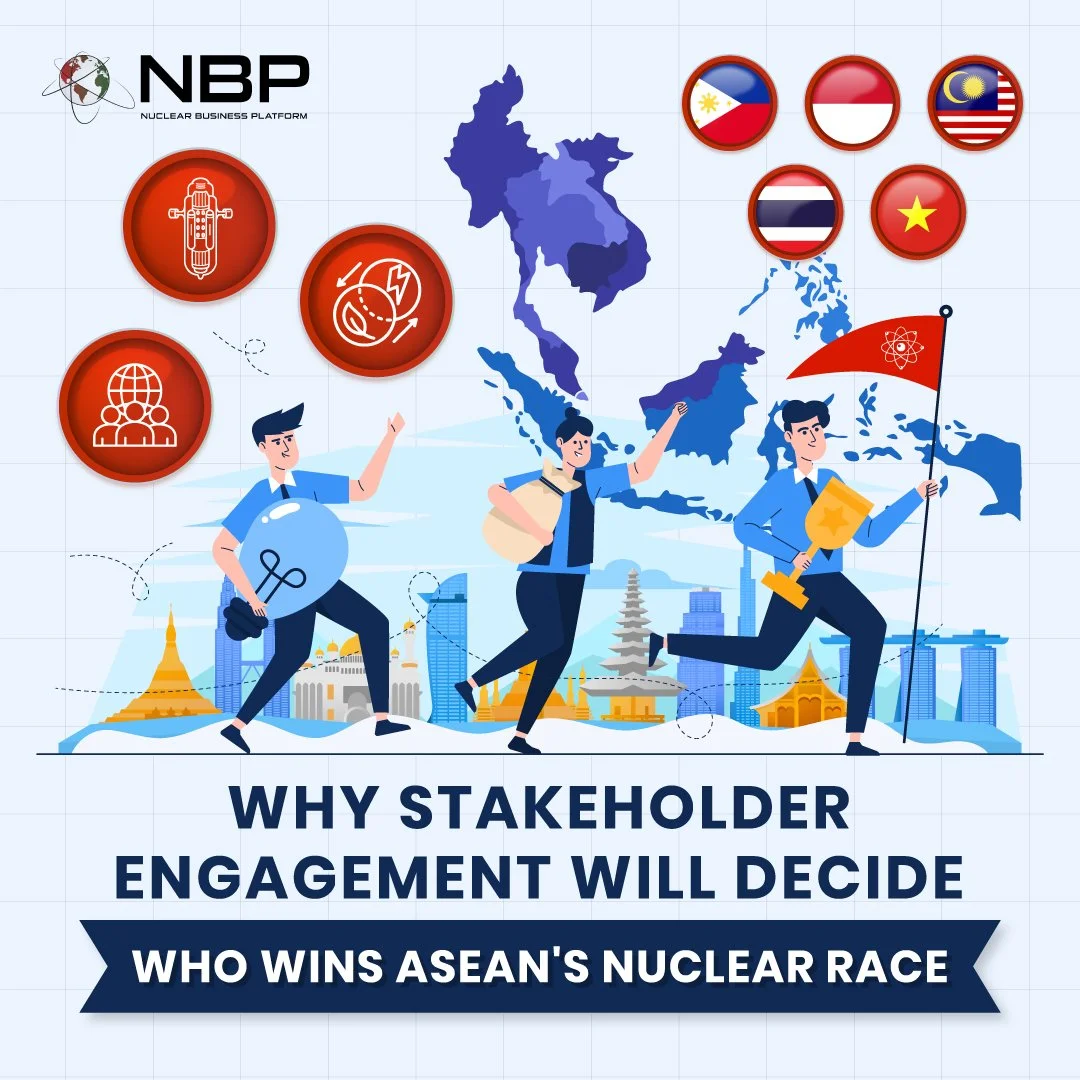
Southeast Asia's nuclear pipeline is now valued at roughly $208 billion. Every major reactor vendor — American, Korean, Russian, and European — is chasing a share of it. But the vendors circling loudest are not necessarily the ones best positioned to win. In a region where nuclear power is being built from a near-standing start, the deciding factor will not be reactor design, cost per megawatt, or even financing terms. It will be the seriousness, or the superficiality, of stakeholder engagement. Vendors who treat this as a sales cycle will lose to those who treat it as institution-building.
The Region Is Not One Market. It Is Five Negotiations.
The Philippines: a 123 Agreement, multiple US agencies engaged simultaneously, a $2.7M USTDA feasibility study for Meralco — and Meralco simultaneously signed a tripartite MOU with KHNP and Korea's Eximbank. The lesson: the utility is the real stakeholder, and it is shopping. Indonesia: regulatory sequencing is the challenge. Vendors engaging now are shaping the rules the deals will be judged by — not closing deals. Those who wait until the regulatory agency is fully operational will find standards already set. Malaysia: the newest market, but a July 2025 US strategic MOU shows a government cultivating a preferred partner before the formal framework exists. Thailand: the US 123 Agreement, in force since July 2025, reflects sustained engagement that predates the commercial opportunity it now unlocks. Vietnam: the cautionary tale. Rosatom secured the Ninh Thuan 1 IGA (23 March 2026) within a year. Western vendors weren't fast enough. Ninh Thuan 2 remains open — but it's now a catch-up contest.
Engagement Is the Strategy, Not a Precursor to It
Three disciplines define success: (1) Financing engaged early and jointly — USTDA instruments work because they're woven into feasibility, not the closing stage; (2) Treaty frameworks as engagement platforms, not just legal cover — the treaty is the invitation, not the deal; (3) Multi-purpose applications — Indonesia's hydrogen co-generation engagement produces fundamentally more durable conversations than grid power pitches alone. The vendor with the most patient, structurally embedded stakeholder relationships will be the one standing when contracts are signed. NBP's Asia Nuclear Business Platform (ANBP) 2026 (November, Hanoi, Vietnam) is where these relationships are being built.