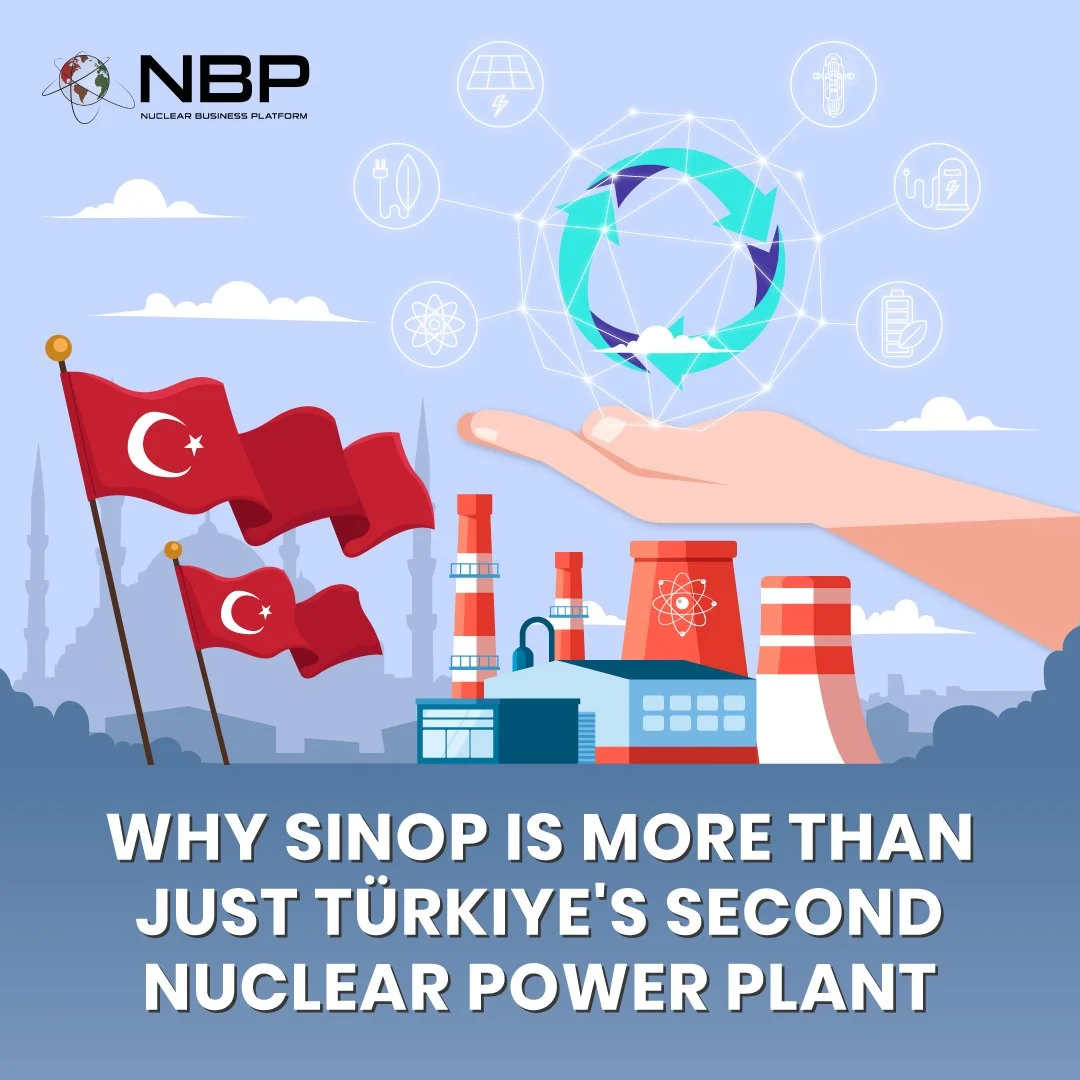
Why Sinop Is More Than Just Türkiye's Second Nuclear Power Plant
For most of the past decade, the international nuclear business community has trained its attention on Akkuyu. Four VVER-1200 reactors, the first nuclear plant ever built under a BOO model, advancing through commissioning in a NATO member state. But as Akkuyu moves into operation, the next major chapter of Türkiye's nuclear programme is taking shape — and it is centred on the Black Sea. Sinop is the project the global nuclear business community should now be focused on.
What Sinop Is and Where It Stands
4,800 MW, Sinop peninsula on the Black Sea coast, targeted via a trilateral framework involving Türkiye, the United States, and South Korea. Generation III+ technology — placing Sinop firmly within the Western and allied nuclear technology ecosystem. This defines technology standards, financing instruments, supply chain access, and the regulatory framework governing construction and operation.
Why the US-Korea Framework Changes Everything
Akkuyu is a Russian project built within Rosatom's supply chain — the commercial opportunities for non-Russian firms were real but bounded by Rosatom's ecosystem. Sinop is structurally different. Candidate technologies: APR-1400 (KHNP, operational credentials established at Barakah) and options from the US vendor field. Both built on Western regulatory standards compatible with IAEA guidelines and consistent with US EXIM Bank, KEXIM, and European ECA procurement practices. These financing tools were not available to Akkuyu. For firms that watched Türkiye from a distance because Akkuyu's structure limited their participation, Sinop is a genuine and structurally open entry point.
The Supply Chain Opportunity
Akkuyu validated Turkish industrial capability: electromechanical materials (86% domestic), hydrotechnical structures (85% domestic), pipeline products (51% domestic). That verified supplier base transfers to Sinop's EPC structure. But Akkuyu's data also reveals the gap: electrical equipment — 85% foreign supply, due to the absence of qualified Turkish nuclear electrical manufacturers. This is a priority localisation target at Sinop. For international electrical equipment firms with nuclear safety qualifications: engage now, form joint qualification programmes with Turkish partners, arrive at vendor selection with a co-production arrangement already in place.
The Timing and Why It Matters Now
Sinop is entering the phase where today's decisions define the commercial landscape for the decade ahead. Intergovernmental frameworks, technology preferences, regulatory engagement, and financing architectures will soon be formally discussed. Nuclear supply chain positions are not won at the tender stage — they are built in the years before, through accumulated technical credibility, institutional familiarity, and demonstrated commitment. Firms engaged now will be best positioned when procurement formally opens. Firms that build credible Sinop positions build foundations for a relationship with Türkiye's nuclear programme spanning decades and tens of gigawatts. NBP's Türkiye Nuclear Business Platform (TNBP) 2026 (26–27 August, Ankara) will bring together policymakers, investors, utilities, technology vendors, and supply chain leaders.