Africa's SMR Market 2026: The $105B Market Every SMR Vendor Should Watch
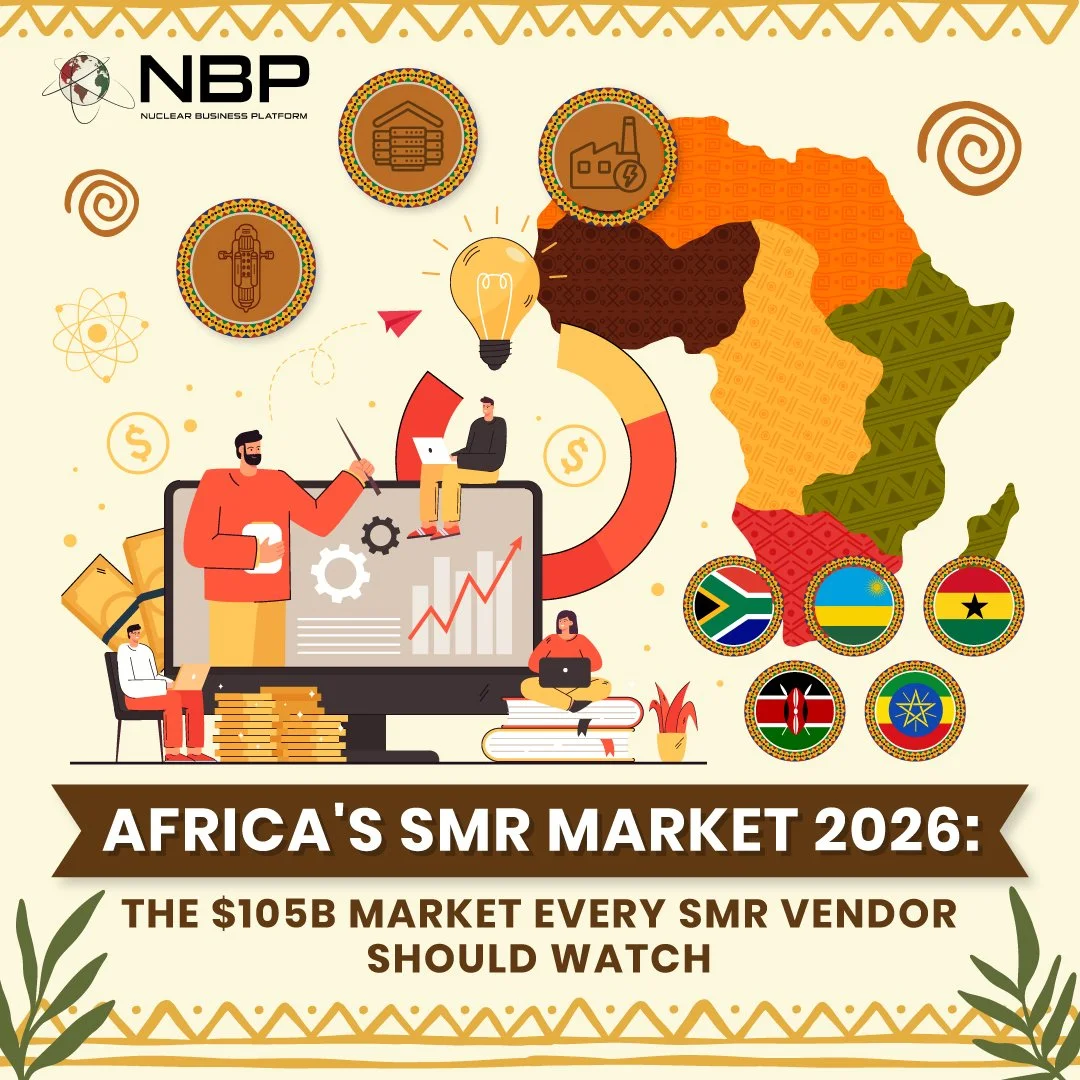
Africa's nuclear market is no longer a long-range projection. The continent could add up to 15,000 MW of nuclear capacity by 2035, representing an investment pipeline of approximately $105 billion. The global SMR market is projected to expand at a CAGR of 29%, reaching $53.8 billion by 2036. Africa is increasingly central to that trajectory.
Why SMRs Are Finding a Specific Role in Africa's Market
Most African national grids cannot absorb the sudden loss of a gigawatt-scale generator. SMRs, typically under 300 MWe per module, allow incremental additions that match how African grids are actually growing. Their factory manufacturing model shifts cost risk from on-site construction — where Africa has limited nuclear experience — to controlled industrial production. Beyond grid integration: Africa holds ~14% of global uranium production and significant critical mineral deposits. Off-grid mining operations need continuous 24/7 power — SMRs with 3–7 year refuelling cycles compete directly against diesel. Data centre expansion in digital hubs like South Africa needs reliable, clean baseload.
The Active National Pipelines
South Africa: IRP 2025 approved by Cabinet October 2025 — binding mandate for 5,200 MW by 2039, first 1,200 MW by 2036, part of R2.23 trillion ($128B) strategy. Necsa launched SMR Expression of Interest on 31 March 2026. PBMR programme revived November 2025 with IP transferred from Eskom to Necsa. Rwanda: Holtec SMR-300 agreement for up to 5 GW with Hyundai E&C. Rosatom commercial nuclear agreement signed 15 May 2026 (SMR operational 2030–2032). Plus Dual Fluid Energy demonstration reactor and Nano Nuclear micro-reactors. Most open SMR competitive environment in Africa. Ghana: 1 GW by 2034, NuScale + Regnum + Japanese firms announced March 2025, with adjacent industrial hub for local off-takers. Kenya: NuPEA targeting 2027 construction, 2,000 MW Siaya County, first power 2034. Evaluating Rosatom, China, US, and PSSECC/Rolls-Royce (two 470 MW SMRs). Research reactor at Konza with KAERI (September 2025). Ethiopia: Rosatom 2,400 MW (two reactors) by 2032–2034. Nigeria and Morocco: active SMR policy development.
What Vendors Need to Prepare For
Prequalification criteria are becoming more structured: technical readiness, multi-decade financial capacity, and credible localisation + skills transfer commitments. Pure technology exporters without a localisation strategy will find procurement processes increasingly resistant. Regulatory maturity varies — nuclear liability legislation gaps create legal exposure. Kenya's Siaya County experience shows community opposition can disrupt timelines even in committed national programmes. The World Bank's June 2025 lifting of its nuclear financing ban opens a multilateral channel previously unavailable. Blended finance structures (sovereign guarantees + export credit + development banks) are the bankability pathway. Vendors arriving with financing already mapped are in a materially stronger position. NBP's Africa Nuclear Business Platform (AFNBP) is the primary industry convening for these conversations. The Africa Nuclear Industry Report 2025 provides detailed country analysis.