Türkiye's Nuclear Market: The Five-Year Roadmap International Firms Can't Ignore
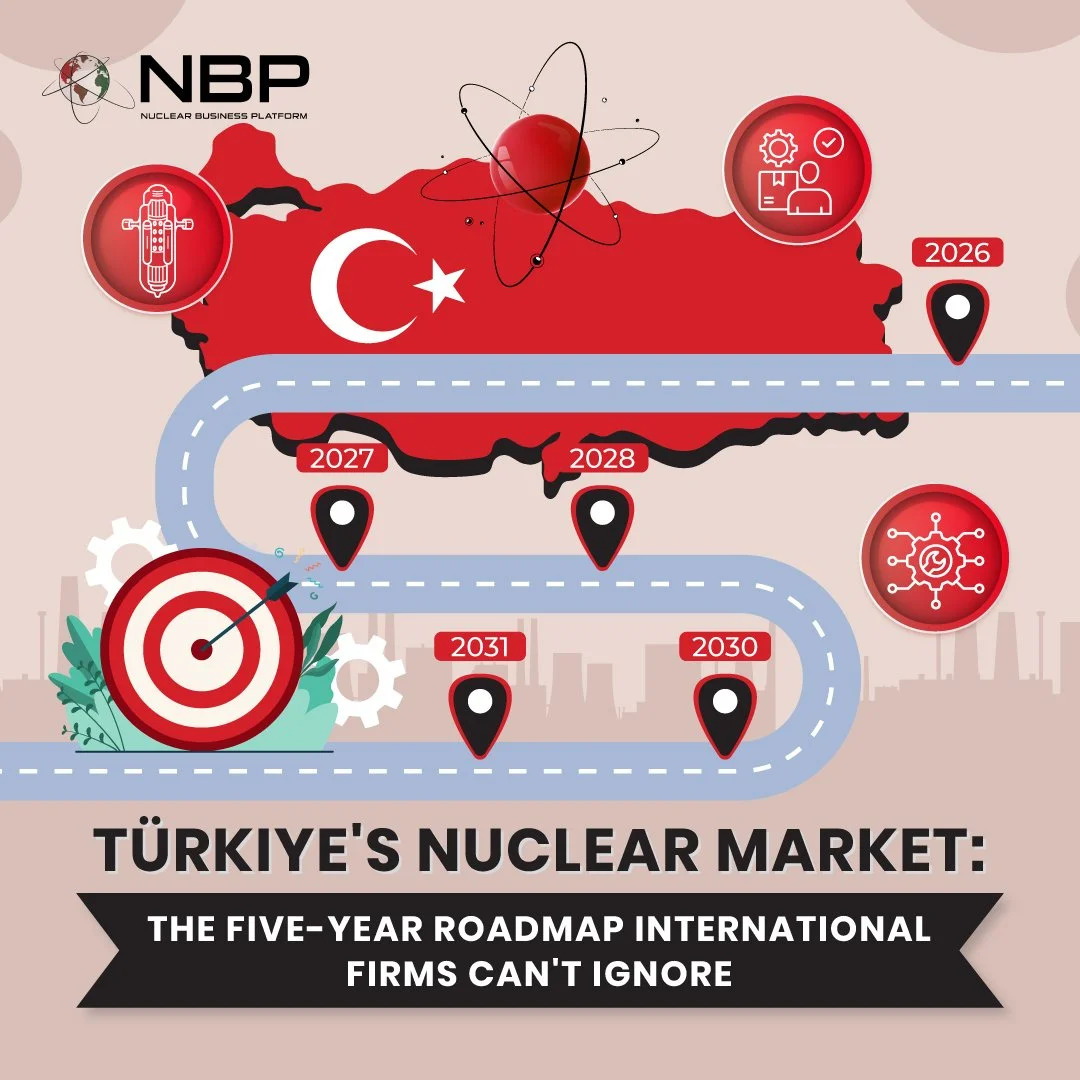
Most analysis of Türkiye's nuclear industry focuses on what is already built — Akkuyu's four VVER-1200 units in commissioning — or what is ultimately planned — a 20 GW target by 2050. What gets less attention is the five-year window between now and 2031, which is where the commercial activity will be most concentrated, the decisions most consequential, and the entry opportunities for international firms most accessible. Four major decision streams are converging simultaneously, and firms that map them accurately will find one of the most commercially dense nuclear timelines currently active in any single country.
2026 to 2027: Akkuyu Enters Operation and Creates Sustained Demand
Akkuyu's four units are in various stages of commissioning and early operation. Unit 1 is targeting first electricity generation in 2026, with the remaining three units expected to come online sequentially through 2028, bringing the full 4,800 MW plant to complete operation. A nuclear plant in full operation generates a continuous and multi-decade demand stream for components, services, and systems that the construction phase does not — replacement parts, scheduled maintenance, inspection equipment, simulation and training infrastructure, and digital upgrades across instrumentation and control. For firms without a prior position in Türkiye's nuclear market, Akkuyu's operational phase is a more accessible entry point than construction was, because procurement structures for operational services are less dominated by the main EPC contractor relationship.
2027 to 2028: Sinop Vendor Selection and the First Major Western Contract
The Sinop Nuclear Power Plant, a planned 4,800 MW project on Türkiye's Black Sea coast, is the most commercially significant procurement decision expected in the next five years. The project is being negotiated under a framework including the United States and South Korea. Candidate technologies include Westinghouse's AP1000 and KHNP's APR-1400. For Western firms specifically, Sinop is the first major entry point into Türkiye's nuclear programme that does not run through Rosatom's supply chain ecosystem. Sinop's vendor selection will also carry a signal effect across the region: if a Western technology wins at Sinop, it strengthens that technology's commercial position across every subsequent Middle East and Central Asian nuclear procurement where Türkiye's programme serves as a regional reference.
2028 to 2030: The SMR Programme Moves from Policy to Procurement
Türkiye has a formal government target of 5,000 MW of SMR capacity by 2050, supported by active discussions with developers from the US, Canada, France, and the UK including Rolls-Royce. The nuclear technopark announced by President Erdoğan in March 2025 and the domestic SMR development call issued to Turkish industry are both targeted at this programme. Between 2028 and 2030, these policy foundations are expected to translate into concrete feasibility commitments, site selections, and early procurement frameworks. Deployment targets include industrial clusters, data centre corridors, and locations currently dependent on expensive imported fossil fuel generation. Firms offering only technology without a localisation pathway will find the procurement terms less favourable than those that align with Türkiye's explicit industrial ambitions.
2030 to 2031: Thrace Decision and the Completion of a Three-Plant Industrial Base
The Thrace Nuclear Power Plant, a proposed 5,600 MW project in European Türkiye being developed with China's SPIC using CAP1400 technology, is the third large reactor programme in Türkiye's pipeline. Its construction decision, expected within the 2030 to 2031 window, would complete a three-plant large reactor base totalling approximately 15,200 MW alongside the SMR programme. A country operating three large nuclear plant programmes simultaneously, across three different vendor technology families, with an SMR programme running in parallel, is no longer simply a nuclear electricity consumer. It is a nuclear industrial economy. By 2031, the progressive indigenisation driven through localisation requirements at Akkuyu, technology transfer provisions at Sinop, and the technopark framework will have produced a domestic industrial base with genuine export potential. NBP's Türkiye Nuclear Business Platform (TNBP) 2026 (26–27 August, Ankara) is the primary forum where policymakers, investors, utilities, and technology vendors are shaping the commercial and partnership frameworks that will define this five-year roadmap.