
Southeast Asia's Nuclear Market: A Five-Year Commercial Roadmap for Vendors
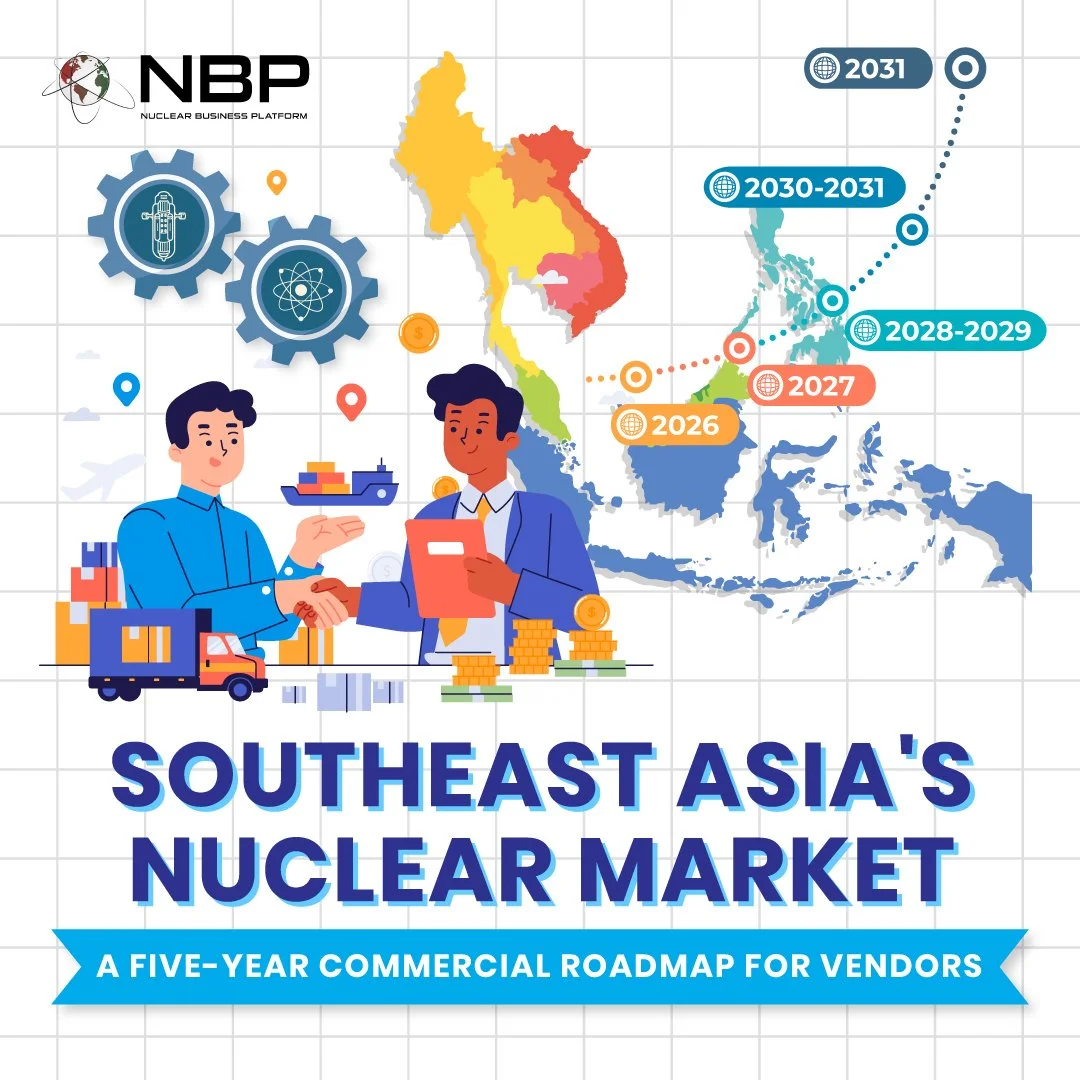
Southeast Asia's nuclear market is valued at USD 208 billion across five active procurement environments. The bilateral frameworks are signed, feasibility studies are underway, and vendor competitions are open. What most market analysis does not provide is a practical timeline: which decisions happen when, which commercial windows open in which year, and what a vendor needs to have done before each one arrives. This roadmap covers the five-year period from 2026 to 2031, organised by what is actually expected to happen year by year rather than country by country. For international vendors, this is the calendar that matters.
2026: Feasibility Outputs and the Last Window for Influence
The most important commercial reality of 2026 is that feasibility studies across the region are concluding, and their outputs will define vendor selection criteria before formal tenders open. In the Philippines, the USTDA-funded feasibility study directed at Meralco is producing its SMR technology evaluation and site assessment. Malaysia's feasibility study runs through 2026 and will produce the technical baseline for its 1.2 GW SMR target by 2035. In Vietnam, Russia secured an intergovernmental agreement for Ninh Thuan 1 on 23 March 2026, covering two VVER-1200 reactors at 2,400 MW. Ninh Thuan 2 remains without a confirmed vendor — vendors need to be building relationships with PetroVietnam and VARANS now. NBP's Asia Nuclear Business Platform (ANBP) 2026 in Hanoi (3–5 November) is the single most important structured engagement event in the region this year.
2027: Philippines and Thailand Move Toward Vendor Selection
The Philippines is targeting 1,200 MW by 2032 — vendor selection must happen in 2027. Meralco's tripartite MOU with KHNP and KEXIM means South Korea arrives with an integrated technology-plus-financing package. Western vendors must match that structure. Thailand's EGAT is expected to issue structured vendor engagement frameworks in 2027. The US-Thailand 123 Agreement, in force since July 2025, provides the legal pathway — but converting that into a commercial position requires regulatory engagement now.
2028 to 2029: Vietnam's Second Plant and Indonesia's Industrial SMR Window
By 2028, Ninh Thuan 2's vendor selection becomes a realistic near-term event. Vendors with institutional credibility built from 2026 will be structurally ahead. Indonesia's 9 GW hydrogen nuclear target beginning 2045 creates unique demand for high-temperature SMR designs. Off-grid modular deployment in Sumatra and Kalimantan creates a distinct industrial procurement track with faster decision cycles.
2030 to 2031: Malaysia's SMR Procurement and Regional Supply Chain Consolidation
Malaysia needs a procurement decision by 2030 for its 1.2 GW SMR target by 2035. By 2030–2031, the regional supply chain consolidates around vendors with multi-market positions. A vendor active across Philippines, Vietnam, Malaysia and Indonesia doesn't compete market-by-market. It builds a regional reference portfolio where each win makes the next easier. The vendors that arrive in 2031 to compete for contracts will find the most consequential positions already taken.