
Vietnam's Nuclear Programme: A Decade-Long Business Relationship
Vietnam has done something in 2026 that no other country in Southeast Asia has managed. It has moved a nuclear programme from legislative revival to ground-level construction activity within a single calendar year. An intergovernmental construction agreement signed with Russia. Site clearance and population resettlement launched in Khanh Hoa Province. A financing framework for the second plant assembled within months of Japan's withdrawal. And an IAEA Phase 2 nuclear infrastructure review completed, making Vietnam the only ASEAN nation to reach that institutional milestone. The question for the global nuclear business community is no longer whether Vietnam's programme is real. That question has been answered on the ground. The question is what serious commercial engagement here actually looks like.
Two Plants, Two Distinct Commercial Environments
Ninh Thuan 1 and Ninh Thuan 2 are not the same opportunity. They have different lead investors, different technology frameworks, different financing structures, and different partner ecosystems. Treating them as a single procurement will produce a poorly targeted commercial strategy.
Ninh Thuan 1 is structured around a Rosatom construction framework, with Vietnam Electricity as the Vietnamese investor. Its supply chain will be shaped largely by Rosatom's established component and services network. International firms without prior Rosatom relationships face a narrower entry point at the primary contractor level, but a genuine one at the specialist services and workforce development layer. Engineering advisory firms, nuclear safety consultancies, and training providers are all needed within the Ninh Thuan 1 environment and are not exclusively sourced through Rosatom's primary network.
Ninh Thuan 2 is a different landscape entirely. Japan's withdrawal in December 2025 left the second plant's partner position open, and Vietnam responded with unusual speed. A four-party MOU was signed bringing together Korea Eximbank, Korea Trade Insurance Corporation, KEPCO, and PetroVietnam to explore Korean financing for the project. That MOU is not a contract. It is an active framework within which technology selection, project structuring, and financing terms are still being shaped. The firms that arrive after this framework closes will find the commercial architecture already built around others. The current period is when positions at Ninh Thuan 2 are established, not after.
The INIR Milestone and What It Signals
The IAEA's Phase 2 Integrated Nuclear Infrastructure Review (INIR), completed in December 2025 and delivered to the Vietnamese government in April 2026, is the most underappreciated development in Vietnam's nuclear timeline from a commercial standpoint. INIR Phase 2 is conducted specifically when a country is ready to invite bids for its first nuclear power plant and preparing to commit to construction. Vietnam completing this mission means its regulatory framework, legal infrastructure, human resource pipeline, and nuclear safety architecture have been assessed at the level the IAEA applies to countries in active procurement.
For firms that have been watching Vietnam from a distance and waiting for a credible institutional signal, this is it. The basis for continued deferral of engagement is now substantially weaker than it was twelve months ago.
What Vietnam Cannot Yet Supply Itself
The commercial opportunity in Vietnam's nuclear market is most clearly visible when mapped against what the country currently lacks. Vietnam does not have a domestic nuclear engineering workforce at the scale its programme requires. It does not have deep regulatory review capacity across multiple reactor families simultaneously. It does not have established domestic supply chain capability for nuclear-grade components. And it has no institutional memory of nuclear construction management, because no nuclear plant has ever been built here before.
Each of these gaps is a live commercial opening. Workforce training providers can engage with Vietnamese universities, the Vietnam Atomic Energy Institute, and the two designated project investors to build the human resource pipeline the programme needs. Regulatory advisory firms can support licensing framework development and safety review capacity that will need to scale significantly as both plants move toward active construction. Component manufacturers and specialist engineering firms can establish early supplier relationships that carry forward into the full construction procurement cycle. These are not future opportunities. They are active needs in a programme that is already moving.
The Scale and the Timeline
The combined investment attached to Ninh Thuan 1 and Ninh Thuan 2 stands at approximately USD 22 billion. The broader ambition targets between 4,000 and 6,400 MW from both plants. But the USD 22 billion figure understates the full commercial value of a sustained engagement, because the supply chain, services, workforce development, and regulatory support that accompany a programme of this scale generate revenue across a decade of construction and decades more of operation. Firms approaching Vietnam as a project will capture a fraction of that value. Firms approaching it as a long-term market relationship will capture a multiple of it.
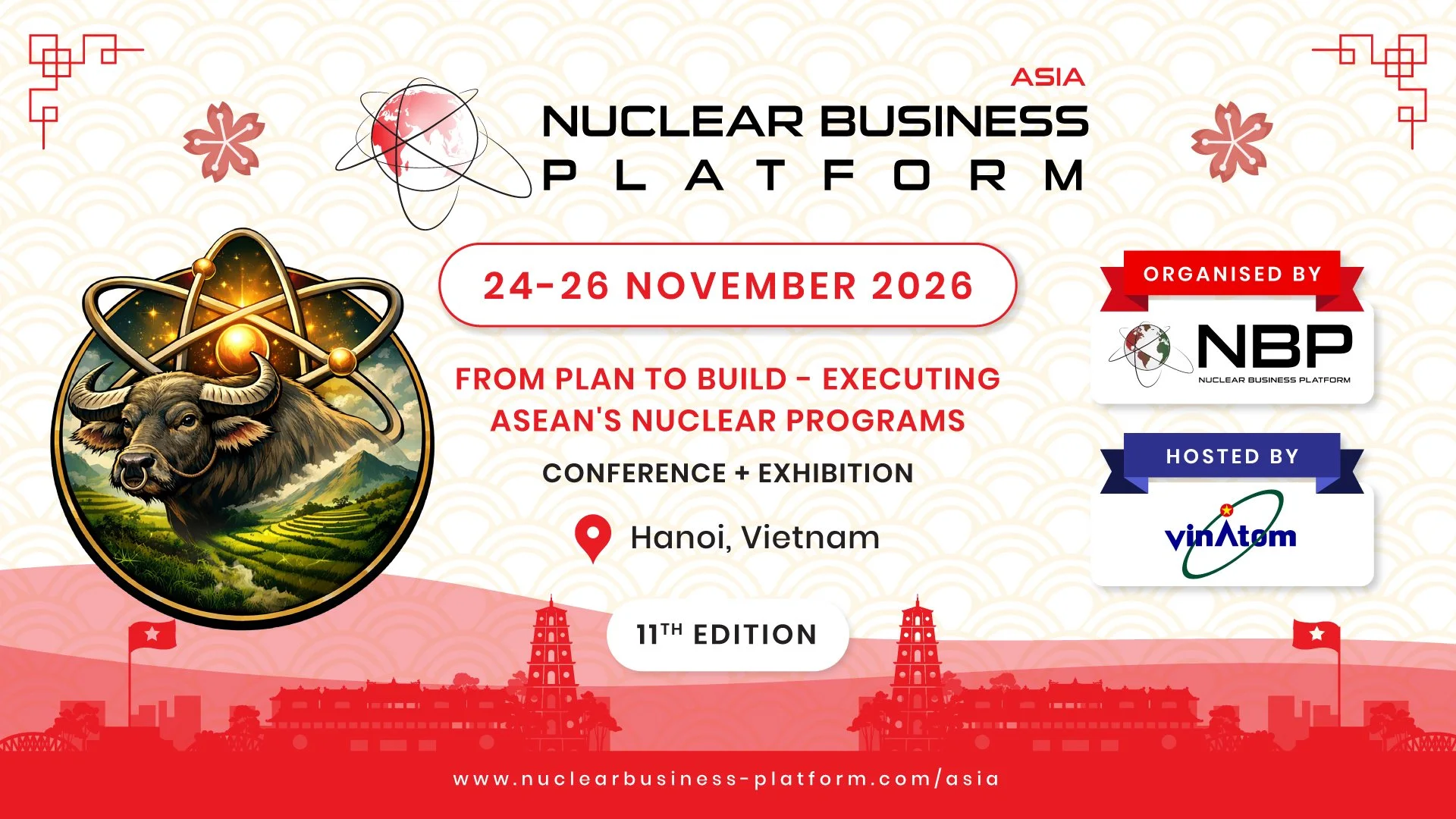
Vietnam is hosting NBP's Asia Nuclear Business Platform (ANBP) 2026 from 24 to 26 November in Hanoi at precisely the moment its own programme is transitioning from preparation to active construction. The relationships that precede contracts are built in environments like this one. Vietnam's nuclear decade has started. The window to establish a position before the commercial architecture is locked is closing.