Africa Is the World’s Most Versatile Nuclear Market. Here’s Why the Entry Window Is Closing
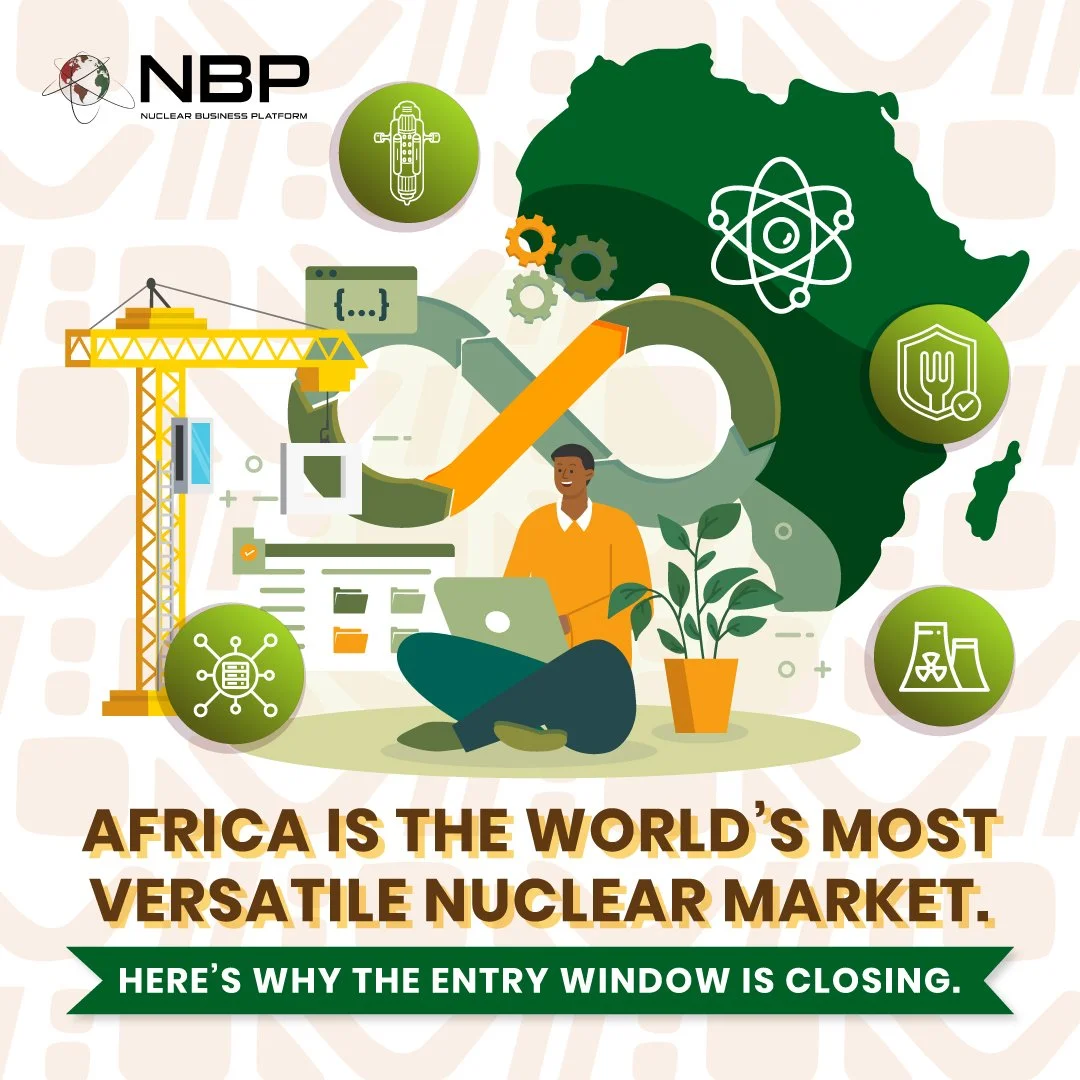
There is a market characteristic more commercially significant than size, and it is rarely discussed in nuclear industry analysis. That characteristic is versatility: the simultaneous presence of multiple technology segments, multiple demand drivers, multiple financing structures, and multiple stages of programme maturity within a single addressable geography. In 2026, no nuclear market in the world possesses that quality to the degree that Africa does. The continent is running concurrent procurement and development activity across large pressurised water reactors, Small Modular Reactors, research reactors, and advanced demonstration units. It is deploying nuclear for grid baseload, industrial growth, desalination, healthcare, food security, and the emerging data centre economy. It spans markets that are construction-ready today and markets that are building their institutional foundations for entry by the end of the decade. For global firms across the nuclear supply chain, that breadth represents an unusually wide distribution of genuine commercial entry points, all active at the same time.
The scale of the underlying opportunity gives that versatility its full weight. Projections by NBP indicate Africa could add up to 15,000 MW of nuclear capacity by 2035, representing an investment pipeline of approximately $105 billion. That figure places Africa among the most significant nuclear growth markets anywhere in the world. But the headline number alone does not capture what makes this market structurally distinctive. Understanding Africa’s nuclear opportunity in 2026 requires understanding not just how large it is, but how it is organised, what is driving it, and why the window for strategic engagement is narrowing faster than most firms currently appreciate.
A Continent Organised for Execution
Africa’s nuclear market is not a uniform bloc. NBP’s analysis categorises the continent’s active nuclear nations into three tiers based on government commitment, programme timelines, and institutional infrastructure development, and the composition of each tier tells an important story about the market’s current state and near-term trajectory.
Tier 1 represents the frontrunners. Seven nations are firmly committed to integrating nuclear power into their energy mix between 2030 and 2037, and they form the commercial core of Africa’s nuclear expansion. Ghana, Nigeria, Uganda, Kenya, and Rwanda are advancing active programmes with defined technology preferences, regulatory frameworks under development, and international partnerships already in place. Egypt is already in construction on its first nuclear power plant, the El-Dabaa facility developed with Rosatom. South Africa, the continent’s only current nuclear operator with 40 years of experience at Koeberg, holds a binding government mandate for 5,200 MW of new nuclear capacity by 2039 as part of a R2.2 trillion national energy investment strategy. These seven markets are where the near-term procurement activity is concentrated, and they represent the primary commercial focus for firms entering the African nuclear space.
Tier 2 adds a second layer of substantive opportunity. Ethiopia, Morocco, Niger, Burkina Faso, and Togo are each advancing national nuclear programmes at varying stages of policy formalisation and vendor engagement. Ethiopia announced its nuclear programme in September 2025 and established the Ethiopian Nuclear Energy Commission (ENEC) in October 2025, with a mandate spanning power generation, healthcare, and industrial applications. The country has committed to two 1,200 MW reactors with commissioning targeted between 2032 and 2034. Niger announced plans in September 2025 for two 1,000 MW pressurised water reactors, leveraging its position as one of the world’s significant uranium producers. Morocco is developing nuclear alongside desalination ambitions and a green hydrogen strategy. These are markets where early positioning now will translate into competitive advantage when formal procurement opens.
Tier 3, encompassing Algeria, Burundi, DR Congo, Guinea, Namibia, Republic of Congo, Senegal, Sudan, Tanzania, Tunisia, Zambia, and Zimbabwe, represents the longer horizon. These are nations where nuclear ambitions are stated but institutional development remains at early stages. Their significance to the current market discussion is prospective rather than immediate, but the pipeline they represent reinforces the structural case: Africa’s nuclear market is a multi-decade expansion across a continent of 54 nations, and the geography of opportunity will continue to widen as Tier 1 and Tier 2 programmes demonstrate execution.
A Demand Profile That Requires Every Technology
The reason Africa has become the world’s most technology-diverse nuclear market is grounded in a single structural reality: the continent’s energy deficit cannot be answered by any single reactor type or deployment model. Over 600 million people across Africa lack reliable electricity access. Industrial growth is outpacing generation capacity in East, West, and Southern Africa simultaneously. The nature of the energy challenge varies fundamentally from one market to the next, and that variation is what drives technology diversity across the continent.
South Africa needs large-scale baseload that can stabilise a national grid currently overdependent on ageing coal infrastructure. Its pre-approved nuclear sites at Thyspunt, Bantamsklip, and Duynefontein, combined with Necsa’s revival of the Pebble Bed Modular Reactor (PBMR) programme for both domestic deployment and potential regional export, reflect a market where proven large reactor technology and indigenous SMR development are advancing in parallel. Ethiopia is building nuclear into the structural foundation of an industrial economy serving over 130 million people, requiring the kind of multi-gigawatt baseload that only large reactors can deliver at the pace required. Rwanda, a landlocked nation of approximately 14 million people targeting 60 to 70 percent of its electricity from nuclear in the long term, is pursuing SMR deployment as the technology most suited to its grid scale and geography. Kenya has engaged in an active multi-vendor process, with an RFP expected by late 2026 and construction targeted for 2027.
Beyond electricity generation, nuclear is being pursued across the continent for desalination in water-scarce markets, for industrial heat in mining and manufacturing, for healthcare applications through medical isotope production, for food security through irradiation technology, and increasingly for data centre power supply as Africa’s digital economy expands at a pace that is beginning to generate serious baseload power requirements. This multi-application demand profile means that the addressable market for nuclear technology in Africa in 2026 extends well beyond the electricity grid, and firms with capabilities in any of these segments have legitimate and active commercial opportunities to pursue.
Infrastructure Crossing the Credibility Threshold
The most persistent challenge to Africa’s nuclear credibility has been the gap between political commitment and institutional readiness. That gap is closing. Across the continent’s leading markets, the regulatory, workforce, and site development infrastructure that international partners require is being systematically built, and the pace of that development accelerated markedly in 2025 and into 2026.
The IAEA conducted a Phase 1 Integrated Nuclear Infrastructure Review (INIR) in Rwanda in March 2026, returning findings that identified good practices in strong government commitment and coordination, proactive engagement with stakeholders, and early and comprehensive preparation for emergency preparedness and response — practices formally recognised as worth sharing with other prospective nuclear nations. Ghana and Nigeria have developed National Nuclear Positions and are in advanced stages of regulatory alignment with international standards. Kenya’s Nuclear Power and Energy Agency (NuPEA) demonstrated the procurement sophistication to run a structured multi-vendor process that attracted serious engagement from multiple competing supplier blocs simultaneously. Ethiopia established the Ethiopian Nuclear Energy Commission (ENEC) in October 2025 with a defined mandate spanning power generation, healthcare, and industrial applications. Niger’s regulatory authority is operational, with engagement with Russia underway following a July 2025 MoU with Rosatom.
South Africa underpins the credibility of the entire regional narrative. Four decades of operational nuclear experience, an established nuclear regulatory framework, a binding procurement mandate from government, stringent local content and industrialisation requirements that create supply chain opportunities for both domestic and international firms, and an active SMR development programme through Necsa combine to make South Africa the continent’s most immediately bankable nuclear market and its most persuasive proof of concept for the region as a whole. When international firms assess the seriousness of African nuclear ambitions, South Africa is the reference point. And that reference point has never been stronger than it is now.
The Strategic Case for Engagement Now
Africa’s nuclear market in 2026 combines scale, diversity, and forward momentum in a configuration that the global nuclear industry has not previously encountered in a single geography. A $105 billion investment pipeline building toward 15,000 MW of new capacity by 2035. Twenty-plus nations at active stages of nuclear programme development, organised across a tier structure that gives the market both near-term procurement opportunity and a long-horizon expansion trajectory. A technology demand profile spanning every reactor class currently in development or deployment globally. An institutional infrastructure that is advancing toward the readiness thresholds that serious capital requires. And a vendor competition of an intensity that confirms, beyond reasonable doubt, that the world’s most experienced nuclear industry participants regard this market as strategically essential.
The argument for engagement is not that Africa’s nuclear market is risk-free. No emerging market is. The argument is that the combination of opportunity scale, technology diversity, advancing institutional readiness, and competitive vendor dynamics makes Africa the most commercially varied nuclear market currently active in the world. Firms that engage now, with a clear value proposition and a commitment to building genuine relationships within the market — often initiated and reinforced through convening platforms such as NBP’s Africa Nuclear Business Platform (AFNBP) 2026, hosted by the Nigeria Atomic Energy Commission in Abuja from 22–23 April 2026 — will be positioned across a pipeline that will compound in value for the next three to four decades. The firms that wait for the market to fully mature before engaging will find that the most consequential positions have already been taken.