
India Is Building 100 GWe of Nuclear Capacity. The Fuel Question Has Not Been Answered
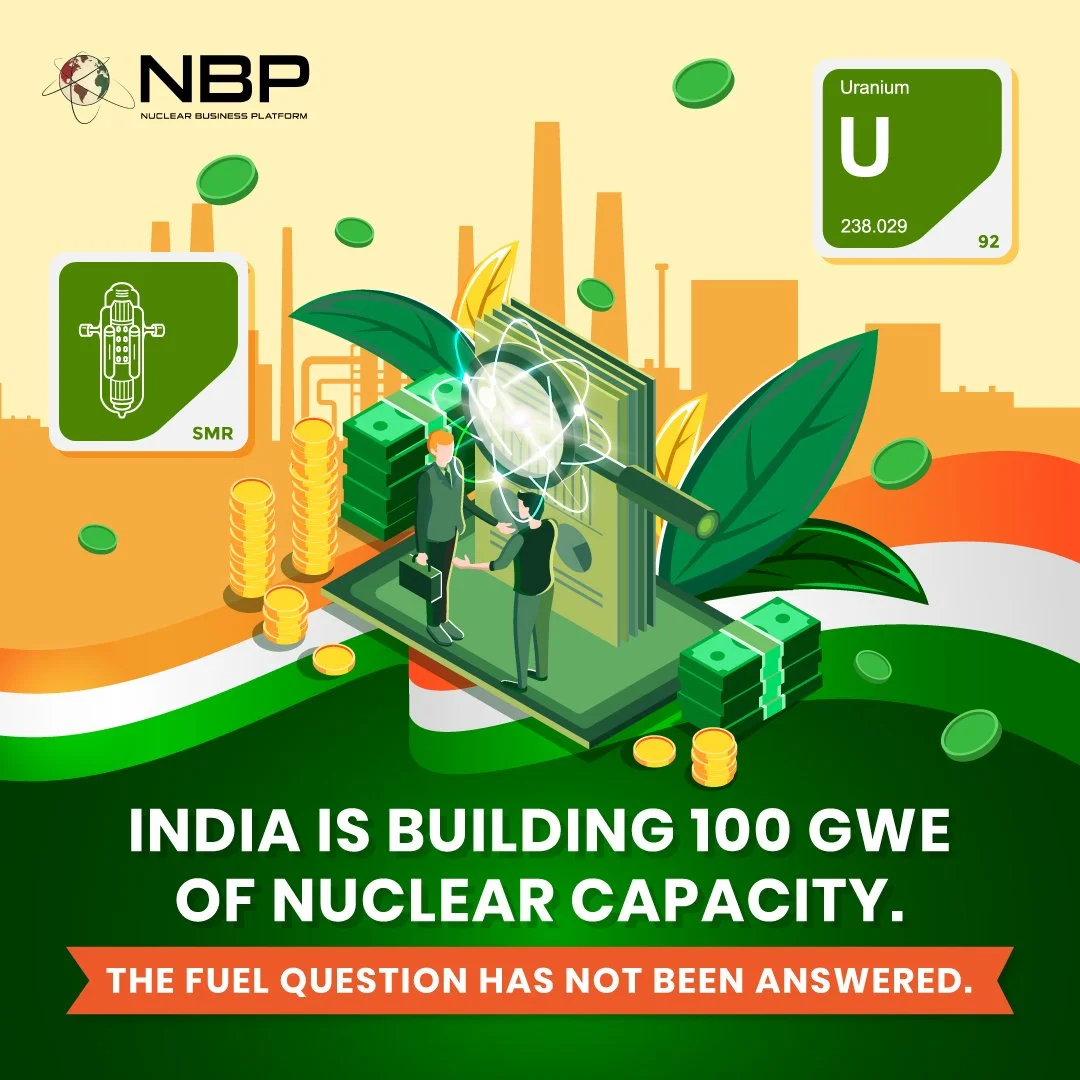
India’s nuclear energy programme is confronting a structural issue that sits beneath its most optimistic policy headlines. The SHANTI Act of 2025 has opened the sector to private capital and — through joint ventures and expected foreign equity guidelines — international participation. A budget allocation of Rs 20,000 crore is backing the deployment of Small Modular Reactors by 2033, and the 100 GWe target by 2047 signals political intent that the sector has not seen in a generation. For international vendors, technology partners and project developers watching India, the direction is genuinely encouraging. The fundamental question, however, is not whether India is moving forward on nuclear energy. It is whether the fuel supply strategy is keeping pace with the construction ambitions being announced.
India’s domestic uranium reserves are limited and commercially constrained. Achieving 100 GWe of nuclear capacity is estimated to require between 18,000 and 20,000 tonnes of uranium annually — roughly one-third of current global uranium production. The country cannot meet that figure from its own ground. If the programme scales as planned without a credible parallel effort to secure fuel supply, India will have built an expanding fleet of reactors with a structural import dependence at its core. That is not an energy security strategy. It is a deferred version of the same vulnerability that crude oil already creates every time the Middle East enters a period of geopolitical instability.
The Exploration Investment Gap and Its Business Consequences
A parliamentary standing committee has recently flagged that the Atomic Minerals Directorate for Exploration and Research (AMDER) is underfunded, with a capital shortfall of Rs 118.18 crore in the current budget cycle, and has called for the full shortfall to be restored at the revised estimate stage for 2026–27. The committee’s recommendation rests on a straightforward operational reality: uranium exploration carries a lead time of eight to twelve years between initial survey work and actual mine production. This means that investment decisions made today determine fuel availability in the mid-2030s, which is precisely when India’s expanded nuclear capacity will begin coming online in meaningful volume.
Treating exploration funding as a discretionary budget line is therefore not a conservative fiscal choice. It is a risk being loaded onto the programme’s future. For international nuclear vendors and project developers currently assessing India’s market under the SHANTI Act’s investment framework, this is a material consideration. A country building toward 100 GWe while its domestic fuel pipeline remains underdeveloped will become a large and sustained uranium importer. That creates commercial opportunity, but it also introduces procurement risk, price exposure, and the kind of supply chain complexity that complicates long-term project economics. Vendors entering India through joint venture and private participation provisions will want clarity on how the government intends to manage fuel security across the programme’s lifetime, because reactor construction timelines and fuel supply timelines need to be planned together, not treated as separate decisions.
The Thorium Question Cannot Be Postponed Indefinitely
India holds one of the world’s largest reserves of thorium — approximately 25% of known global reserves — a resource that carries the genuine potential to provide energy independence for over two centuries if the full thorium fuel cycle is operationalised. For years, this was treated as the long-term answer to India’s uranium constraints and the eventual foundation of the country’s three-stage nuclear programme. Today, that confidence is harder to locate. India’s thorium-based Advanced Heavy Water Reactor (AHWR) has remained largely at the design stage without progressing into construction. Dr. Anil Kakodkar, one of the principal architects of India’s nuclear programme, has been explicit in warning that abandoning the thorium path would be a serious strategic error for the nation.
That warning deserves to be taken seriously in business terms, not just scientific ones. A country sitting on one of the world’s largest thorium reserves and choosing not to develop the technology to utilise them is leaving its most significant long-term energy asset idle. The thorium programme is not a competitor to the current expansion strategy. It is the stage that makes long-term energy sovereignty possible. Treating it as a background priority while front-loading import-dependent capacity is a sequencing choice that will have permanent consequences for the programme’s independence.
It is worth noting that India’s three-stage programme does have a structural pathway toward thorium. The Prototype Fast Breeder Reactor (PFBR) at Kalpakkam, which achieved criticality in 2025, represents the operationalisation of Stage 2 — a critical prerequisite for Stage 3 thorium deployment. The AHWR question is therefore not whether the architecture exists, but whether the pace of progression is consistent with India’s expanded capacity ambitions.
What the Market Opportunity Actually Requires
India’s nuclear market is opening at a scale that is genuinely significant for the global industry. The SHANTI Act’s provisions for private participation, the SMR programme targeting at least five indigenously developed reactors by 2033, and the long-term 100 GWe capacity target together represent a sustained pipeline of procurement, construction and technology collaboration. International players looking at this market are right to assess it as a major opportunity. The context that needs to accompany that assessment, however, is that the opportunity is being built on a supply-side foundation that remains incomplete.
The 100 GWe target is achievable. Whether it is achievable on India’s own strategic terms — with sovereign fuel security at its foundation — depends on decisions being made in the current budget and planning cycle. Exploration investment, thorium programme timelines, and domestic fuel strategy are not secondary considerations to be addressed once capacity is built. They are prerequisites for the kind of nuclear programme that delivers genuine energy security rather than simply shifting the source of dependence. India’s atomic establishment and its government partners have the policy tools in place. Applying the same urgency to the supply side that has recently been applied to the investment and regulatory side is the work that now needs to happen.
In this context, the India Nuclear Business Platform (INBP) 2026, scheduled for 16–17 June in Mumbai, assumes particular strategic significance. As the first major global convening following the SHANTI Act reforms, held under the theme “India’s Nuclear 100: Delivering the $200 Billion Opportunity,” it is expected to serve as a key platform where policymakers, investors, and industry stakeholders align on execution priorities, including fuel security, financing structures, and technology partnerships that will ultimately determine the trajectory of India’s nuclear expansion.