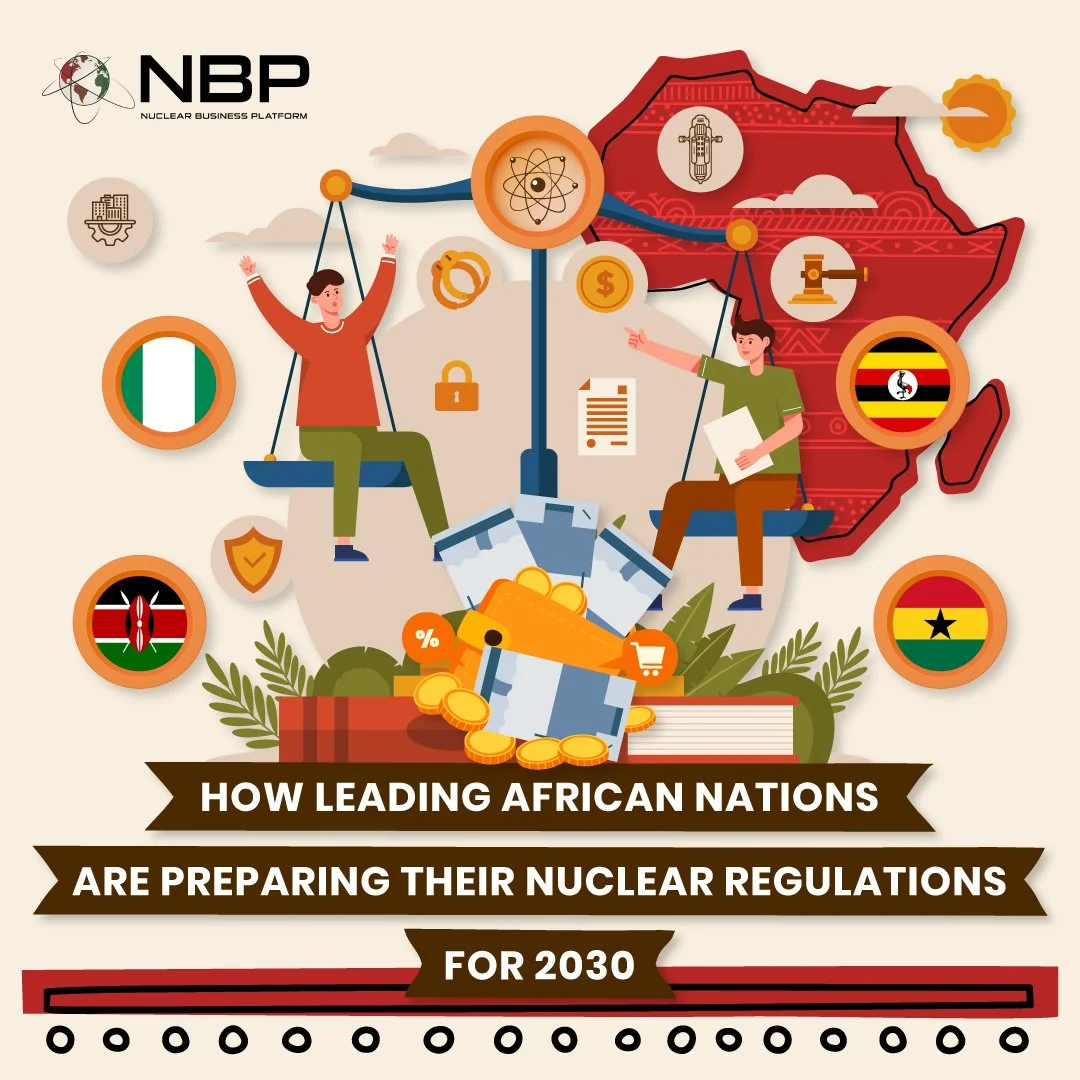
How Leading African Nations are Preparing their Nuclear Regulations for 2030
Africa is entering a decisive phase in its nuclear energy journey, one defined not by ambition alone, but by execution readiness. With nearly 600 million people still lacking access to electricity, and power demand projected to rise 47% by 2030 and almost sevenfold by 2050, nuclear energy is increasingly positioned as a long-term anchor for grid stability, industrial growth, and decarbonization.
As African governments align with the global commitment to triple nuclear capacity by 2050, regulatory development has emerged as the primary enabler of capital deployment. Far from being a procedural hurdle, regulation is the mechanism through which nuclear investments are de-risked, bankability is established, and industrial ecosystems are formed. Between 2024 and 2026, Africa’s regulatory build-out represents a foundational market window, creating immediate demand for technical services, licensing support, safety systems, software platforms, environmental monitoring, and workforce training. The following examines how Kenya, Ghana, Nigeria, and Uganda (four countries at different stages of nuclear maturity) are transforming regulation into infrastructure, and why this shift is opening one of the most underappreciated commercial frontiers in the global nuclear industry.
Kenya: Regulatory Acceleration in a Newcomer Market
Kenya is prioritising legislative and regulatory readiness ahead of procurement. Since the establishment of the Kenya Nuclear Regulatory Authority (KNRA) under the Nuclear Regulatory Act of 2019, the country has focused on aligning its framework with international best practice.
A major milestone was achieved in October 2025 with the completion of the IAEA Integrated Regulatory Review Service (IRRS) mission, which confirmed that Kenya now possesses a comprehensive nuclear and radiation safety regime. Fourteen detailed draft regulations (covering security, waste management, transport, and facility protection) are nearing final adoption, providing clarity and predictability for future bidders.
Kenya’s regulatory depth extends to granular areas such as design basis threat assessments and intrusion detection systems, signalling readiness for high-standard nuclear operations. Concurrently, plans for a nuclear research reactor will establish domestic training capacity ahead of the proposed 1,000 MW Siaya nuclear plant..
Ghana: Regulatory Maturity?
Ghana is among Africa’s most advanced nuclear newcomers, with a mature regulatory framework in place ahead of construction. The Nuclear Regulatory Authority (NRA), established under Act 895 (2015), has formally entered Phase 2 of the Nuclear Power Programme, covering preparatory activities for the first nuclear power plant.
Key milestones were achieved between 2024 and 2025. In 2024, the NRA hosted its first IAEA Integrated Regulatory Review Service (IRRS) Mission, strengthening oversight capacity. This was followed in 2025 by participation in the Advanced Licensing Exercise Project (ALEP) with the US Nuclear Regulatory Commission, focused on Safety Analysis Report (SAR) review.
Ghana is participating in the IAEA COMPASS initiative (2024–2026), finalising legal instruments to align national safeguards with international obligations.
Nigeria: Scale, Enforcement, and Strategic Certainty
Nigeria represents Africa’s largest prospective nuclear market, with nuclear power elevated to a state-level strategic priority through presidential approval and a national nuclear white paper.
Regulatory readiness is advancing in parallel. The Nigerian Nuclear Regulatory Authority (NNRA) has approved nuclear power plant construction safety regulations and is finalising regulatory frameworks for licensing, commissioning, and decommissioning. Institutional sequencing aligns with IAEA guidance, with the regulator operational and work underway to establish the plant operating organisation.
While large reactors form the baseline strategy, regulatory frameworks are also being adapted to accommodate future SMR deployment, particularly for grid-constrained and industrial applications. Nigeria’s scale and regulatory momentum are generating sustained demand for site evaluation, environmental monitoring, physical protection systems, safeguards instrumentation, and long-term inspection and compliance services.

Uganda: Legislative Acceleration and Site Readiness
Uganda has emerged as an important nuclear newcomer in East Africa, targeting 24,000 MW of nuclear capacity by 2040. Current efforts focus on legislative strengthening and detailed site evaluation for the country’s first nuclear facility.
In May 2025, the Ministry of Energy and Mineral Development signed a 26-month contract with Korea Hydro & Nuclear Power (KHNP) to conduct a comprehensive site evaluation at Buyende, running through July 2027 and covering geological, seismic, hydrological, and cooling-water assessments in line with IAEA standards.
Concurrently, the Atomic Energy Council (AEC) initiated a review of the Atomic Energy Act Cap. 154 in 2025 to address gaps in the handling, transport, and use of nuclear materials. The launch of the AEC Client Charter 2025–2029 signals a move toward transparent, service-oriented regulation.
Uganda’s nuclear programme is linked to industrial development, with government support for private investment in iron ore mining, steel manufacturing, and technology transfer. The designation of Soroti University as a Centre of Excellence for Nuclear Science and Technology is already generating demand for laboratory infrastructure, simulation tools, and curriculum development.
The Regulatory Market Opportunities
The transition from "feasibility" to "execution" in Africa has created a commercial landscape estimated by the Nuclear Business Platform to be worth over USD 105 billion by 2035. For industry participants, opportunity clusters around five core areas:
1. Technical Support Organizations (TSOs): New regulators face acute shortages of experienced technical capacity. TSOs are increasingly required to support licensing reviews, probabilistic safety assessments, seismic analysis, and independent verification, particularly in newcomer states such as Ethiopia, Rwanda, and Uganda.
2. Digital Regulatory and Safety Systems: Beyond IAEA baseline tools, regulators and operators require advanced platforms, including real-time radiation monitoring, digital twins for construction oversight, and integrated regulatory management systems that link inspection data, compliance tracking, and reporting.
3. Waste and Environmental Infrastructure: Regulatory mandates for spent fuel storage, environmental monitoring, and site remediation are expanding rapidly. Demand is rising for dry storage design, mobile and fixed monitoring systems, and site remediation services for legacy uranium sites, notably in Namibia and Niger.
4. Security and Safeguards Solutions: Physical protection systems, cybersecurity frameworks, and safeguards instrumentation represent a fast-growing compliance-driven market as African states strengthen nuclear security commitments.
5. Training and Human Capital Development: From simulator-based operator training to regulator certification programmes, workforce development is now embedded into licensing pathways (creating long-term service demand rather than one-off contracts).
The next five years will determine the competitive landscape of Africa’s nuclear sector. Platforms such as the 5th Africa Nuclear Business Platform (AFNBP) 2026, scheduled for 21–23 April in Abuja, Nigeria, and hosted by the Nigeria Atomic Energy Commission will play a pivotal role in aligning procurement pathways, regulatory expectations, and investment frameworks.