Russia. America. China. Why They're All Building Nuclear in Türkiye.
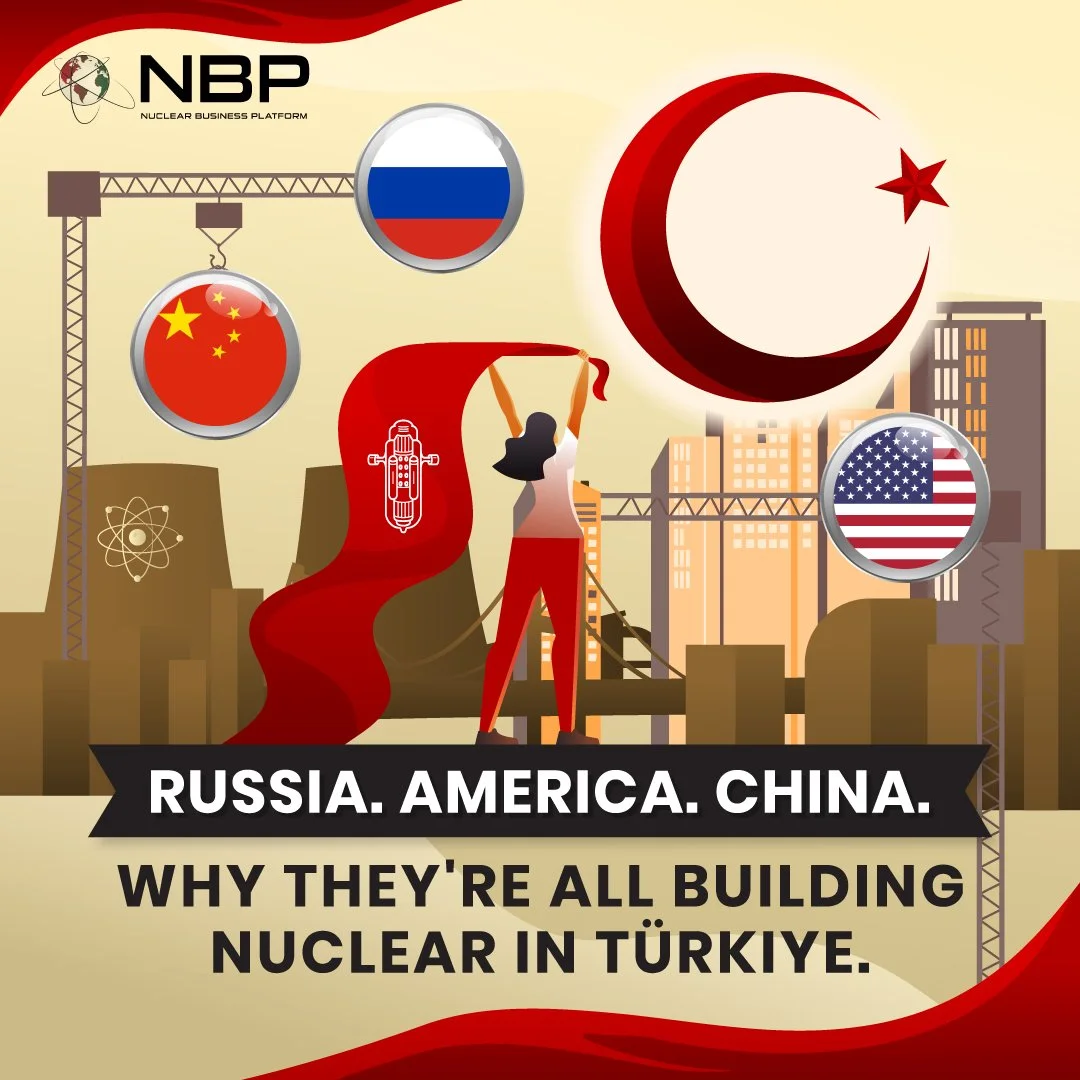
Every major nuclear market operates within a recognisable geopolitical logic. Most nuclear client nations pick one bloc and build within it. Türkiye has made a different choice entirely, and that choice is creating a commercial environment with no direct parallel anywhere in the global nuclear industry. Türkiye is simultaneously building one nuclear plant with Russia, negotiating a second with a US-South Korean framework, and discussing a third with China. This is not indecision. It is deliberate national strategy.
The Three-Bloc Nuclear Programme
Akkuyu: four VVER-1200 reactors, 4,800 MW, Build-Own-Operate with Rosatom — the first BOO nuclear plant in the world. Russia owns the plant, sells the electricity, manages the fuel cycle. Sinop: 4,800 MW, negotiated with a US-South Korea framework, Generation III+ technology (APR-1400 and US vendor field). Western export credit frameworks and regulatory standards — distinct from Akkuyu in every material way. Thrace: 5,600 MW, China's SPIC with CAP1400 technology. Combined capacity: 15,200 MW. Plus a formal 5,000 MW SMR target with US, UK, France and Canada all in discussions.
What This Means Commercially
Each project operates within a different technology ecosystem — supply chain opportunities are not dominated by any single vendor's preferred supplier network. Akkuyu is shaped by Rosatom's supply chain. Sinop will be shaped by KHNP or a US vendor. Thrace by SPIC. A firm positioned within one project is not locked out of the others. The SMR programme adds another layer of openness — the least consolidated active SMR procurement environment in the world. Firms from the US, UK, France and Canada are all in genuine contention. The multi-vendor strategy also produces structural leverage: no single supplier can present itself as indispensable, which improves Türkiye's negotiating position on technology transfer, localisation requirements, and financing terms. The localisation rate at Akkuyu — over 73% of EPC expenditure going to Turkish suppliers — is partly a product of this leverage.
Beyond Türkiye: A Model for the Future
If Türkiye successfully delivers and operates Russian, Western, and Chinese nuclear technologies alongside a future SMR fleet, it will demonstrate something the global nuclear industry has rarely seen: that geopolitical diversification in nuclear energy is achievable in practice, not just in theory. This could reshape how future client countries approach reactor procurement and supply chain development. NBP's Türkiye Nuclear Business Platform (TNBP) 2026 (26–27 August, Ankara) will bring together policymakers, investors, utilities, technology vendors, and supply chain leaders to explore the opportunities driving Türkiye's evolving nuclear energy sector.