
NBP periodically publishes short articles on nuclear energy matters which either have a geographic or topical focus. Feel free to browse through all our articles and if you would like to read on something specific, please use the search function. For example, you can search for articles relating to Africa or India or financing or SMR etc. You can also use the filter function to see articles pertaining to Asia, Africa, India or Türkiye.
Make in India Meets Nuclear Power: Opportunities for Suppliers and Manufacturers
India's 100 GW by 2047 nuclear target is a manufacturing story as much as an energy one. Fleet-mode PHWRs, 46 GW open to private and joint-venture players, 49% FDI under the SHANTI Act and factory-built SMRs create supplier orders now. Foreign vendors need Indian manufacturing partners, and the draft rules are still open for consultation.
Technology Sovereignty & Technology Import: Understanding India's Dual-Track Nuclear Market
India's nuclear programme runs on two complementary tracks: an indigenous thorium-based three-stage programme anchored by the PFBR, and an import track evaluating France's EPR and Russia's VVER-1200. Both serve the 100 GW by 2047 target under the new SHANTI Act, which permits 49% FDI and private participation from Tata Power, Adani, and others.

Why the Next Five Years Matter for India's SMR Market
India's SMR market crossed a threshold in July 2026: 5 indigenous SMRs by 2033 ($2.11B committed) + Tata Power targeting 2032–33 commissioning (construction 2028, sites in MP/Odisha/Gujarat). Three tracks: BSMR-200 (220 MWe), SMR-55 (55 MWe), HTGR (5 MWt, hydrogen). No binding vendor deals yet. NTPC talking to EDF, Rosatom, Westinghouse, KHNP, Holtec. The window is open.
India's 100 GW Nuclear Target Has a Supply Chain Gap. That Gap Is the Opportunity.
India's nuclear equipment market grows from USD 1.54B (2024) to USD 2.31B by 2033 — before SHANTI Act acceleration. With BHEL, L&T, Godrej and Walchandnagar as anchor suppliers, the supply chain exists but lacks scale. Entry terms: technology transfer + localisation = a 25-year relationship in a USD 214B programme.

Five Business Lessons the Indian Nuclear Industry Is Teaching the World
India's nuclear opening is teaching the world 5 business lessons: closed markets are compressed springs; state supply chains are JV assets; tech diversity is leverage; liability reform unlocks capital; and progressive indigenisation builds the longest-duration commercial relationships in the sector.
Additive Manufacturing in India's Nuclear Sector: The Business Case for Entry Now
India: 8.78 GW → 100 GW nuclear by 2047. AM cuts lead times from 24 months to weeks & waste by 90%. BARC, IGCAR, L&T, Wipro 3D & Midhani are ready. SHANTI Act opens the market. Entry window is now.
India's Nuclear Market: A Long-Duration Investment Opportunity Being Misread
India's nuclear sector is opening to private capital after the SHANTI Act 2025. With 8.88 GW today and a 100 GW target by 2047, the USD 214 billion opportunity is attracting Adani, Tata, Westinghouse and EDF.
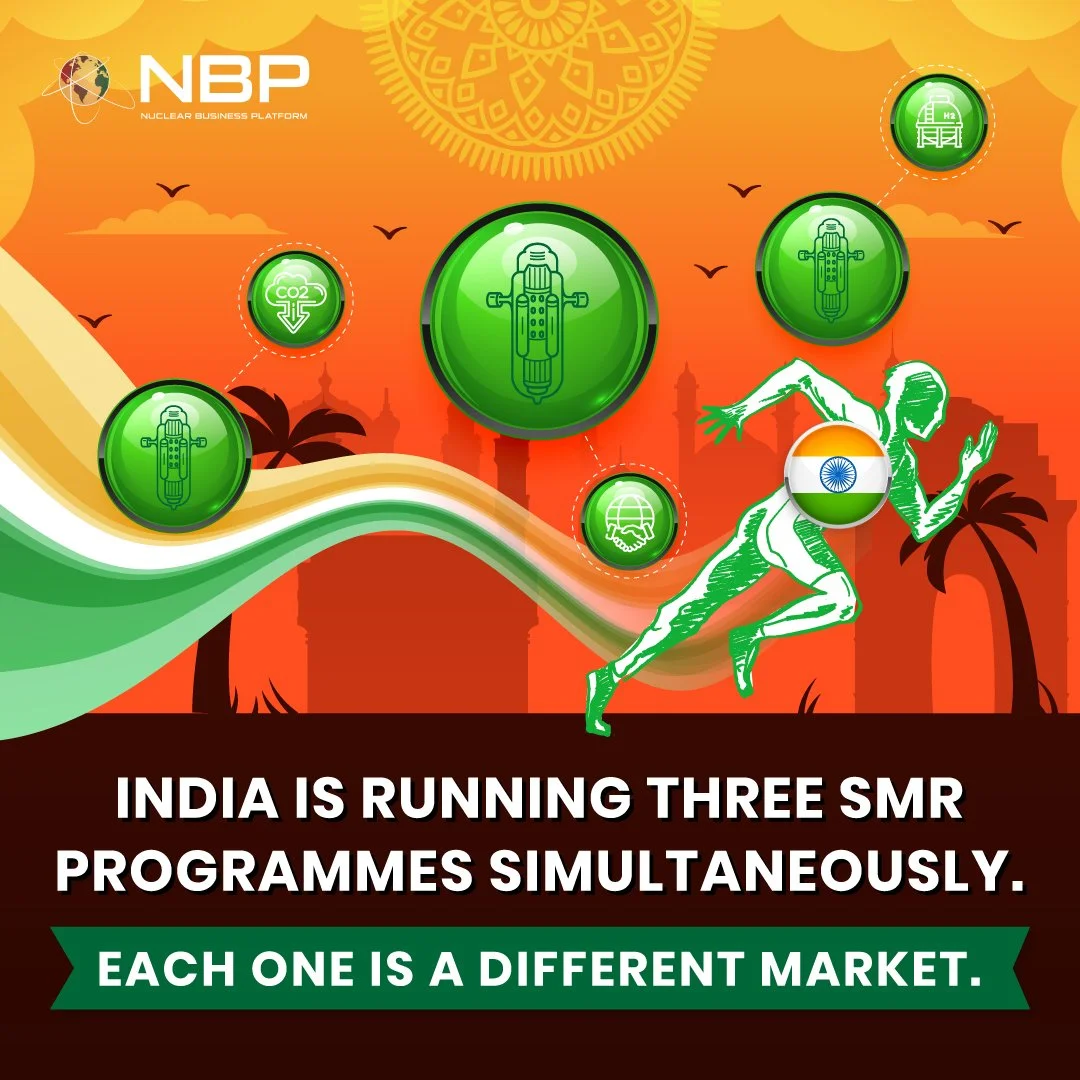
India Is Running Three SMR Programmes Simultaneously. Each One Is a Different Market
India runs 3 parallel SMR tracks: BSMR-200 for industrial decarbonisation, SMR-55 for remote grids, and a hydrogen HTGR — each a distinct commercial opportunity. With SHANTI Act reforms, $2.5B committed, Adani eyeing 1.6 GW, and INBP 2026 in June, the market is open but differentiated. Know which track you're targeting.
India's Private Nuclear Sector Opened. The First Movers Are Already Here
India's private nuclear sector just made its first concrete move. And it didn't come with a press conference. 𝗔𝗱𝗮𝗻𝗶 𝗣𝗼𝘄𝗲𝗿 has quietly incorporated two nuclear entities. Our latest NBP Insights article decodes the corporate architecture behind Adani's move, maps who follows and how, and explains why the next 18 months are the most important window for international engagement in India's private nuclear market.
India Is Building 100 GWe of Nuclear Capacity. The Fuel Question Has Not Been Answered
India has a 100 GWe nuclear target by 2047. It has the SHANTI Act opening the sector to private capital. It has Rs 20,000 crore committed to SMR deployment by 2033. The political intent is the clearest it has been in a generation. But achieving 100 GWe requires an estimated 18,000 to 20,000 tonnes of uranium annually — roughly one-third of current global production. India's domestic reserves cannot supply that.
100 GW and Open for Business: India's Nuclear Market After the SHANTI Act
The enactment of the SHANTI Act of 2025 marks a historic shift in India’s energy landscape, dismantling state monopolies to invite private capital and international expertise. By permitting 49% Foreign Direct Investment and reforming liability frameworks, India has transformed its 100 GW nuclear target into a bankable investment proposition.
The $200 Billion Convergence: Pairing India’s AI Infrastructure with Nuclear Power
India is rapidly transitioning from an outsourcing hub to a core global AI market, with hyperscalers like Microsoft, Google, and Amazon committing over $67 billion to domestic data centers. As capacity triples to 4.5 GW by 2030, the demand for stable, high-density baseload power is positioning nuclear energy as a critical capital hedge.
India’s Nuclear Budget 2026–27: What the Numbers Reveal
India’s Union Budget 2026–27 has quietly signaled a major strategic shift by removing customs duties on critical nuclear imports until 2035. Combined with the SHANTI Act’s liability reforms, New Delhi is pivoting away from state-funded construction toward a market-driven model designed to attract private capital and global technology.
India’s Nuclear Market Is Open: A $214 Billion Opportunity Emerges
The "India Nuclear Paradox"—the gap between massive industrial demand and marginal nuclear supply—is officially over. With the landmark SHANTI Act, India has dismantled its 60-year state monopoly, de-risked its liability framework, and invited private equity into a 100 GW growth trajectory. Seeking over $214 bn in investment by 2047, the nation is now a premier infrastructure asset class.
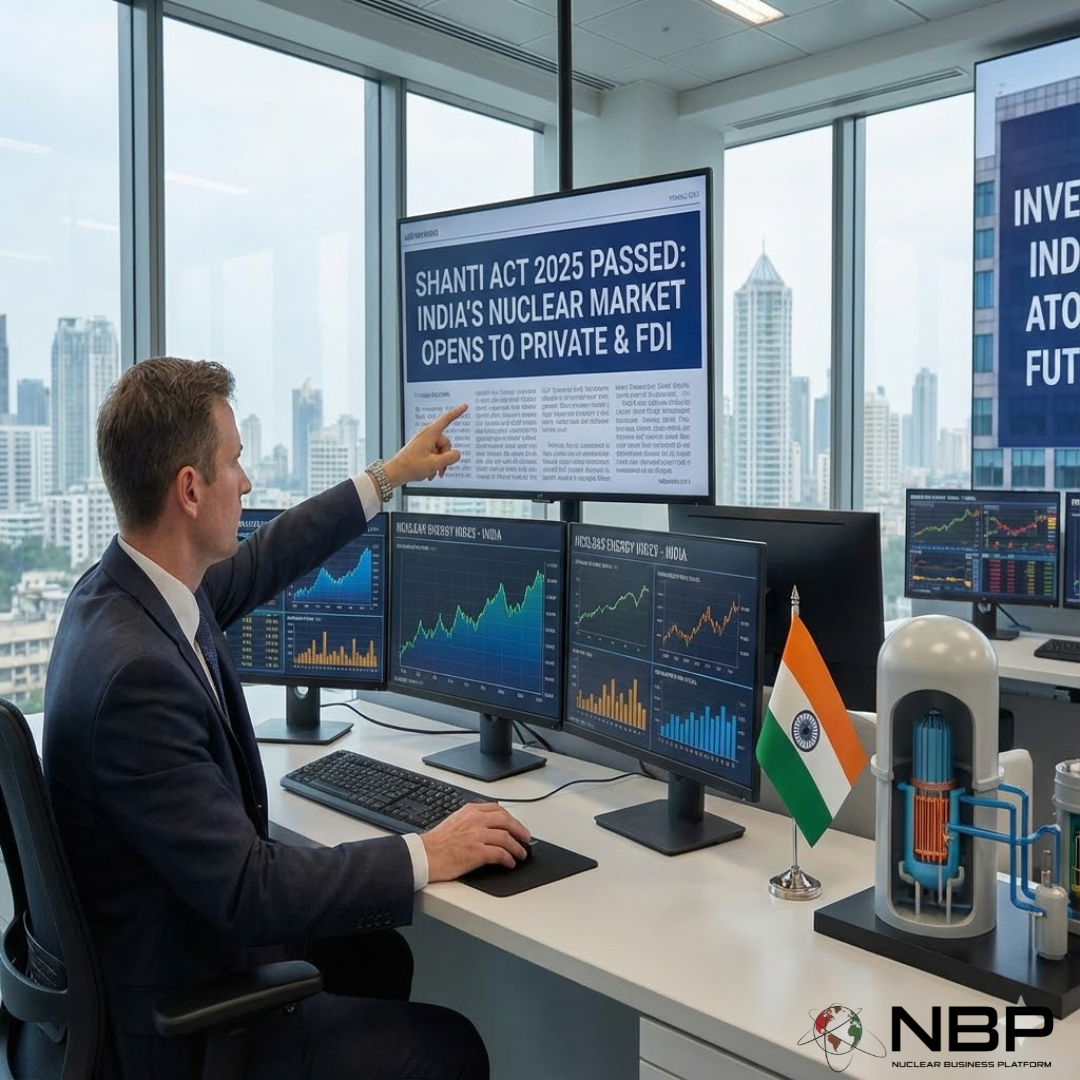
India’s $214 Billion Nuclear Opening: How the SHANTI Act Dismantles Monopoly to Unlock Global Investment
India’s nuclear sector is officially open for global business! With the passing of the SHANTI Act 2025, the transition from a state-run monopoly to a regulated market is complete. By aligning liability laws with international standards and enabling private equity, 🇮🇳 India has created a transparent, $214 billion architecture for vendors and investors.
Make in India, Power the World: The New Nuclear Supply Chain Opportunity
India's nuclear sector is transitioning to a global hub, targeting 100 GW by 2047! This massive growth, supported by the Nuclear Energy Mission, is fueled by world-class indigenous manufacturing and co-development partnerships. Understand this strategic shift and the multi-billion dollar opportunities in India's nuclear supply chain.
De-risking Nuclear Investments: How India Offers Stability in a Dynamic Global Energy Market
India's nuclear sector stands out as a stable investment amid global volatility! With cross-party consensus and policy reforms, India has created a de-risked environment to achieve its 100 GW target by 2047. This blend of political stability and investor-friendly frameworks offers a unique opportunity for long-term capital. India is a preeminent destination for nuclear investment, read the full article.
India’s Nuclear Robotics Market: The Next Multi-Billion-Dollar Growth Frontier
Robotics is fueling India's nuclear renaissance! As India targets 100 GW by 2047, robotics emerges as a critical enabler for safety, efficiency, and decommissioning. This presents a multi-billion dollar opportunity for technology firms. Understand how robotics will shape India’s nuclear future.
Why India Is Ready to Become the Global South’s Nuclear Investment Powerhouse
India is solidifying its position as a global leader in nuclear energy! With a 100 GW target by 2047, the country is leveraging indigenous technology, a strong workforce, and a stable political environment to attract international partners. This is a generational opportunity to invest in one of the world's most ambitious clean energy transformations.
Additive Manufacturing: Unlocking Multi-Billion-Dollar Opportunities in India’s 100 GW Nuclear Expansion
India is embracing Additive Manufacturing (AM) to revolutionize its nuclear sector! 3D printing offers a game-changing approach to modernize infrastructure, cut costs, and accelerate the 100 GW by 2047 goal. A huge opportunity for private and international firms to enter India's high-tech nuclear supply chain!