India Is Running Three SMR Programmes Simultaneously. Each One Is a Different Market
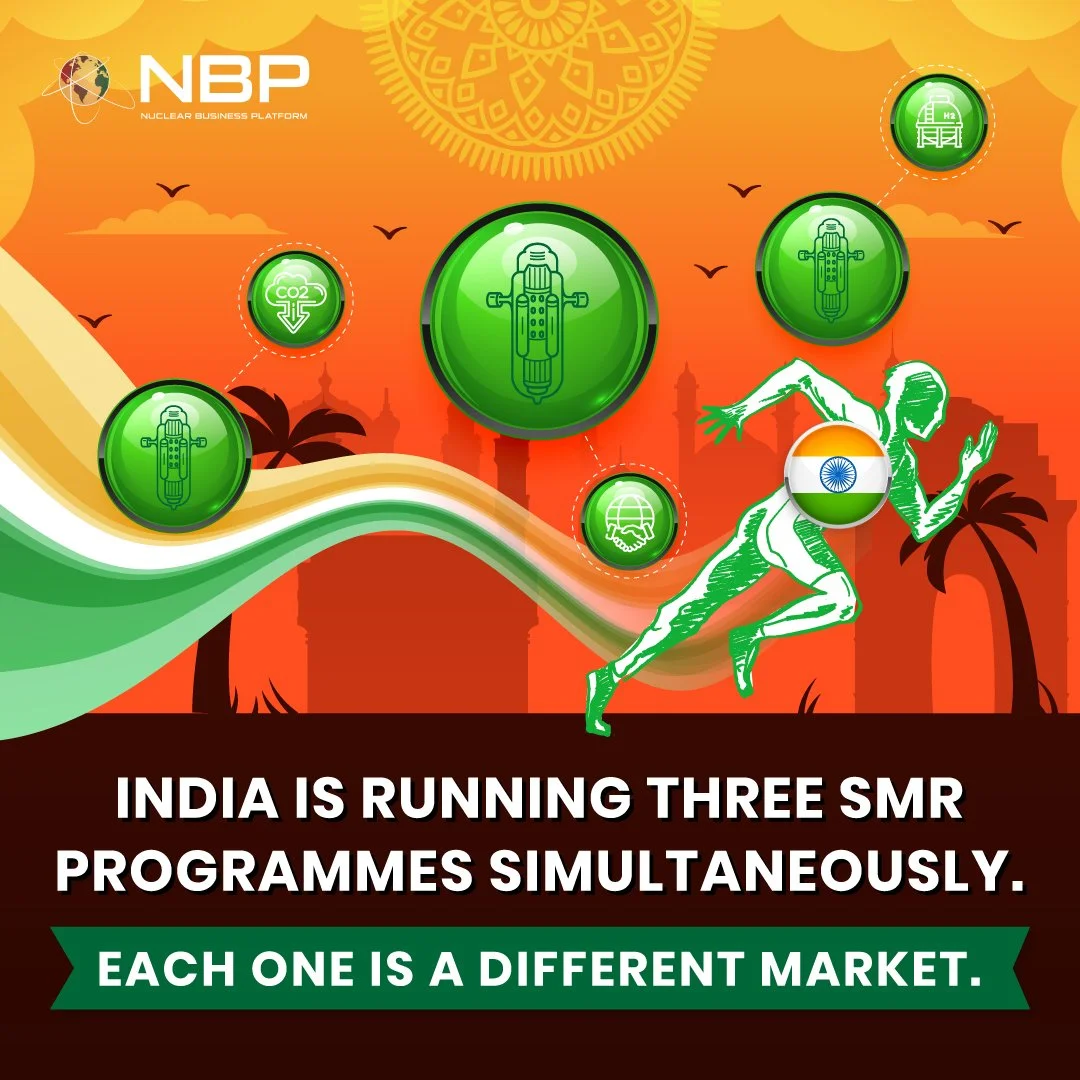
India's SMR goals are regularly discussed as a single programme: a government commitment, a budget allocation, and a target date. The Union Budget 2025–26 allocated approximately $2.5 billion under the Nuclear Energy Mission for the design, development, and deployment of Small Modular Reactors, with five indigenously developed units targeted for operationalisation by 2033. These are accurate headline figures, but they obscure a more important analytical reality. India is not building one SMR programme. It is running three parallel technology tracks, each designed for a different application, at a different stage of development, and carrying a different commercial profile. Reading them as a single entity produces a distorted picture of where the real opportunities lie.
Track One: The Industrial Decarbonisation Engine
The Bharat Small Modular Reactor, the BSMR-200 at 220 MWe, is the flagship of India's SMR programme and the track closest to deployment. The Detailed Project Report has been approved, the lead unit is proposed for the Tarapur Atomic Power Station site in Maharashtra, and the design draws directly on India's pressurised heavy water reactor (PHWR) experience using components already in serial production. Bhabha Atomic Research Centre (BARC) is leading development with the specific intent of deploying this reactor in three brownfield contexts: repurposing retiring fossil fuel power plants, captive power supply for energy-intensive industries, and data centre corridors where India's capacity is projected to grow fivefold to 8 GW by 2030.
Cost is a key factor here. Larsen and Toubro has stated India can manufacture SMRs at least 30% cheaper than global rivals, drawing on a mature domestic supply chain, lower fabrication labour costs, and established PHWR technology. That cost advantage is not incidental. It is a defining feature of this track's commercial case. The Adani Group, for instance, is in discussions to build eight BSMR-200 units in Uttar Pradesh — a potential 1.6 GW project that would place the conglomerate at the forefront of India's private nuclear sector.
Track Two: The Modular Flexibility Layer
The SMR-55, a 55 MWe design being developed in parallel, addresses the segment that larger reactors cannot reach: remote locations without grid connectivity, island territories, defence installations, and smaller industrial clusters. Design detailing is in progress with the lead unit also proposed for Tarapur. At this scale the reactor serves a fundamentally different deployment logic than the BSMR-200. For international firms in safety systems and modular component manufacturing, this track presents a distinct product specification where international technology input is more directly relevant, given the smaller domestic precedent base.
Track Three: The Hydrogen Vector
The third track is the most technically distinct. BARC is developing a high-temperature gas-cooled reactor of up to 5 MWt specifically for hydrogen generation, with the lead unit proposed for BARC's Vizag facility in Andhra Pradesh. High-temperature gas reactors sit outside India's technology base, which makes this track the most open to international collaboration from partners with gas-cooled reactor design expertise and nuclear hydrogen production experience. The application positions this track within India's clean hydrogen ambitions and the decarbonisation of fertiliser production, refining, and long-haul transport.
The Regulatory Reset That Makes All Three Tracks Viable
Running three parallel SMR programmes of different technology types requires a regulatory framework capable of handling that diversity, and until recently India's framework was not built for it. The SHANTI Act of 2025 changes this in two consequential ways. First, it grants statutory independence to the Atomic Energy Regulatory Board (AERB), empowering it to establish and enforce safety codes for both public and private operators across all reactor types. Second, it modernises the nuclear liability framework, directly addressing the barrier that had kept Western vendors from engaging commercially at scale.
The AERB has already completed a review of its existing requirements and concluded that new SMR-specific provisions must be incorporated, particularly around modular construction methodologies and passive safety systems. India's SMR designs rely on passive safety mechanisms that use natural physical processes — gravity, natural circulation, and pressure differentials — rather than active mechanical systems. These features reduce the exclusion zone requirement from the 1 to 1.5 kilometres required for conventional large reactors to approximately 500 metres, enabling the entire brownfield deployment strategy that underpins the BSMR-200's commercial logic.
The Collaboration Landscape and What It Signals
No binding international agreements have been signed yet, but the field is genuinely contested. National Thermal Power Corporation Ltd (NTPC) is in active discussions with Électricité de France (EDF), Rosatom, Westinghouse, GE Vernova, Korea Hydro & Nuclear Power (KHNP), and Holtec International across the three tracks. Russia holds a structural advantage on the pressurised water track through the existing Kudankulam partnership. Western vendors are engaging more credibly now that the SHANTI Act has addressed the liability concerns that previously limited their commercial participation.
Domestic private demand is already named and structured. Beyond Adani, Tata, Reliance, and JSW Group are evaluating nuclear sector entry. Indian Railways has identified SMR sites for its own energy requirements. The global SMR market is projected at $300 billion by 2040. India's three-track programme, backed by committed sovereign capital, a 100 GW national target by 2047, and a manufacturing base capable of delivering internationally competitive costs, is positioned to participate in that market both as a deployer and eventually as a supplier.
In this context, the India Nuclear Business Platform (INBP) 2026, scheduled for 16–17 June in Mumbai, assumes particular significance. As the first major global convening following the SHANTI Act reforms, held under the theme "India's Nuclear 100: Delivering the $200 Billion Opportunity," it is expected to serve as a key platform where policymakers, investors, and industry stakeholders align on execution priorities — including technology partnerships across all three SMR tracks — and the firms that engage with each track on its own terms will find a more accessible and more differentiated market than the headline numbers alone suggest.