Kyrgyzstan’s Nuclear Shift: Addressing Hydropower Fragility with SMRs
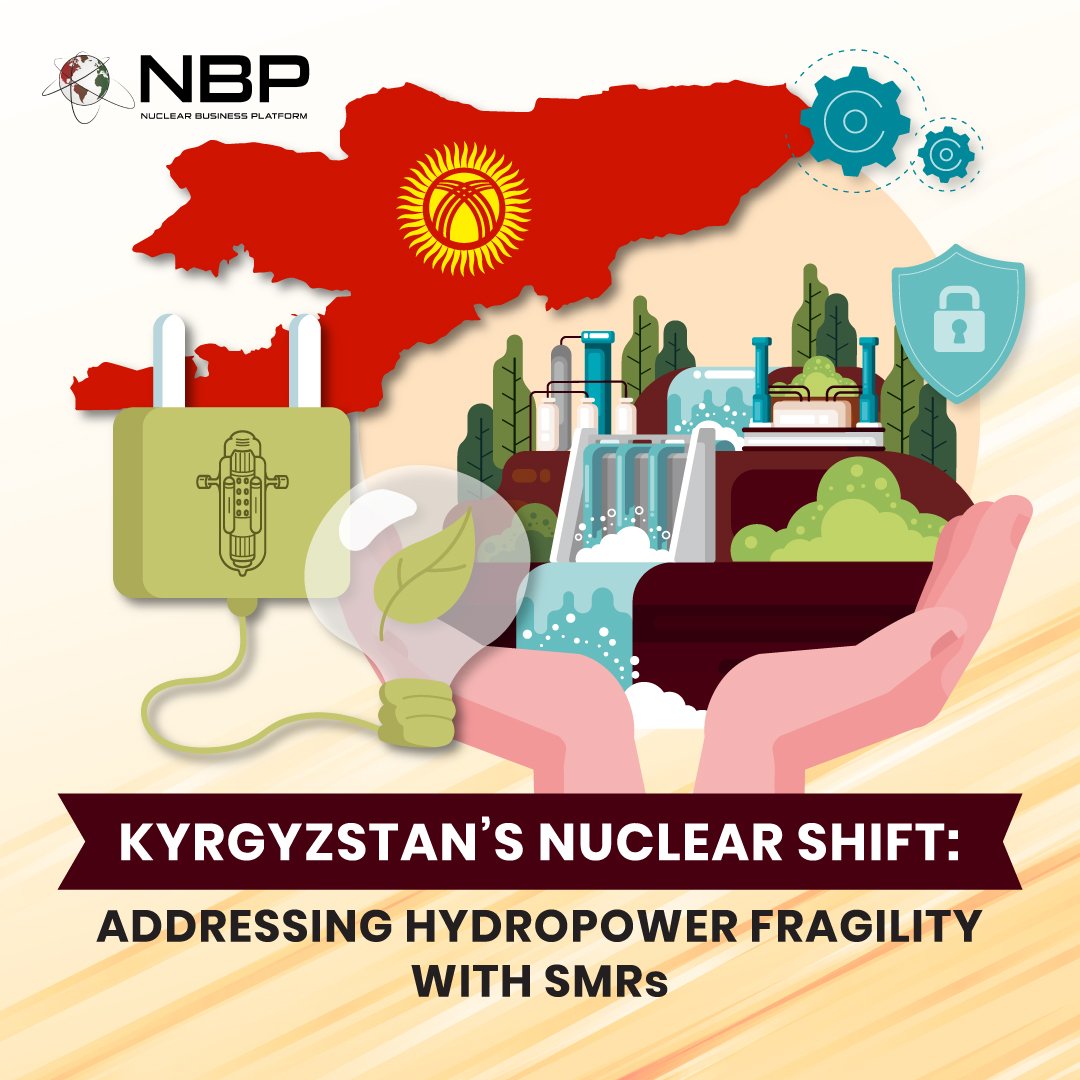
Kyrgyzstan’s nuclear discussion is not emerging from industrial ambition. It is emerging from structural stress. For decades, the country’s electricity system has rested on hydropower, which accounts for more than 90 % of generation, much of it concentrated in the Soviet-era Toktogul cascade. In favourable water years, this model functions. In dry seasons, it falters. What were once occasional shortages have evolved into recurring structural deficits driven by rising consumption, ageing infrastructure, and climate-related variability.
In 2023, Bishkek formally declared a state of emergency in the energy sector, an unusual step that publicly acknowledged the fragility of the national system. Against this backdrop, nuclear energy has entered the policy conversation not as a prestige project, but as a potential stabiliser. The question is whether this conversation signals a real deployment trajectory or simply a geopolitical alignment exercise.
Russia’s Strategic Offer
In late 2025, during a visit to Bishkek, Russian President Vladimir Putin publicly announced Moscow’s readiness to construct Kyrgyzstan’s first nuclear power plant using small modular reactor (SMR) technology. The proposal might centre on Rosatom’s RITM-200N design, a land-based adaptation of reactor technology originally developed for Arctic icebreakers.
The concept under discussion envisions a plant ranging from roughly 110 to 440 MW, depending on configuration. At the lower end, this would provide meaningful seasonal relief to Kyrgyzstan’s grid. At the upper end, it would represent a transformational addition to a relatively small electricity system.
However, the proposal did not emerge in isolation. In early 2022, Rosatom and the Kyrgyz Ministry of Energy signed a non-binding memorandum on cooperation in the peaceful use of nuclear energy. While modest in formal status, the memorandum laid groundwork for regulatory development and longer-term technical engagement.
For Rosatom, Kyrgyzstan could represent an important proving ground for land-based SMR deployment in a region where competition from Western and Chinese suppliers is gradually increasing.
Energy Security vs Institutional Readiness
From a purely energy perspective, the logic is clear. Nuclear generation provides stable baseload output independent of rainfall patterns. In a system where hydrological variability directly translates into import dependency and domestic shortages, diversification has economic merit.
Yet nuclear deployment is not simply a matter of installing hardware. Kyrgyzstan currently lacks a comprehensive nuclear regulatory framework, an independent safety authority, trained operating personnel, and emergency preparedness systems appropriate for nuclear operations. Long-term fuel supply and waste management arrangements would also need to be secured.
In practical terms, the country would face a choice: build institutional capacity domestically at considerable cost and time, or rely extensively on Russian regulatory, technical, and operational support. The latter would accelerate deployment but deepen institutional dependence. For international suppliers assessing market entry, this distinction is critical. Kyrgyzstan is not yet a procurement-ready market; it is an institutional formation market.
Financial and Strategic Exposure
Even though SMRs are marketed as more flexible and potentially less capital-intensive than large reactors, they remain high-cost infrastructure assets with extended payback horizons. Any project in Kyrgyzstan would almost certainly require sovereign guarantees, state-backed financing, or vendor-led credit structures.
Such arrangements would extend beyond construction. Fuel supply, maintenance, software systems, spare parts, and periodic upgrades would require long-term contractual frameworks. In practice, this creates sustained partnerships with technology providers and opens space for diversified participation across services, safety systems, and lifecycle support.
This dynamic must be evaluated not only economically but strategically. Nuclear cooperation inherently involves long-term interdependence. If structured carefully, however, it can also create stable, rules-based partnerships that strengthen institutional capacity while broadening Kyrgyzstan’s international engagement within a highly technical sector.
The Uranium Dimension
Kyrgyzstan’s historical relationship with uranium adds nuance to the discussion. The country possesses uranium deposits and has supplied Russia in the past. It is also the focus of significant remediation efforts addressing Soviet-era uranium tailings.
In June 2024, the Kyrgyz parliament lifted a ban on uranium mining and exploration that had been in place since 2019. While not directly linked to the SMR proposal, this legislative shift signals a renewed willingness to re-engage with the nuclear fuel cycle.
For Rosatom, ongoing reclamation work on uranium mining sites strengthens its technical footprint in the country. For Kyrgyzstan, reopening uranium exploration potentially introduces a complementary economic rationale to nuclear discussions, though commercial viability remains to be demonstrated.
A Strategic Foothold, Emerging Market Signals
Viewed collectively, these developments suggest that Kyrgyzstan is moving toward the early structuring phase of nuclear development.
The energy stress is real. Hydropower dependence exceeding 90 % is structurally risky in an era of climate variability. Demand growth is persistent. Institutional recognition of crisis has already occurred, and diversification is now part of the conversation.
Moreover, institutional readiness remains a work in progress. Financing capacity will require external structuring. Public opinion is mixed but not prohibitive. Regulatory infrastructure is nascent, yet the foundations for engagement have begun to take shape.
For Rosatom, Kyrgyzstan offers a politically aligned environment to advance land-based SMR deployment. For Kyrgyzstan, nuclear energy presents a potential hedge against hydrological vulnerability and a pathway toward greater system stability.
For other international nuclear stakeholders, the landscape is emerging rather than closed. Entry pathways may initially centre on advisory services, regulatory development, safety systems, and technical cooperation, creating space for broader participation as the institutional framework matures.
Moving Forward
Kyrgyzstan’s nuclear exploration reflects both genuine energy security concerns and broader strategic recalibration. An SMR could stabilise seasonal deficits and diversify generation sources. It could also introduce long-term technological partnerships that reshape the structure of the national energy system.
The country is not yet an actionable build-to-market. It is a strategic positioning environment shaped by hydropower fragility, evolving external partnerships, and cautious domestic politics.
For nuclear industry observers, the key question is not whether a reactor will be announced. It is whether Kyrgyzstan will invest in the institutional architecture and financing frameworks required to transform interest into a bankable reality.
That trajectory will gain further clarity through platforms such as the Asia Nuclear Business Platform’s 11th edition in 2026, taking place 3–5 November in Hanoi, Vietnam, where policymakers, investors and vendors are expected to refine financing structures and partnership models. Until that threshold is crossed, the SMR question remains open, a hedge against structural vulnerability, but not yet a defined deployment pathway.