Unlocking Africa’s Nuclear Potential Through Regional Grid Integration
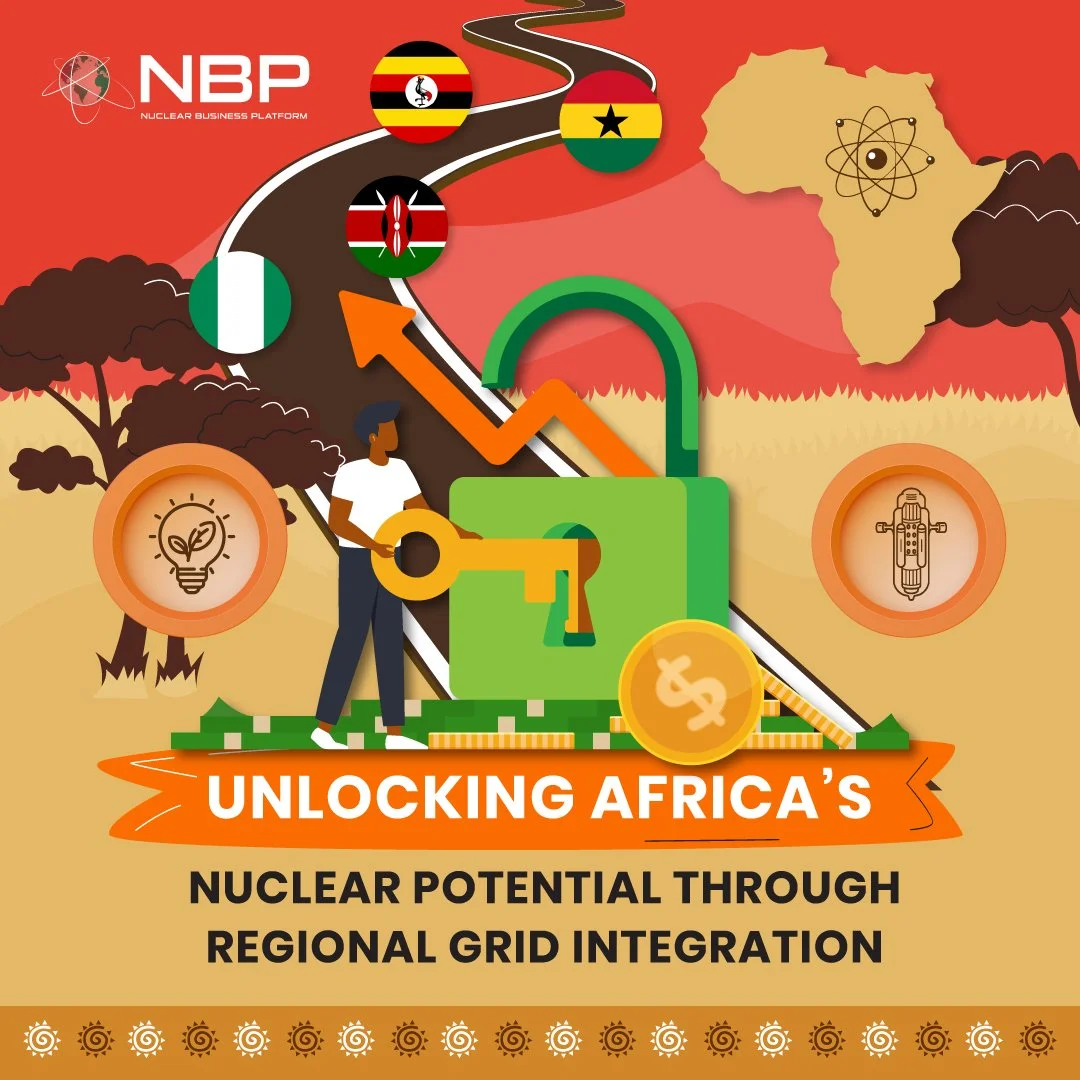
Africa’s nuclear future will not be determined by reactor technology alone. It will be determined by market structure. Across the continent, electricity demand continues to grow, industrialisation ambitions are accelerating, and governments are searching for stable, long-term generation assets. Yet one structural constraint has consistently limited nuclear deployment in many African countries: grid scale. Large nuclear power plants require strong transmission networks, diversified demand centers and system redundancy. Many national grids remain too small or financially constrained to independently absorb gigawatt-scale capacity. Therefore, the real opportunity lies not within individual national markets, but within regional integration.
Regional Power Pools: Building the Scale Nuclear Requires
Africa is divided into five regional power pools: the Southern African Power Pool (SAPP), the West African Power Pool (WAPP), the Eastern Africa Power Pool (EAPP), the Central African Power Pool (CAPP) and the North African Power Pool (NAPP). These pools were established to enable cross-border electricity trade, optimize resource allocation and strengthen grid reliability.
Among them, SAPP remains the most advanced, with functioning market mechanisms and established interconnections. However, even within the most mature system, cross-border trade represents only a small fraction of total electricity demand. Transmission bottlenecks, limited market liquidity and regulatory fragmentation continue to constrain trade volumes.
For nuclear developers and suppliers, this is not a weakness; it is an opening. As interconnections expand and market rules mature, these pools can transform from fragmented systems into aggregated demand platforms capable of supporting large-scale baseload assets. Nuclear projects that may appear oversized within a single national grid become technically viable when viewed across a multi-country balancing area.
AfSEM: Creating the World’s Largest Electricity Market
The Africa Single Electricity Market (AfSEM), under the African Union, aims to integrate regional power pools into a single continental electricity market by 2040. If fully realised, this would represent the largest unified electricity market in the world, serving more than 1.3 billion people.
For the nuclear industry, this is transformational. A continentally integrated market reduces offtake risk by diversifying demand across borders. It enhances grid stability through interconnected balancing. It improves project bankability by expanding the revenue base beyond a single sovereign utility. And it creates the conditions necessary for integrating gigawatt-scale reactors without destabilising smaller national systems.
In effect, AfSEM is not just an energy reform initiative, but it can be considered as a market architecture that can make nuclear commercially viable at scale.
De-Risking Nuclear Through Regional Cooperation
Nuclear projects are capital-intensive, long-duration assets. Financing terms are shaped by sovereign risk, grid strength, demand certainty and political alignment. Regional cooperation addresses each of these variables.
Joint nuclear projects allow participating countries to share capital expenditure, coordinate long-term power purchase agreements and distribute generation across interconnected grids. Multi-country offtake structures can reduce single-buyer exposure. Harmonised regulatory frameworks improve predictability for vendors and financiers. Shared human resource development programs reduce duplication of effort and build regional technical capacity.
Stronger collective bargaining power also improves negotiating positions with reactor vendors, EPC contractors and export credit agencies. Instead of isolated national projects, Africa could present aggregated regional demand, improving pricing leverage and financing terms.
For nuclear companies, this shifts the opportunity from small, politically constrained national tenders to structured, region-backed infrastructure platforms.

Financing Models and Private Capital Participation
Public debt pressures across many African countries limit the ability of governments to self-finance large infrastructure projects. As a result, public-private partnership structures are increasingly central to transmission and generation expansion.
Models such as Build-Own-Operate, Build-Own-Operate-Transfer, Build-Transfer-Operate and EPC+Finance frameworks are already being deployed in cross-border transmission projects. These mechanisms can be adapted to nuclear deployment, particularly where regional offtake guarantees enhance revenue visibility.
According to Nuclear Business Platform (NBP), for an industry projected to add up to 15 GW of new capacity by 2035, representing an investment opportunity of approximately $105 billion, financing innovation will be decisive. Regional integration improves the risk profile necessary to unlock that capital.
Large Reactors, SMRs and Market Matching
An integrated African grid creates differentiated entry points for nuclear technology providers. Large reactors can anchor major industrial corridors or regional demand hubs within strong interconnected systems. At the same time, emerging Small Modular Reactors (SMRs) offer scalable options for smaller grids or phased deployment strategies. As interconnections deepen, even SMR fleets could operate within coordinated regional markets, further strengthening reliability and flexibility. The critical factor is not reactor size, it is market design.
The Way Ahead
With several sub-Saharan countries (including South Africa, Ghana, Uganda, Nigeria, Rwanda, Kenya, Niger and Ethiopia) signalling plans to introduce nuclear power between 2030 and 2037, Africa’s nuclear conversation has clearly moved beyond exploration. The strategic question is no longer whether deployment will occur, but under what structural conditions projects will reach financial close and construction.
The determining variable will be integration. As regional power pools deepen coordination and continental market mechanisms mature, nuclear projects gain access to broader demand bases, stronger grid stability and more diversified revenue structures. In this emerging architecture, joint development models and multi-country offtake frameworks shift nuclear from a sovereign-scale gamble to a regionally supported infrastructure strategy.
Structured engagement between industry and governments, including platforms such as the Africa Nuclear Business Platform’s 5th edition (AFNBP 2026) in Abuja, hosted by the Nigeria Atomic Energy Commission (NAEC), will be instrumental in translating ambition into bankable frameworks. Africa’s nuclear trajectory will ultimately reward those who understand that the next growth frontier is being built through market coordination.